
by Gjet Ndoj Tarazhi
Abstract
This text presents a contemporaneous narrative of political assassinations and assassination attempts carried out in Albania during 1943. It documents targeted killings of ministers, deputies, military officers, intellectuals, and educators, including figures associated with Albania’s independence and interwar political life. The account emphasizes the geographic spread of violence, the organizational attribution of attacks to communist guerrilla units, and the resulting destabilization of state institutions and civil society. Particular attention is given to the impact on public administration and education. The text reflects the political language and interpretations of its source while providing detailed descriptions of individual cases.
A Contemporary Narrative
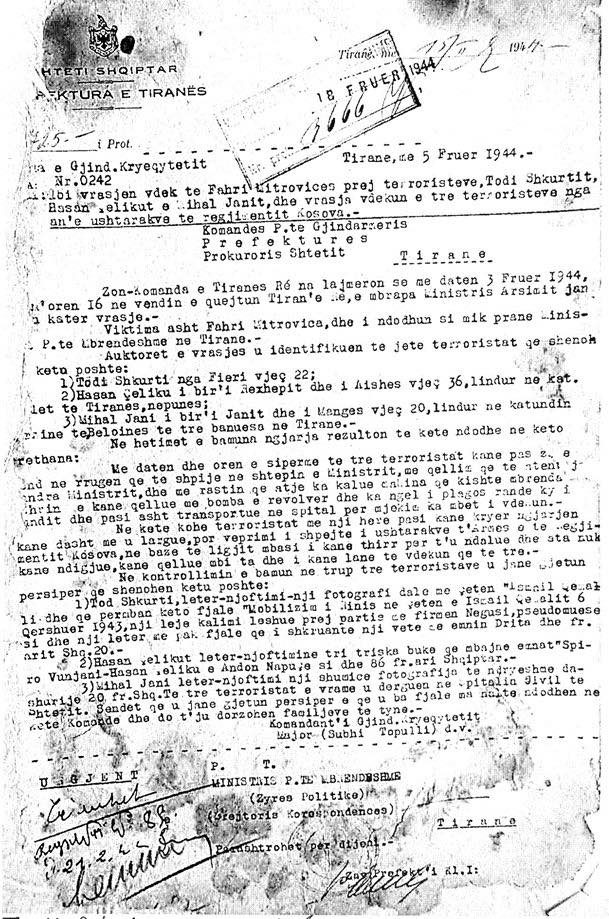
As of today, 82 years ago, Albanian Communist assassins, directed by Serbian–Montenegrin terrorist emissaries, in the continuation of killings carried out in the streets of Tirana, Shkodra, Durrës, Elbasan, Korça, Berat, Vlora, and other cities, succeeded in carrying out an assassination attempt against Xhafer Deva, Minister of the Interior in the Mitrovica Cabinet.¹
In fact, assassination attempts against some of the most prominent figures of the Albanian nation—including signatories of the Albanian Declaration of Independence of 1912—had begun at least as early as 1943.²
In April 1943, an assassination attempt was carried out against Militia Colonel Ndok Gjeloshi on Tirana’s main boulevard, near the maternity hospital. The guerrilla action was executed by Myslym Keta, Adnand Qatipi, Shemsi Haka, and Njazi Meka, under the direction of Beqir Balluku.³
Ndok Gjeloshi originated from the village of Mekshaj (Shalë) in Dukagjin. He was educated at the Franciscan Gymnasium in Shkodra and later graduated from the Military Academy in Modena, Italy, with the rank of Gendarmerie Lieutenant. He supported Prince Wilhelm of Wied in 1914 and was an associate of Luigj Gurakuqi and Fan Noli, under whose government he attained the rank of Captain.
As an opponent of King Ahmet Zog, he fled Albania following the triumph of the Legalist movement. In Vienna, he became a member of the “National Union” group and participated in the attempted assassination of King Zog on 20 February 1931.⁴
Gjeloshi served as an officer in both the Albanian Gendarmerie and the Fascist Militia. From its formation, he commanded militia legions in Shkodra, Vlora, and later Tirana, participating in military campaigns against Greece and Yugoslavia. From 1942 onward, he also served as a judge at the Special State Court.⁵
Azis Çami, former First-Class Questore in Korça and Durrës until November 1942, had participated in the 1931 Vienna assassination attempt against King Zog alongside Ndok Gjeloshi, Hasan Prishtina, Sejfi Vllamasi, Rexhep Mitrovica, Qazim Mulleti, and Angjelin Suma.
He was also known as a leading figure in the 1920 Vlora War and later as commander of Balli Kombëtar forces in southern Albania.⁶
His killing was reported on 16 December 1943 by the newspaper Bashkimi i Kombit, stating that on 15 December 1943, at 8 a.m., he was brutally murdered near the New Bazaar in Tirana.⁷
On 27 September 1943, the fascist intellectual Ludovik Zojsi, an employee of the General Directorate of Posts and Telecommunications (PTT), was killed.⁸
Hysen Myshketa, newly elected deputy of Durrës to the National Popular Assembly, was assassinated on 8 October 1943 before taking his oath. He had previously served as mayor of Durrës during Fan Noli’s government.⁹
On 12 October 1943, Tirana guerrillas organized an assassination attempt against Mustafa Merlika Kruja, founder of the 1908 Alphabet Congress, delegate to the 1909 Elbasan Congress, signatory of the Albanian Declaration of Independence (1912), and former Prime Minister of Albania (December 1941–January 1943). He was seriously wounded but survived. The event received international press coverage, including reports in Moscow, London, and Washington.¹⁰
Iljaz Agushi, deputy of Prishtina and former Minister of Public Works in the Kruja government, was killed on 29 October 1943. A detailed account states that four guerrillas carried out the execution, two inside his residence and two securing the escape route.¹¹
Idhomeni Kosturi, elected Chairman of the National Popular Assembly on 26 October 1943, was assassinated on 25 November 1943 as he exited his home.¹²
Ndrec Preng Marku, commander of the Albanian Gendarmerie in the Shkodra district, and Adem Boletini, son of Isa Boletini and also a gendarmerie commander, were killed in November 1943 in an operation attributed to a guerrilla unit led by Vasil Shanto.¹³
Finally, the teacher Qemal Mici was killed on 29 October 1943 solely for refusing to join the communist movement. Reports from the Korça district indicate additional cases of teachers being executed or threatened, raising concerns that continued persecution could result in the suspension of education in the region.¹⁴
The text concludes by posing the question of how the Albanian Gendarmerie would respond on 4 February, deferring discussion to a subsequent publication.
Footnotes
- Xhafer Deva served as Minister of the Interior in the Rexhep Mitrovica government during the German occupation of Albania (1943–1944).
- The Declaration of Independence of Albania was signed on 28 November 1912 in Vlora.
- Beqir Balluku later became a senior military and political figure in communist Albania.
- The Vienna assassination attempt against King Zog took place on 20 February 1931.
- The Special State Court operated during the Italian occupation period.
- Balli Kombëtar was a nationalist political and military organization active during World War II.
- Bashkimi i Kombit was a contemporary Albanian newspaper active during the occupation period.
- PTT refers to the General Directorate of Posts, Telegraphs, and Telephones.
- The National Popular Assembly was established during the occupation period as a legislative body.
- Mustafa Merlika Kruja was a prominent intellectual and political figure of the Albanian National Awakening.
- The term “quisling government” reflects contemporary political language used to describe collaborationist administrations.
- Idhomeni Kosturi was a senior political figure during the 1943 transitional period.
- Vasil Shanto was a communist organizer active in northern Albania.
- Contemporary reports indicate that educators were frequently targeted during the escalation of political violence in late 1943.


 Balkan Academia