
By Trim Latifi
Abstract
This study examines the submission of the Berisha clan to the Venetian Senate in 1467, highlighting the political, military, and social structures of northern Albania under Venetian influence. Venice relied on Albanian feudal lords, mercenaries, and garrisons to maintain regional control, providing resources such as grain, salt, and Saint Mark’s insignia to secure loyalty. The documents illuminate local power dynamics, the role of prominent dynasties, and the strategic significance of cities like Durrës and Shkodër. The Catholic Church also exerted political influence, illustrating the complex interplay between Venetian authority, Albanian clans, and religious institutions in the late 15th century.
The Venetian Senate Accepts the Submission of the Berisha Clan
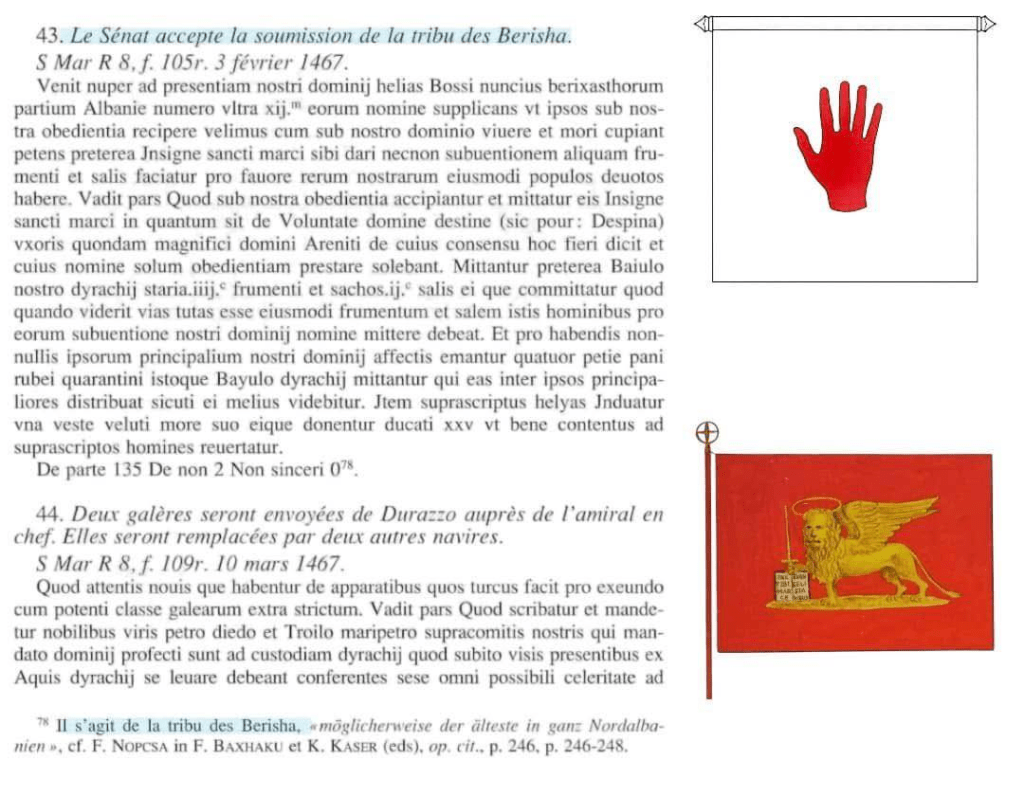
Recently, the messenger of the Berixasthian people from parts of Albania, numbering more than twelve, came before our lord, requesting on their behalf that we consent to accept them under our obedience, since they wish to live and die under our rule. They also requested that they be given the Insignia of Saint Mark and that a subsidy of corn and salt be made in favor of our works, so that these people may dedicate themselves to them.
The provision is that under our obedience they must receive and be sent the Insignia of Saint Mark, as it is by the will of Lady Destine (sic: Despina), wife of the late illustrious lord of Arenitus, with whose approval it is said this was done, and in whose name they paid only allegiance.
Furthermore, our administrator should be sent 3 measures of corn and 3 sacks of salt, which have been entrusted to him, so that when he sees the roads are safe, he should send corn and salt to these men as their subsidy in the name of our lord. And in exchange for the loyalty of the leaders of our lord, four loaves of red bread and forty units of dyraki are purchased and given to this Bayulo, who distributes them among the leaders as he sees fit.
Then the aforementioned Heliasi should be dressed in a garment, as is his custom, and should be given twenty-five ducats, so that he returns satisfied to the aforementioned men.
44. Two galleys will be sent from Durrës to the chief admiral. They will be replaced by two other ships.
March 10, 1467
Considering the news available regarding the preparations the Turk is making to sail with a powerful fleet of helmets beyond the Strait, the provision is: that it be written and sent to the nobility Peter Diedo and Troilus Maripetro, our chief counts, who, by order of our lord, set out to guard Durrës, so that upon seeing the present situation, they may suddenly emerge from the waters of Durrës and proceed with all possible speed to…
- Berisha clan: Possibly the oldest in all of northern Albania. (Compare F. NOPCSA in F. BAXHAKU et K. KASER (eds.), op. cit., pp. 246-248.) This begins our series of documents, mainly illustrating historical events of 1464-1468. Documents are published chronologically; here only a general introduction and brief remarks on the most important parts are provided.
- Instructions for governors (Count-Captain of Shkodra, bailiff, and captain of Durrës) and general governors (provisors of Albania) shed light on the organization of the Venetian corps in Albania, composed of Italian mercenaries, professional soldiers hired for a season, and Italian garrisons in fortresses. Most soldiers, however, were of Albanian origin, including proniars (feudal holders), supporters of Venetian administration, and paid knights. Knights were divided into two companies, “Albanian” and “Italian,” a distinction largely theoretical in the latter half of the 15th century.
Posts reserved for Italians were better paid and more prestigious; however, to compensate for the services of supporters from local dynasties like Humoj, Moneta, Hungaro, Vulkata, and Romestina, Venice distributed these posts to men with an outstanding reputation among their compatriots. - Shkodër region: Retained traces of Byzantine-Serbian dominance, especially in pronia, but mountain clans were dominant. By providing Venetian authorities with military service, these clans secured rare resources such as salt and grain, scarce in their harsh highlands.
- Major Albanian dynasties like the Muzaka, Dukagjini, and Balshiq were forced to cede most of their power and territory to Skanderbeg. He tried to centralize military and economic resources in a region where communication was difficult due to mountains and valleys. Only after his death in January 1468 did these lords reassert themselves and turn to Venice, which aimed to regroup the dispossessed Albanian nobility.
- Catholic Church: One of the foundations of Skanderbeg’s principality and Venetian domination in Albania. Represented by the archbishops of Durrës and Antivari, Benedictine monasteries such as Santa Maria di Rotezos, San Nikolaus near Dulcigno, San Sergius and Bacchus along the Bojana River, as well as cathedrals and churches in cities and villages. Clerics often had significant political influence.
References for further study include works by E. de ŠUFFLAY, V. NOVAK, T. IPPEN, F. CORDIGNANO, A. MEKSI, and M. SPREMIĆ, documenting church conditions, monasteries, and medieval Albanian social structures.


 Balkan Academia