
Abstract
The claim that traditional Albanian clothing—specifically the qeleshe (plis)—originates from ancient Serbian folk dress is historically unfounded and represents a form of nationalist cultural appropriation. The qeleshe is an indigenous Albanian garment, continuously attested in Albanian-inhabited regions and made from felted wool, with its name deriving from Albanian linguistic roots. Similarities between Balkan folk costumes reflect shared regional conditions and pastoral lifestyles rather than ethnic ownership. Selective use of 19th-century ethnographic observations, such as those by Ivan Jastrebov, is misleading and ignores both the pre-Slavic presence of Albanians in the western Balkans and the broader context of cultural overlap. The narrative presented is therefore methodologically flawed, anachronistic, and ideologically motivated rather than historically accurate.
In the Serbian wiki page “Kece” Serbian propagandist writers have written:
Propaganda claim: “In earlier times, today’s traditional Albanian was the Serbian folk costume of the Old Serbian-Torlak region. Ivan Jastrebov wrote that the costume of Fanda, i.e. in general from the people of Dukagjin, almost exactly the same as the costumes of the people of Macan, Shaljan and Montenegrins – tight pants, white caps – these are purely Serbian clothes from ancient times.“
Truth: This claim is a textbook example of cultural appropriation through selective quotation and anachronistic reasoning.
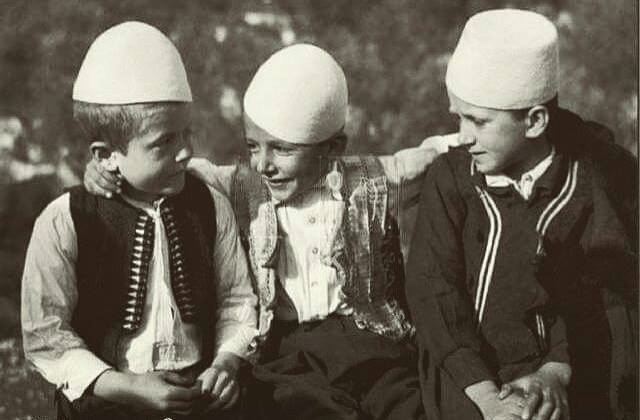
The qeleshe (plis) is the traditional hat of Albanian men and has been continuously attested in Albanian-inhabited territories for centuries. It is made from a single piece of felted wool and is undecorated and white. The word qeleshe derives from the Albanian root lesh (wool), further confirming its indigenous origin within Albanian material culture.
More importantly, the existence of similar garments across the Balkans does not indicate Serbian origin. The Balkans have long functioned as a shared cultural zone shaped by climate, pastoral life, and pre-modern textile techniques. White felt caps, tight trousers, and wool-based clothing appear across Illyrian-descended populations, Vlachs, highland Slavs, and other groups. Similarity does not equal ownership.
The propaganda tactic here relies on a false premise: that because a 19th-century Serbian ethnographer observed similarities between Albanian highlanders and neighboring populations, the Albanian costume must therefore be Serbian. This ignores:
- the much older archaeological and iconographic continuity of the qeleshe among Albanians,
- the fact that Albanians are indigenous to the western Balkans, predating Slavic migrations by many centuries,
- and the well-known phenomenon that border populations often share clothing styles without sharing ethnic origin.
Ivan Jastrebov’s writings reflect the political-nationalist atmosphere of his time, when Serbian and other Balkan intellectuals routinely attempted to retroactively nationalize shared or non-Slavic cultural elements. His observations describe resemblance, not origin — a distinction deliberately erased in modern propaganda narratives.
In short, the claim that the qeleshe or Albanian traditional clothing is “purely Serbian from ancient times” is historically unsustainable, methodologically dishonest, and ideologically motivated. It confuses regional overlap with ethnic provenance and weaponizes ethnography to serve nationalist revisionism rather than historical truth.
Sources
Wikipedia – Qeleshe
The qeleshe (also known as plis) is described as a traditional Albanian felt hat worn by Albanian men, made from a single piece of white felted wool and deeply rooted in Albanian cultural heritage.
Source: Wikipedia, “Qeleshe”
Encyclopaedia / Everything Explained Today – Qeleshe
Confirms that the qeleshe is a traditional Albanian skullcap, part of Albanian folk costume across Albania, Kosovo, and other Albanian-inhabited regions, produced using traditional wool-felting techniques.
Source: Everything.Explained.Today, “Qeleshe”
Albanian Folklore – The Albanian Skullcaps (Qeleshe)
Provides ethnographic detail on the production, cultural meaning, and historical continuity of the qeleshe as an element of Albanian traditional dress.
Source: Albanian-Folklore.com
Encyclopaedia Britannica – Albanian Folk Dress (contextual)
Describes Albanian traditional clothing as regionally diverse but culturally distinct, shaped by local history and pre-Slavic Balkan traditions, rather than derived from neighboring Slavic peoples.
Source: Encyclopaedia Britannica, “Albanian Folk Dress”
Wilkes, J. J. – The Illyrians
Discusses the cultural continuity of Illyrian-descended populations in the western Balkans, providing historical context for indigenous Albanian material culture predating Slavic migrations.
Source: Wilkes, J. J., The Illyrians, Blackwell Publishing.


 Balkan Academia