
by Feri Arifi.
Abstract
This article explores the disputed historical narratives concerning the ethnic identity of Goce Delchev and his family. Drawing on genealogical details, regional context, and selective historiography, it highlights gaps in Albanian academic engagement with the possibility of an Orthodox Albanian background. The study also situates personal sacrifice within revolutionary history, emphasizing how memory, identity, and politics intersect in the construction of national narratives.
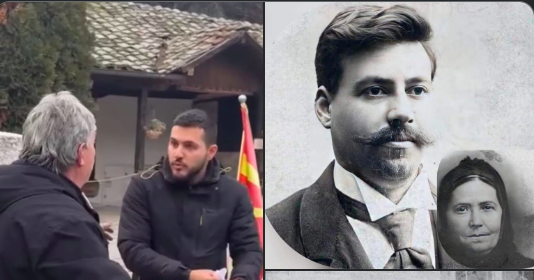
It is not permitted to approach the grave of Goce Delchev in the Church of St. Spas in Skopje with a Bulgarian flag.
Yet the question remains: to whom did his family belong? The answer invites reflection when one examines the names and historical context.
On February 4, 1901, Dimitar Mico Delchev, the brother of Goce Delchev, died.
The Delchev family consisted of:
- Father: Nikolla Dhimitri
- Mother: Sultana Nurgjiu
- Sons: Goce, Mico, Milan, and Hristo
- Daughters: Rusha, Cuca, Tina, Lika, and Elena
According to numerous historians, it is documented that Sultana Nurgjiu was of Albanian Orthodox origin. Scholars discuss several possibilities, as the family lived in Kukush (Kilkis), a civic and social environment characterized by mixed communities. For this reason, it cannot be stated with absolute certainty whether the family was Albanian or Vlach; existing interpretations are based on birthplace, naming traditions, and the broader historical context of Orthodox Albanian communities in the region.
This raises an important question: why have neither mainstream historians nor Albanian academic institutions—apart from Academician Abdullah Mehmeti and more recently Elida Jorgoni—systematically examined or argued the possibility that Mico and Goce Delchev were Orthodox Albanians?
On February 4, 1901, Mico Delchev was killed in the first major battle fought by the cheta against Ottoman forces near the village of Bajalce, in the Bojmija region of Aegean Macedonia, close to Gevgelija. He was only twenty-two years old. Eternal glory to him.
When Goce Delchev learned of his brother’s death, he asked only one question:
“Did he stand bravely, my brother?”
He took pride in the affirmative answer, which testified to the courage of his brother, Dimitar Mico Delchev.

