
Abstract
This article presents a critical examination of recurring patterns of violence, moral transgression, and institutional failure within segments of Serbian military and paramilitary formations from the Balkan Wars of 1912–1913 through the Yugoslav Wars of the 1990s. Drawing on primary reports, contemporary observers, and modern historiography, the study argues that repeated war crimes against civilian populations—particularly Albanians, Bosniaks, and Croats—were not merely episodic excesses but were facilitated by command structures, nationalist ideology, paramilitary outsourcing, and persistent impunity. While rejecting ethnic essentialism, the article contends that elements of Serbian military culture repeatedly tolerated, encouraged, or failed to restrain extreme violence against civilians, producing a historically traceable pattern of abuse.
Introduction: Beyond Accidents and “Excesses”
The history of warfare involving Serbian military and paramilitary forces reveals a disturbing recurrence of violence against civilians that cannot be dismissed as accidental, isolated, or purely reactive. From the Balkan Wars to the disintegration of Yugoslavia, patterns of looting, mass killing, ethnic terror, and systematic abuse appear with striking regularity. This article argues that these acts were repeatedly enabled by command tolerance, ideological framing of enemies as subhuman or traitorous, and the deliberate use of irregular forces to conduct atrocities while preserving plausible deniability.
The Balkan Wars (1912–1913): Violence as Policy and Practice
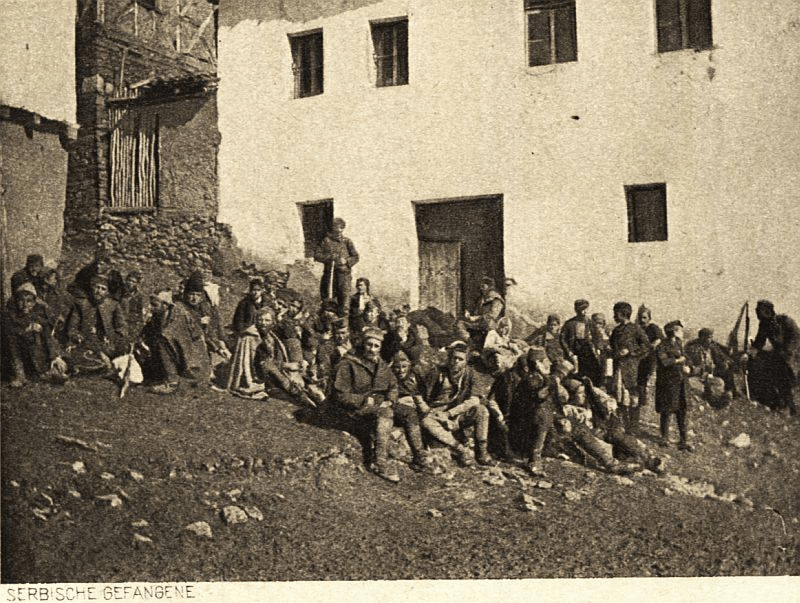
Contemporary observers, including international commissions and journalists, documented widespread atrocities committed by Serbian forces against Albanian civilians during the Balkan Wars. The Carnegie Endowment’s 1914 report described mass executions, village burnings, and terror explicitly aimed at depopulation.
Several sources recount Serbian officers openly inciting violence. Ostijic and others note instances where commanding officers allegedly shouted commands such as “Kill!” upon entering Albanian towns—language that signals not loss of control, but authorization.
Looting by Serbian officers was not incidental. Albanian civilians were routinely stripped of money and valuables, reinforcing the perception that occupation was both punitive and extractive. Such behavior reflects a collapse of military ethics at the officer level, not merely among undisciplined troops.
Paramilitarism and the Chetnik Model
A critical feature of Serbian military violence is the recurrent reliance on paramilitary auxiliaries, most notably Chetnik formations. These groups functioned as instruments of terror, conducting massacres, forced displacement, and reprisals against civilians while maintaining formal separation from regular command structures.
This model allowed:
- operational coordination without legal responsibility,
- ideological radicalism unconstrained by military law,
- systematic ethnic violence framed as “spontaneous” or “retaliatory.”
The use of Chetnik forces during both the Balkan Wars and World War II demonstrates continuity in this strategy.
World War II: Collaboration, Ethnic Terror, and Civilian Targeting
During World War II, Serbian Chetnik units under leaders such as Draža Mihailović committed extensive crimes against Bosniak and Croat civilians, including massacres, village destruction, and forced conversions. While often portrayed in nationalist narratives as resistance fighters, substantial archival evidence shows collaboration with Axis forces and prioritization of ethnic cleansing over anti-fascist struggle.
These actions further entrenched a military culture in which civilian populations were legitimate targets if defined as ethnically or politically hostile.
The 1990s: Yugoslav Wars and the Return of Atrocity
The wars in Croatia, Bosnia-Herzegovina, and Kosovo during the 1990s marked not a rupture, but a reactivation of earlier patterns. Units linked to the Yugoslav People’s Army (JNA), Serbian security forces, and paramilitaries such as Arkan’s Tigers engaged in ethnic cleansing, mass rape, executions, and terror campaigns.
International Criminal Tribunal for the former Yugoslavia (ICTY) judgments confirmed:
- command responsibility,
- coordination between state forces and paramilitaries,
- systematic targeting of civilians.
The persistence of these practices across decades points to institutional failure rather than historical coincidence.
Conclusion: A Tradition of Impunity, Not an Ethnic Essence
This article does not argue that violence is inherent to Serbian identity. It argues something more damning in institutional terms: that segments of Serbian military and security structures repeatedly failed to enforce moral or legal restraint, and at times actively promoted terror as a tool of statecraft.
The tragedy lies not only in the crimes themselves, but in the refusal—across generations—to confront them honestly. Until this history is fully acknowledged, the cycle of denial and recurrence remains a threat not only to victims, but to the integrity of military ethics itself.
References
Carnegie Endowment for International Peace. Report of the International Commission to Inquire into the Causes and Conduct of the Balkan Wars. Washington, DC: Carnegie Endowment, 1914.
Trotsky, Leon. The Balkan Wars 1912–13. New York: Monad Press, 1980 (original articles 1912–1913).
Malcolm, Noel. Kosovo: A Short History. London: Macmillan, 1998.
Levene, Mark. “Frontiers of Genocide: Jews in the Eastern War Zones, 1914–1920.” In The Oxford Handbook of Genocide Studies, edited by Donald Bloxham and A. Dirk Moses, 462–481. Oxford: Oxford University Press, 2010.
Tomasevich, Jozo. War and Revolution in Yugoslavia, 1941–1945: The Chetniks. Stanford, CA: Stanford University Press, 1975.
Hoare, Marko Attila. Genocide and Resistance in Hitler’s Bosnia: The Partisans and the Chetniks, 1941–1943. Oxford: Oxford University Press, 2006.
Ramet, Sabrina P. Balkan Babel: The Disintegration of Yugoslavia from the Death of Tito to the Fall of Milošević. 4th ed. Boulder, CO: Westview Press, 2002.
United Nations. Final Report of the Commission of Experts Established Pursuant to Security Council Resolution 780 (1992). UN Document S/1994/674.
International Criminal Tribunal for the Former Yugoslavia (ICTY). Prosecutor v. Radovan Karadžić, IT-95-5/18-T, Judgment, 24 March 2016.
International Criminal Tribunal for the Former Yugoslavia (ICTY). Prosecutor v. Ratko Mladić, IT-09-92-T, Judgment, 22 November 2017.
Weitz, Eric D. A Century of Genocide: Utopias of Race and Nation. Princeton, NJ: Princeton University Press, 2003.
Bieber, Florian. Serbian Nationalism from the Death of Tito to the Fall of Milošević. Boulder, CO: Westview Press, 2000.
Glenny, Misha. The Balkans: Nationalism, War, and the Great Powers, 1804–1999. New York: Viking, 1999.


 Balkan Academia