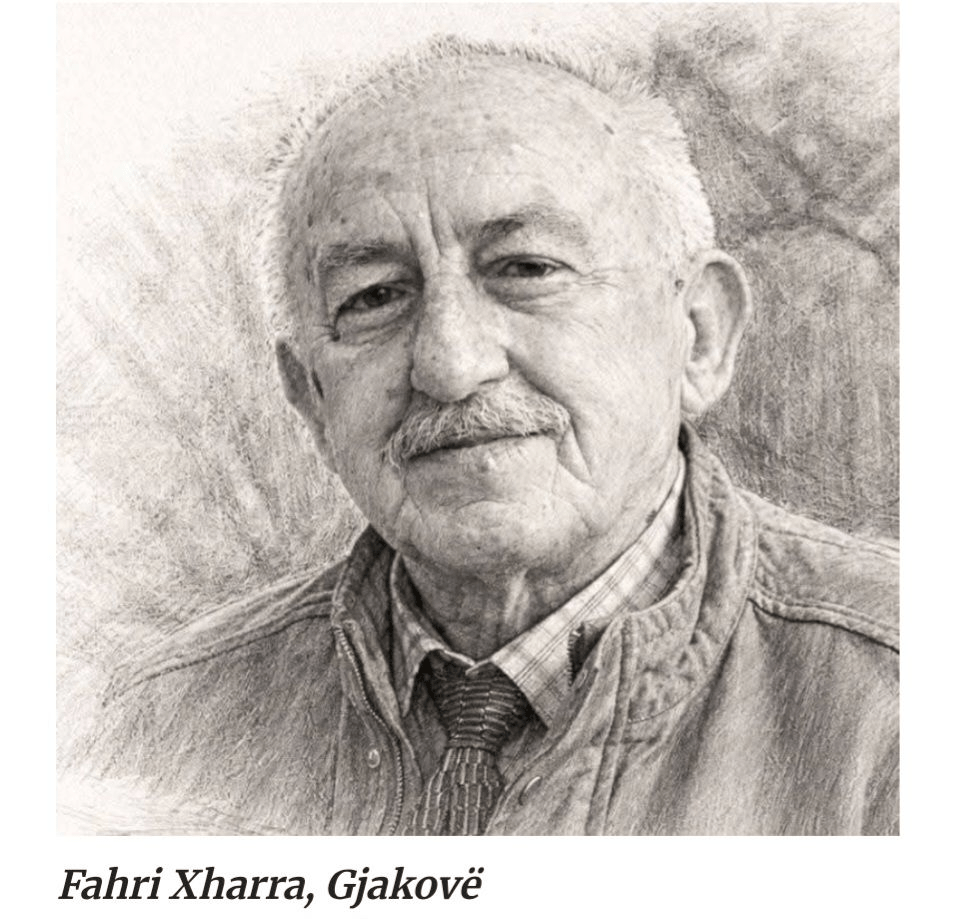

by Fahri Xharra
Abstract
This study analyzes Serbian propaganda narratives during the Kosovo war that framed the conflict as a religious struggle against Islam. Using eyewitness testimony and Western diplomatic, military, and media sources, it demonstrates that the KLA was a secular, multi-confessional movement and that international actors consistently rejected claims of Islamist motivation. The findings highlight the gap between propaganda and documented reality and underscore the political, not religious, nature of the Kosovo conflict.
“We were in Bishtazhin, and the American diplomat Richard Holbrooke got out of his vehicle and invited me to accompany him,” writes Veton Surroi.
“He approached the Serbian police commander and asked him what he was guarding there. The commander said that he was protecting Albanian Catholics from the Islamist-fundamentalist KLA.
Holbrooke then turned to me and, in the presence of the Serbian commander, asked whether this was true. I told him NO, this is not true, because the KLA commander there himself was an Albanian Catholic.
The Serbian commander fell silent, and Holbrooke and I got back into the vehicle and continued our journey.”
What can be added to this topic (historical context)
This fragment is politically and propagandistically very significant, because it touches on several key points:
1. Serbian propaganda during the Kosovo war
The narrative that the KLA was “Islamist/fundamentalist” was widely used by the Serbian state apparatus:
- to delegitimize the liberation struggle,
- to present the conflict as a religious threat rather than a colonial/political issue,
- to frighten the West (especially the USA and the EU).
This narrative directly contradicts the reality on the ground:
- the KLA was multi-confessional (Muslims, Catholics, Bektashis, secular individuals),
- its leadership and structures had no religious character.
2. The role of Richard Holbrooke
Holbrooke was:
- the architect of the Dayton Agreement,
- a key figure in American diplomacy in the Balkans,
- highly sensitive to ethnic and religious manipulation.
The fact that:
- he directly questioned the Albanian side,
- and did not automatically accept the Serbian version,
shows that American diplomacy:
- verified propaganda on the ground,
- was aware of the pluralism within Albanian society.
3. Albanian Catholics and the KLA
The mention that the KLA commander was an Albanian Catholic is essential because it:
- dismantles the myth of an “Islamist KLA,”
- demonstrates the historical continuity of Albanian interfaith coexistence,
- connects the Kosovo war to national, not religious, tradition.
This line is consistent with:
- the role of Catholic clergy in the Albanian National Awakening,
- the participation of Catholics in the LPK, the KLA, and post-war institutions.
Short summary
This text:
- is evidence against Serbian propaganda,
- confirms the national and non-religious character of the KLA,
- and shows how Western diplomacy tested narratives on the ground.
How the KLA war was interpreted
1. Official American documents (U.S. State Department)
U.S. State Department – Kosovo Crisis Background (1998–1999)
In annual human rights and Kosovo crisis reports, it is clearly stated that:
- the KLA is described as an “ethnic Albanian guerrilla movement,”
- it is NOT described as a religious or Islamist organization,
- the conflict is defined as political and ethnic, not religious.
“The KLA was composed of ethnic Albanians from different backgrounds and did not espouse a religious ideology.”
This wording appears in several reports from 1998–2000.
2. OSCE – the most authoritative Western report on Kosovo
OSCE – Kosovo/Kosova: As Seen, As Told (1999)
This is the most authoritative Western document on the Kosovo war.
What the OSCE states:
- the KLA is never characterized as Islamist,
- there is no reference to religious motivation,
- the focus is on:
- Serbian state repression,
- ethnic cleansing,
- Albanian armed resistance.
“The conflict in Kosovo was not a religious conflict but a political struggle arising from systematic discrimination.”
This report directly refutes the Serbian claim of “protecting Catholics from the KLA.”
3. NATO & Western military analyses
NATO – Briefings 1998–1999
In NATO documents:
- the KLA is described as:
- “Kosovar Albanian armed resistance,”
- no religious dimension is identified,
- there is no warning of Islamic extremism.
This is crucial because:
- NATO had active intelligence services on the ground,
- any Islamist element would have been an absolute red flag.
4. American diplomacy – Holbrooke’s own testimony
To End a War – Richard Holbrooke
In his memoirs, Holbrooke speaks about:
- systematic Serbian manipulation,
- efforts to portray Kosovo as a “religious problem,”
- and the fact that the reality on the ground did not support this narrative.
Although the Bishtazhin episode is not quoted verbatim, the logic of the account fully aligns with his position.
5. Western media (BBC, NYT, The Guardian)
Key analyses:
- BBC: an ethnic and state conflict, not a religious one,
- The New York Times: the KLA as a reaction to repression,
- The Guardian: emphasis on Albanian secular and pluralist society.
None of these:
- describe the KLA as Islamist,
- mention “protecting Catholics from Albanians.”


 Balkan Academia