
Abstract
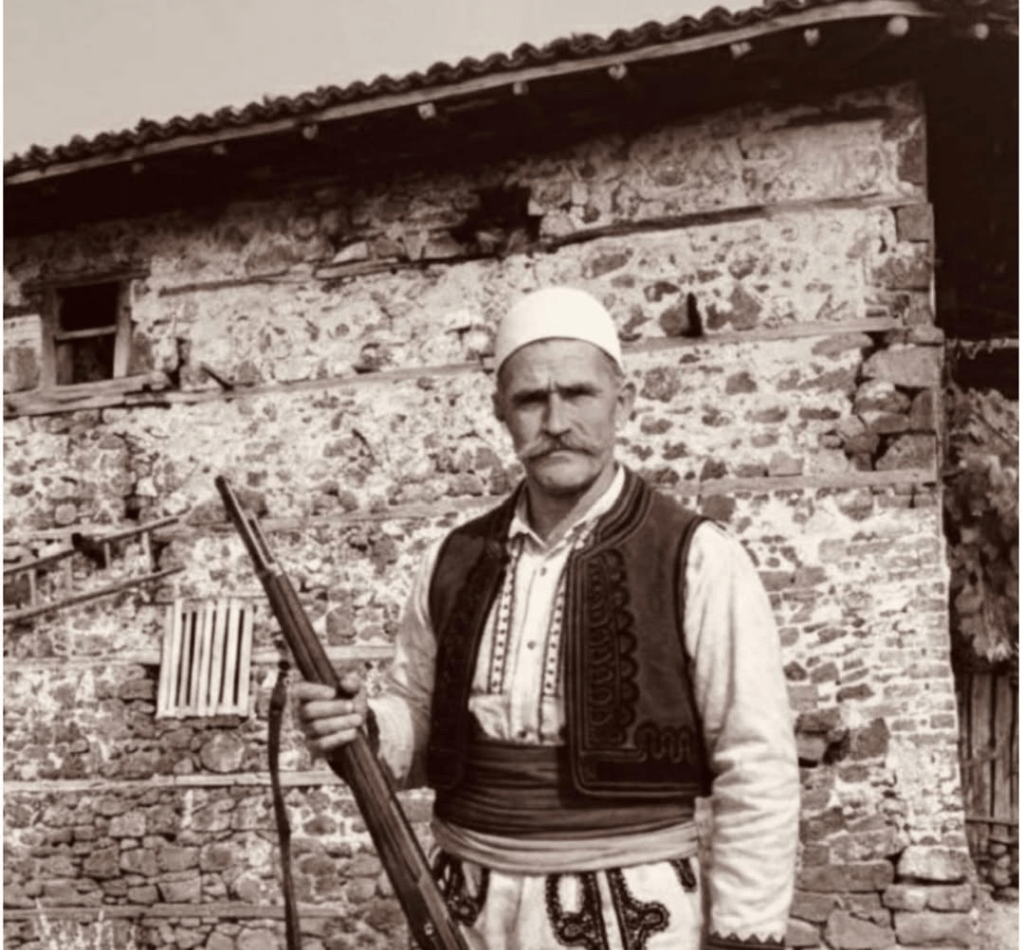
This text examines the life and political-military activity of Daut Lah Muhadri (1873–1926), known as Daut Laha, a prominent figure of armed resistance and democratic activism in the region of Has in northern Albania. Rooted in local traditions of honor, loyalty (besa), and communal defense, Daut Laha emerged as a key actor in the struggles against Ottoman authority, Serbian and Montenegrin expansion, and later authoritarian rule within Albania. The study traces his role in border defense, cooperation with leading national figures such as Bajram Curri, and participation in the June Democratic Movement of 1924. It further analyzes the personal tragedies that shaped his resistance and the political persecution that led to his assassination in 1926. The article argues that Daut Laha represents a synthesis of local resistance, national liberation, and democratic aspiration in early twentieth-century Albanian history.
Written by: Besim Muhadri
Daut Lah Muhadri, widely known in popular memory as Daut Laha—after his father’s name—was born in 1873 in the village of Vlahna in Has, one of the most distinguished regions of northern Albania for its tradition of resistance, honor, and besa (sacred pledge). As a borderland and strategically important area, Has had historically been forced to live on the front line of confrontation with various occupiers, shaping a resilient society deeply connected to land, honor, and national survival. Daut was the second son of Lah Rama, after Beqir, and was followed by three other brothers—Salih, Sadik, and Hysen—also known for their bravery and physical strength, admired throughout the community.
In this harsh environment, imbued with profound patriotic sentiment, the character of Daut Laha was formed. From early childhood, he grew up listening to stories of wars, resistance, and the sacrifices of previous generations, understanding at an early age that his personal fate was inseparable from that of the homeland. Has and his beloved Vlahna became his first school of patriotism, where he learned the importance of courage, responsibility, and besa.
Youth and Patriotic Formation
Daut Laha’s youth coincided with one of the most turbulent periods in Albanian history. The late nineteenth and early twentieth centuries marked the gradual disintegration of the Ottoman Empire, while neighboring states—particularly Serbia and Montenegro—sought to expand their borders over Albanian lands.
In Has, these developments were not distant political events but direct threats to life and property. In this reality, Daut Laha grew up in an environment where national consciousness, responsibility toward the community, and readiness for armed defense were part of everyday life.
His patriotic formation was profoundly influenced by prominent local figures, especially the bayraktars of Vlahna and Has, Ali Sahiti and later his contemporary Mehmet Ali Sahiti—leaders with authority and symbols of resistance in Has and beyond. Under their influence, Daut Laha learned not only the art of warfare and organization, but also the deeper meaning of besa, solidarity, and sacrifice for the common good.
During this period, he established his first connections with major figures of the Albanian national movement, most notably Bajram Curri, gradually becoming part of the broader network of Albanian resistance for freedom and national liberation.
Struggles Against the Ottoman Empire and Neighboring Forces
Daut Laha’s military activity began early and developed in parallel with the escalating threats to Albanian lands at the turn of the nineteenth and twentieth centuries. This was a period when Ottoman authority was weakening, yet violence and repression against the Albanian population persisted, while neighboring states prepared to exploit every weakness to expand at Albania’s expense.
In this harsh historical reality, Daut Laha saw direct involvement in the defense of Has and surrounding areas as a necessity. He actively participated in efforts against Ottoman interventions, particularly in actions aimed at defending social order and local autonomy, and later stood at the forefront of resistance against the brutal advance of Serbian forces in northern Albania, with special emphasis on Has.
For Has, these confrontations were not isolated clashes but battles for collective survival—for the preservation of land, homes, and national identity. The battles at Qafë Prush, Qafë Ahmat, and other clashes in Has and its surroundings mark key moments of this period. In these encounters, Daut Laha distinguished himself not only through personal courage and readiness to stand on the front lines, but also through his ability to act in an organized manner, closely cooperating with other leaders of local and regional resistance.
For Daut Laha, war was not an act of random violence or a momentary emotional reaction. It represented a moral and national obligation, deeply rooted in the traditions of Has and in his patriotic consciousness. Weapons, in this sense, were means of defense rather than ends in themselves, while the ultimate goal remained the preservation of Albanian identity and the construction of a free and united Albania founded on the will of its people.
Personal Tragedies and the Strength of Resistance
The year 1914 marked one of the deepest and most painful wounds in Daut Laha’s life. At a time when new borders were being imposed violently and arbitrarily on Albanian lands, during the crossing of the newly established border, two of his brothers—Sadik and Hysen—were killed by Serbian military forces and gendarmerie in Gërçina of Has. This shocking event was not only a family tragedy, but also a clear testimony to the systematic and ruthless violence inflicted upon the Albanian population of border regions.
The killing of his two brothers represented the brutal fragmentation not only of a family, but also of the moral and social order of a region paying the highest price for the decisions of the Great Powers. For Daut Laha, this loss was not merely personal grief; it became a symbol of the historical injustice inflicted upon Has and Albania as a whole.
Yet this heavy tragedy did not break his fighting spirit. On the contrary, it further tempered his character and strengthened his conviction that freedom, honor, and national dignity are not achieved without blood and sacrifice. The pain for his fallen brothers was transformed into a personal and moral vow never to retreat from the path of resistance.
Independence and the Post-1912 Period
The declaration of Albania’s Independence on 28 November 1912 was a major historical act for the Albanian nation, but it did not immediately bring peace or security to all Albanian regions. For Has, this period was marked by deep uncertainty, anxiety, and constant confrontation with the violent reality of newly imposed borders. The decisions of the London Treaty left many Albanian territories outside the new state, turning Has into an exposed border zone subject to pressure, provocations, and continuous incursions by neighboring forces, especially Serbian ones.
In these circumstances, independence for the people of Has was not a completed victory, but an ideal that had to be defended every day. In the absence of a consolidated state and a regular army, the defense of territory and population remained in the hands of local fighters who bore the heavy burden of safeguarding borders and national dignity.
In this historical context, Daut Laha emerged as one of the key figures of local resistance in Has. He did not view independence as the end of struggle, but as the beginning of a new, more demanding phase. His commitment extended beyond physical defense to the preservation of Albanian identity, social order, and unity at a time when the threat of fragmentation remained real.
Connection with Bajram Curri and the June Democratic Movement
Before establishing direct ties with Bajram Curri, Daut Laha had built close relations with Mehmet Ali Bajraktari of Vlahna. They were united not only by age and origin, but also by a shared ideal of defending the community and local autonomy. Daut Laha joined the Bajraktari as a member of the Great Banner (Bajraku i Madh), which, after its predecessor Rexhë Bajraktari, assumed leadership of Has in 1914 and played a significant role in wars against Serbian forces during 1913–1915 and later 1918–1921.
His connection with Bajram Curri marked one of the most important moments in Daut Laha’s life. Curri, known as a popular tribune and symbol of resistance and democratic reform, found in Daut Laha a loyal, resolute, and honorable comrade. According to family testimonies and oral memory in Vlahna, Bajram Curri stayed in Daut Laha’s centuries-old tower house, which served as a strategic center for resistance activities.
In 1924, Daut Laha devoted himself passionately to the June Democratic Movement, seeing it as the greatest opportunity for a just and democratic Albania based on the will of the people. Although wounded during clashes, he did not abandon the cause and continued to play a key role in organizing and supporting the movement in Has.
Political Persecution and Assassination
The failure of the June Democratic Movement marked the beginning of a dark period for Albania. After the killing of Bajram Curri in 1925, the regime of Ahmet Zogu launched a systematic campaign of persecution, surveillance, and physical elimination of his supporters.
In 1926, at a place known as Kodra e Berës near Kruma, Daut Laha was treacherously killed by government forces. His murder was not an isolated incident, but part of a deliberate state policy aimed at eliminating figures symbolizing resistance, freedom, and democratic ideals.
Legacy and Posthumous Recognition
Daut Laha of Vlahna in Has remains one of the most representative figures of Albanian honor, besa, and national resistance. Though long neglected by official historiography, popular memory preserved his name as a just warrior and martyr of democracy. In 1994, he was posthumously honored by the President of Albania for his merits in the June Democratic Revolution.
Although his family home and material traces were destroyed in 1998 by Serbian forces, his name and legacy endure—as a symbol of sacrifice, resistance, and the enduring price of freedom.


 Balkan Academia