
Abstract
This text analyzes M. Živković’s study Stara Raška pod italijanskom okupacijom 1941–1943, focusing on how the position of the Muslim population of Sandžak during World War II is interpreted through their real or alleged relations with Turkey. Živković builds his narrative primarily on the perceptions of the warring parties, presenting “Turcophilia” as a central explanatory framework for Muslim political behavior, propaganda, and repression. The analysis demonstrates that this approach reduces Muslims to a religious category, neglects their ethnic, social, and regional diversity, and shifts analytical attention away from organized violence toward the discourses and fears of external actors. Consequently, the work risks relativizing violence against Muslim civilians and obscuring the structural nature of wartime persecution.
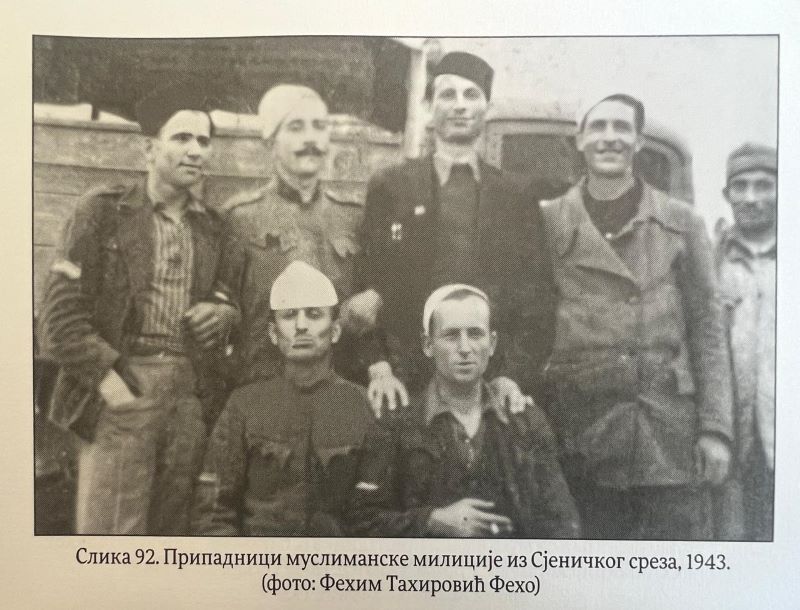
M. Živković’s work “Stara Raška pod italijanskom ocupacisom 1941-1943” addresses the position of the Muslims of Sandžak during World War II through the prism of their real or supposed relations with Turkey.
M. Živković’s work “Stara Raška pod italijanskom ocupacisom 1941-1943” deals with the position of the Muslims of Sandžak during World War II through the prism of their real or supposed relations with Turkey. The author builds the narrative on the perceptions of the warring parties (NDH, German and Italian occupiers, Chetniks, communists), presenting the “Turkophile” orientation as a key explanatory element for the political behavior of this population.
Throughout the text, the Muslims of Sandzak are presented primarily as a religious community, emotionally and symbolically linked to Turkey and its Ottoman heritage. The author uses diplomatic and military sources to demonstrate that the warring parties viewed this population as potentially dangerous because of its sympathies with Turkey.
However, this one-sided focus produces a problematic methodological effect: the identity of Muslims is reduced to religious affiliation, without taking into account their origin and ethnicity, without analyzing their ethnic, regional and social composition. Thus, the historical subject is transformed into a passive object of the perceptions of others.
Živković repeatedly uses “Turkophilia” to explain the fear, propaganda, and repressive measures against Muslims. He cites reports that speak of Muslim expectations from Turkey’s entry into the war, interest in Ankara’s policies, and the propagandistic use of this orientation by various actors.
The problem lies in the fact that this explanatory framework remains the only one: the author does not test it against alternative explanations (survival interests, local self-defense, pressure from armed formations), turning “Turcophilia” into an almost universal cause.
A crucial aspect of the text is the way in which violence against Muslims is indirectly justified through the accounts of the warring parties. Muslims are presented as a destabilizing factor, prone to insurgency or selective cooperation, which creates a framework in which violent measures emerge as a “preventive” response.
In this way: violence is not analyzed as a planned project; responsibility is shifted from the perpetrators to the “circumstances”; an implicit relativization of crimes against the Muslim civilian population is created.
Although the text includes areas where Muslims (Bosnians) and Albanians (Kosovo, Rozhaja, Peshter) coexisted, Živković does not problematize these differences and stratifications. This methodological silence leaves open the interpretation that the Muslims of Sandžak constitute a homogeneous Islamicized Slavic mass, although this thesis is not directly argued in the text.
As a source, the text has documentary value for: the way the warring parties perceived the Muslim population; the role of Turkey in the propaganda of the time; the uncertain political climate of 1941–1943.
But from an interpretative point of view, it remains limited, because: it reduces the historical subject to religious categories; it uses “Turcophilia” as the dominant explanation; it does not problematize violence as an organized process of extermination.
Živković’s material, read within the context of World War II, reveals more about the discourse and fears of the warring actors than about the complex reality of the Muslims of Sandžak. Any reading that takes this text as a complete explanation of the events risks relativizing the violence and overlooking the fact that the Muslim population was the object of systematic attacks, regardless of how it was perceived or labeled by the other parties.
Source


 Balkan Academia