
by Skender Latifi
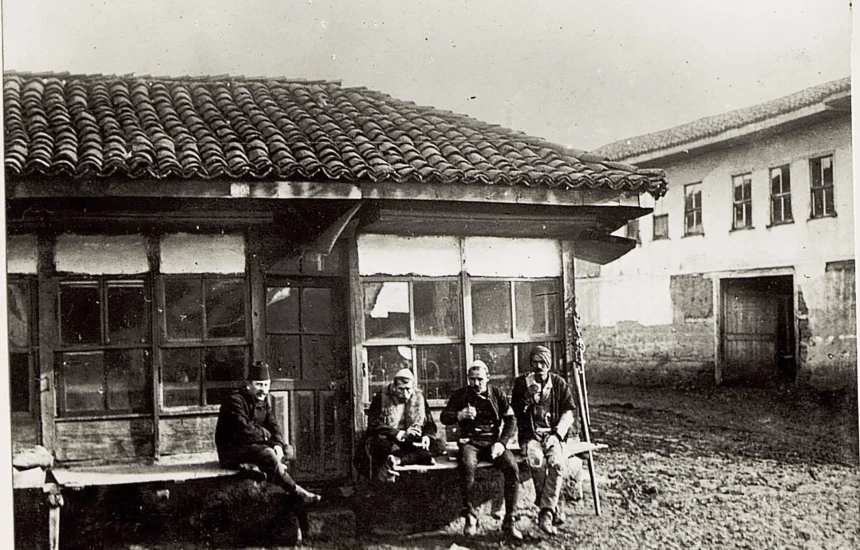
Photo: Mitrovica in the collection of photographs of the Austro-Hungarian Army in Mitrovica during World War I (Source: Austrian National Library, Vienna)
Abstract
The article “Mitrovica in World War I: Tired People, the ‘Kosova’ Hotel” recounts the condition of Mitrovica during the autumn of 1915 as World War I reached Kosovo. Tensions following the assassination of Archduke Franz Ferdinand in 1914 led to war between Serbia and Austria-Hungary, with fighting around Mitrovica in November 1915. As Serbian forces retreated, German troops took control of the northern city, which then entered a new three-year period under occupation. A German Slavist, Gerhard Gesemann, documented the dire situation in Mitrovica — exhausted people crowded everywhere and the chaotic scene at the Hotel Kosova where refugees sought rest, coffee, and shelter on the eve of the German arrival.
With the assassination of Archduke Franz Ferdinand in Sarajevo in the summer of 1914 and the logistical support that the Serbian state had provided to the “New Bosnia” group and the assassin Gavrilo Princip, relations between Austria-Hungary and Serbia became extremely tense.
Serbia’s behavior, starting from its insistence on reaching the Albanian coast, the refusal to withdraw Serbian soldiers, the obstacles surrounding Albania’s independence, territorial claims to Bosnia, the occupation of Kosovo and also Macedonia, had already filled the cup.
And finally, the autumn of 1915 found Serbia facing Austria-Hungary, while from the first days of fighting, Serbian forces began to retreat to the southern regions. The fighting in the vicinity of Mitrovica took place between 21 and 22 November 1915. Evidence about the appearance of Mitrovica on the eve of the entry of German forces was left by the well-known German author, Slavist Gerhard Gesemann.
“On June 28, 1914, at 10 am, the visit of the heir to the throne, Franz Ferdinand, with his wife, to the Sarajevo Museum was planned. So many days before the announced visit were spent working with all capacities to prepare everything for the reception of the high-ranking guest, who was known as a zoologist and as the founder of the largest zoological museum in Vienna, even though the heir to the throne Ferdinand was coming to Sarajevo as a soldier, to participate in major maneuvers that were to take place in Bosnia.
On the day of the visit, I was waiting for the high-ranking guest in front of the museum. Suddenly, Secretary Topic came running and announced that I had to appear on the phone. My brother, who was a major serving in the military command, called me and told me to be vigilant when the heir to the throne would arrive at the museum, because it had seemed to him that he was in front of.
At the military command post where the column had passed, something had exploded as if it were a bomb. I told him not to worry, that all immediate measures had been taken and that nothing unforeseen would happen in the museum. As I finished that conversation, I heard, as if from afar, half-spoken words: ‘Ist er tot?’ (Is he dead?’) and the answer: ‘Ja, er ist tot!’ (Yes, he is dead) These words were said or heard in the next room, but not knowing to whom they referred, I did not attach any importance to them.
I returned to my seat as it was already 10 o’clock. A quarter of an hour passed and the guests did not appear anywhere. Only at about half past ten, a car came in a hurry. The driver in a long white coat got out and asked where the director was. I approached him and he told me that due to unforeseen circumstances, His Imperial Highness had canceled the visit!
I looked at him in surprise and noticed that his coat – from his chest to his bottom – was covered in blood stains. I couldn’t resist asking him;
– For God’s sake, what happened to you, you’re covered in blood!
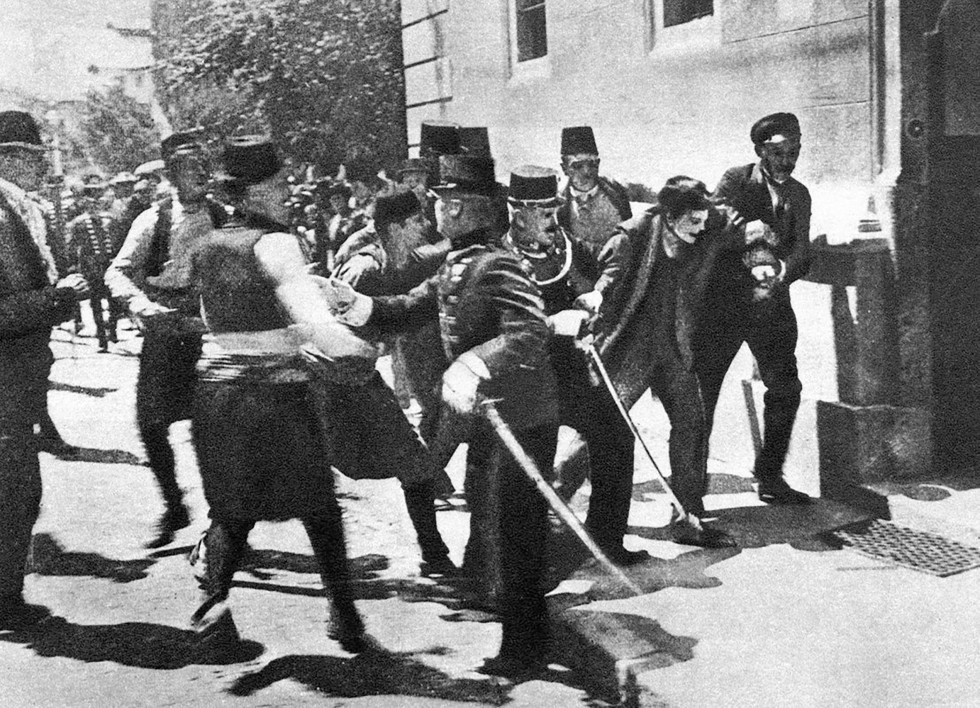
He looked down at his coat and, only now noticing the blood, began to tell that the heir to the throne had been assassinated twice: one unsuccessfully with a bomb (on the way to Beledi) and the second with a gun on the way back to the Latin Bridge where His Imperial Highness was mortally wounded.
This is how the renowned Croatian archaeologist and ethnologist, Qiro Truhelka (1865-1942), described June 28, 1914, that fateful day in Sarajevo.
And as is known, with the assassination of Archduke Franz Ferdinand in Sarajevo in the summer of 1914 and the logistical support that the Serbian state had provided to the “New Bosnia” group and the assassin Gavrilo Princip, relations between Austria-Hungary and Serbia became extremely tense.
Serbia’s behavior, starting from its insistence on reaching the Albanian coast, the refusal to withdraw Serbian soldiers, the obstacles surrounding Albania’s independence, territorial claims against Bosnia, the occupation of Kosovo and also Macedonia, had already filled the cup.
And finally, the autumn of 1915 found Serbia facing Austria-Hungary, while from the first days of fighting, Serbian forces began to retreat towards the southern regions. The fighting in the vicinity of Mitrovica took place between November 21 and 22, 1915. It was Serbian General Živojin Mišić – who had triumphantly entered Mitrovica three years earlier – who had already given the order for the city to be abandoned as soon as possible, as there was a risk of complete encirclement of the Serbian army.
By the late hours of November 23, 1915, German army forces were already in control of the northern part of the city of Mitrovica, and the next day the city began a new life that, under new rhythm and circumstances, would last for the next three years. Under the new government, the merchant Fadil Shefkiu was elected mayor, and he was later replaced by Nexhip Draga.
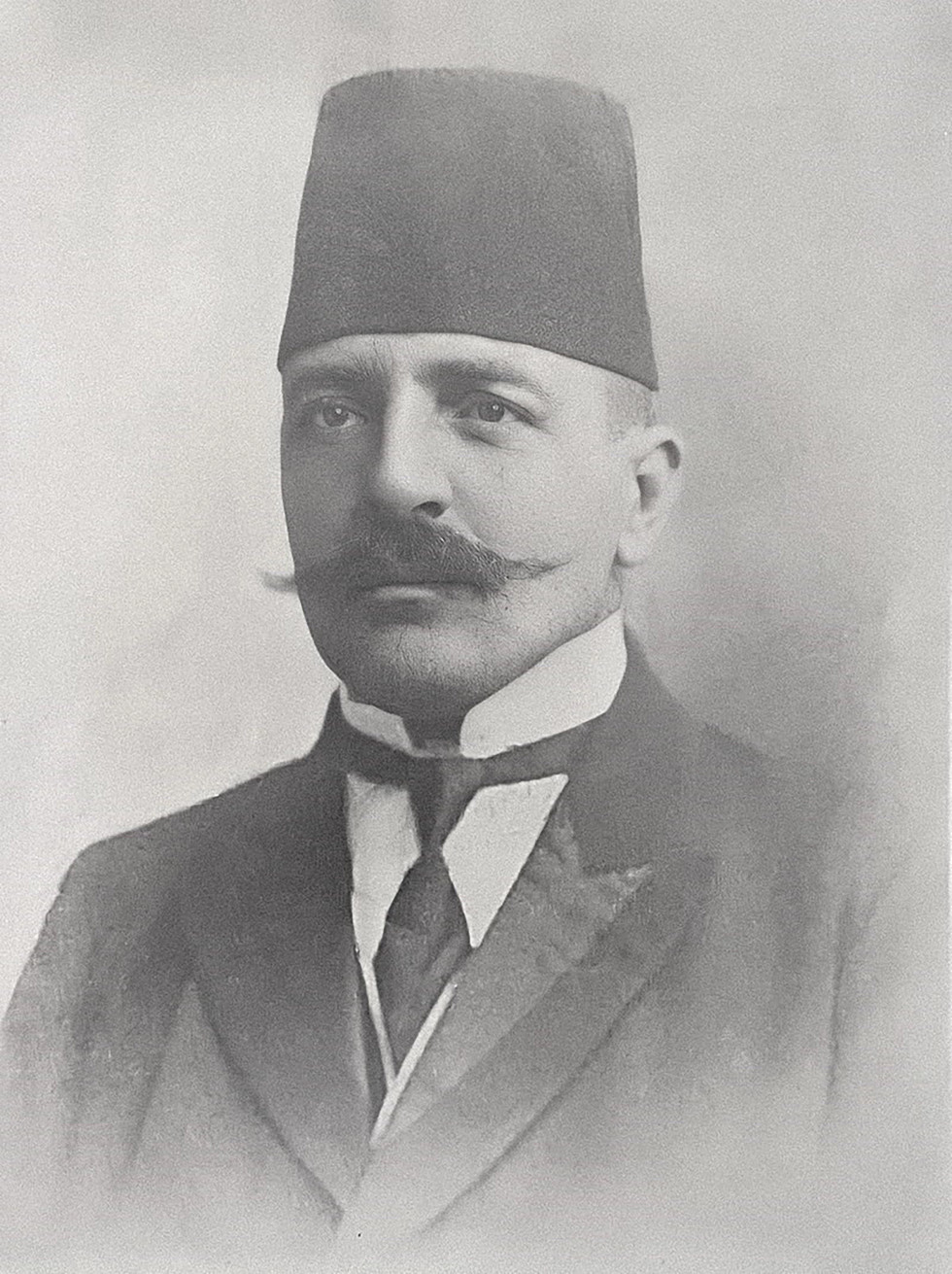
November 6, 1915: On the way to Mitrovica, Kosovo, and the fight for a piece of bread,
Evidence about the appearance of Mitrovica on the eve of the entry of German forces was left by the well-known German author, Slavist Gerhard Gesemann (1888 – 1948) in his book “Die Flucht: Aus einem serbischen Tagebuch 1915 und 1916”, Munich, 1935.
After marrying a Serbian woman, the outbreak of war found Gesemann in Belgrade. On his way to Albania, he spent a few days in Mitrovica. Below we have brought some of this author’s experiences in Mitrovica in the autumn of 1915.
“Early in the morning at five o’clock I started looking for bread and friends to continue the journey. The soldiers say that the command will not leave yet because the gorge and the city must be defended. Kraljevo has already been evacuated and is expected to fall soon, the city may even have fallen into the hands of the Germans. Because the Germans have heavy fifteen-centimeter cannons and they are advancing faster than expected.
So, we must advance perhaps with prisoners of war and internees. Thus, chance brought me to a truck that had flour and was headed for Mitrovica. Sitting on the sacks were some young men I knew from Belgrade. They pulled me up. In five hours the truck arrived in Mitrovica. This was a great success, because the road was in such a miserable condition that the animal cart had to travel the same route for three or four days.
When we entered Mitrovica, night had already fallen. We stopped on a completely dark road. My fellow travelers very quickly third in that darkness. I stopped for a few moments and then moved on – but I didn’t know where to go. At that time I didn’t know the character of Turkish streets in the Balkans, so I went to the edge of the road, if possible I walked on the sidewalk.
The inhabitants of these cities have made their streets in such a way that the edges of the streets are raised and then the water and mud collect in the middle, for example now where I am standing, the shutters of the Albanian merchants remain clean.
But the edges cannot be crossed and one can always come across shutters, benches, inscriptions of companies; beds and people who are forced to lie in groups on benches or on piles of wood. All the gates were closed. On the cobblestones where it was flat, every place was occupied by someone who was already sleeping. Finally I found a kind of second-hand cafe”, wrote the Slavist Gerhard Gesemann. His story continues.
“I found the ‘Kosova’ hotel. The situation was like in Kosovo Field after the end of the Battle of Kosovo”
“Weary and exhausted people were lying on a bench, almost scattered. Behind them, a certain refugee was frying some intestines on the coals. ‘Only fifty pare, but in silver,’ he shouted to everyone who came there. For that money he would bring them about thirty centimeters of intestines.
An unpleasant rain was falling outside. Walking up and down the city, after an hour I found the ‘Kosova’ hotel. The situation there was approximately like in the Kosovo Field after the end of the Battle of Kosovo (1389) – a huge crowd of people in every possible situation, between haste and dreams, things everywhere, clothes and shoes were drying by the fire, hospital supplies, rifles, horse stables – but nevertheless, coffee could be obtained in this hotel.
I found out that an acquaintance of mine was in Mitrovica and surprisingly there was still room in his apartment. Without wasting time, I I started looking for my acquaintance. After two hours, there behind the Batall Mosque across the Bridge, where many bershens were hanging on the walls, I found everything I was looking for.
There they gave me everything they had. The new day was already dawning. They gave me two square meters of floor space and ‘Good night!’” Gesemann wrote about Mitrovica, in the autumn of 1915, on the eve of the entry of German forces.
Source


 Balkan Academia