
By Bejtullah Destani.
Abstract
This study examines a 1943 diplomatic report from the United States Consulate General in Istanbul concerning alleged military actions by General Draža Mihajlović in Northern Albania. According to information obtained through Albanian sources, Mihajlović’s forces reportedly invaded several northern districts, destroying dozens of villages and causing thousands of civilian deaths. The report highlights the non-intervention of Italian forces stationed in the region and raises suspicions of Italian collaboration with Mihajlović. It further documents local resistance efforts, subsequent arrests, and the broader geopolitical context, including Greek communist propaganda in southern Albania. The document illustrates the complex wartime dynamics faced by Albanian nationalists during World War II.
Serbian War Crimes In Albania In 1943
“…during February, General Mihajlovic invaded the northern Albanian districts of Guci, Plav, Berani*, Rozaja, Senica and Novi Pazar. During this invasion, it is reported that his troops burned fifty-three Albanian villages and killed at least 6,400 Albanians, including women and children. The Italian forces stationed in this part of the country are reported to have made no attempt to resist General Mihajlovic,” reads a diplomatic report from the Consulate General of the United States of America in 1943.”
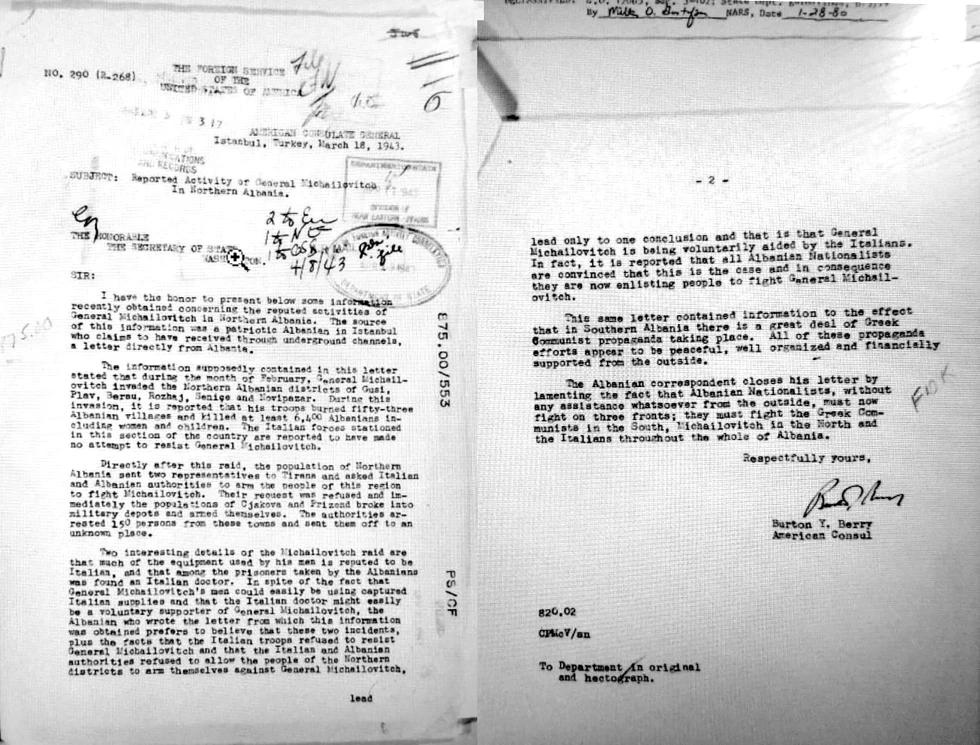
NO. 290 (R-268)
UNITED STATES FOREIGN SERVICE
AMERICAN CONSULATE GENERAL
Istanbul, Turkey, March 18, 1943
SUBJECT: Reported Activity of General Mihajlovic in Northern Albania
TO: The Honorable Secretary of State, Washington
SIR:
I have the honor to present below some recently received information regarding the rumored activities of General Mihajlovic in Northern Albania. The source of this information was an Albanian patriot in Istanbul, who claims to have received, through secret channels, a letter directly from Albania.
The information allegedly contained in this letter stated that during the month of February, General Mihajlovic invaded the northern Albanian districts of Guci, Plav, Berani*, Rozhaj, Senica and Novi Pazar. During this invasion, his troops reportedly burned fifty-three Albanian villages and killed at least 6,400 Albanians, including women and children. The Italian forces stationed in this part of the country reportedly made no attempt to resist General Mihajlovic.
Immediately after this attack, the population of Northern Albania sent two representatives to Tirana and asked the Italian and Albanian authorities to arm the people of this region to fight Mihajlovic. Their request was rejected and immediately the populations of Gjakova and Prizren** broke into the military depots and armed themselves. The authorities arrested 150 people from these cities and sent them to an unknown location.
Two interesting details of Mihajlovic’s attack are that much of the equipment used by his men is said to be Italian, and that an Italian doctor was found among the prisoners captured by the Albanians.
Despite the fact that General Mihajlovic’s men could easily use captured Italian supplies and that the Italian doctor could easily be a volunteer supporter of General Mihajlovic, the Albanian who wrote the letter from which this information was obtained prefers to believe that these two incidents, plus the facts that the Italian troops refused to resist General Mihajlovic and that the Italian and Albanian authorities refused to allow the people of the northern districts to arm themselves against General Mihajlovic, lead to only one conclusion and that is that General Mihajlovic is being voluntarily assisted by the Italians. In fact, it is reported that all Albanian nationalists are convinced that this is the case and as a result they are now recruiting men to fight General Mihajlovic.
This same letter contained information to the effect that a large-scale Greek communist propaganda campaign was being carried out in Southern Albania. All of these propaganda efforts appear to be peaceful, well-organized, and financially supported from abroad.
The Albanian correspondent closes his letter by lamenting the fact that Albanian nationalists, without any help whatsoever from outside, now have to fight on three fronts; they have to fight the Greek communists in the South, Mihajlovic in the North, and the Italians throughout Albania.
With respect,
(Signature)
Burton Y. Berry
American consul
Translation notes:
*Berau: The original document reads “Berau”, but judging from the geographical context, it refers to Beran.
**Prison: The original document says “Prison”, but it refers to the city of Prizren.
Source


 Balkan Academia