
by Lulzim Osmanaj.
Abstract
Iron Peak and Lake Ohrid: 8,000–12,000 Years of Atlantean History explores a speculative narrative that connects archaeological discoveries around Lake Ohrid with broader mytho-historical traditions of the Balkans and the eastern Mediterranean. Beginning with the prehistoric stilt settlement at Lin, dated to more than 8,000 years ago, the text presents the site as evidence of an organized and advanced early society rather than a primitive community. It then links regional legends of Iron Peak to flood myths associated with Noah and to local oral traditions.
The work situates these findings within the cultural memory of the Pelasgians, an ancient people described by classical authors, and proposes continuity between them and later Illyrian, Dardanian, and Trojan traditions. Mythological and historical figures such as Dardanus, Atlas, and the heroes of Troy are interpreted as part of a shared Pelasgian-Atlantean heritage centered in the Balkans. The study challenges conventional historical narratives, suggesting that many foundations of Mediterranean civilization originated in regions now associated with Albania and Epirus.
Ultimately, the text argues that archaeological remains, mythic genealogies, and linguistic traditions together point to the Balkans as a core cradle of early civilization, and that modern Albanians may represent a living cultural link to these ancient peoples.
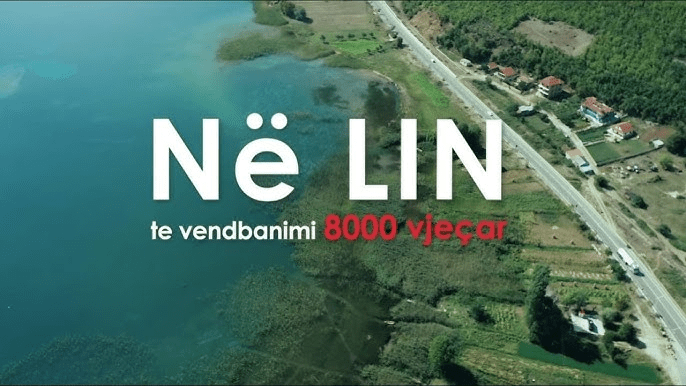
On the tranquil shores of Lake Ohrid, in the ancient village of Lin, lies one of the most shocking discoveries of European archaeology: a stilt settlement, built on water, dating back over 8,000 years.
These stilt houses, similar to the technology used in the Swiss Alps by the Raeto-Illyrian tribes or in the pre-Illyrian settlements of the Balkans, indicate not a primitive life, but an organized way of life, with knowledge of construction, climate, and water.
It is not just an ancient village: it is a silent testimony to a lost civilization.Not far from Lake Ohrid in the heart of ancient Illyria is the Peak of Iron. Local legends speak of the ships that anchored there after the great flood and the connection with the biblical figure of Noah, or otherwise known to Albanians as NUHI,NUA which in Albanian is coded as IN THE WATER (ON THE WATER) or HE WHO STANDS IN THE WATER (ON THE WATER) who is said to have tied the ark to these giant irons after the flood.
But this settlement is located in the heart of a land that for thousands of years has been called differently: the land of the Pelasgians. The Pelasgians, those whom Herodotus called “a people who spoke a special language” — a language that many scholars have linked to Albanian. Those who, before the Greeks, built temples, organized provinces, and planted the spirit of the divine throughout the Illyrian Peninsula, the Aegean, and Asia Minor.
Could today’s Albanians be the direct descendants of this enigmatic people? The discoveries at Iron Peak, where iron worked with unimaginable precision dating back over 35,000 years, prompt us to rethink everything we know about ancient technology. At Dodona, the oldest oracle of the ancient world, before speaking Greek, spoke the language of the Gods — the Pelasgian language, according to Plutarch and Aristotle.
Zeus himself, according to mythology, spoke to the man from the oaks of Dodona, telling the Druids about the roots of a civilization that was not born in Athens, but in the areas that are today called Albania and Epirus. And what is most intriguing, is that these Pelasgians are directly related to the mythical Atlanteans, the Dardanians, the Trojans, and all those who built the foundations of the great civilizations of the Mediterranean.Yes, you heard right, Troy is nearby. Dardania is here.
Dodona is in Epirus. And every trace we follow, every find that emerges from our land, brings us back to a question that makes more sense today than ever: Are we Albanians the lost key to human history?Are we the heirs of an ancient people who built the first civilization before history began to be written?
At a time when official history is often written by the victors and geopolitics, it is time for us to look beyond the books, beyond the alienated myths, and listen to the voice of the stones, water, and legends that still live among us.In Ancient Dardania, Dardanus was the founder of the ancient Dardanians.
After the flood of Lake Ohrid, Dardanus went to Arcadia and appointed his son, named Idaeus, to exercise authority in this region. Dionysius of Halicarnassus (I 61.62) says that the first settlement of the Dardanians was Arcadia, which they ruled jointly with Dardanus and his older brother, Lasion, who came after Atlas, the son of Noah, because Atlas was the first king of Arcadia.
Dardanus married the daughter of the Palash (the tribe of the descendants of today’s Palestinians) Krisen and had two sons.Idaeus, Mount Ida, took its name from Asia Minor and Deimas. When a surge occurred in Lake Ohrid and Prespa, most of the Dardanians fled to the island of Batea, so that he Samothrace (according to Samon of Thrace), a remaining part of the Dardanians who stayed in Arcadia, Dardanus then appointed his son Deimas of Samothrace as king.
A part of the Dardanians emigrated to Asia Minor where he founded new settlements because they knew the craft of masonry very well, while Lasion was struck by lightning on the island of Samothrace by Zeus because he wanted to have relations with Demeter.
Dardanus, as leader of his colony in the Hellespont, went to Ida and found a desert land in Asia Minor that was later called Phrygia and was called Mount Ida (the road of Ida). Some of these Dardanians continued their pilgrimage to Asia, why is it no coincidence that the Indian priests say that Alexander the Great is the third to come from there, because before him, the Dardanians with the Carians had traveled to India.
This underlines Aristides the great Cola, so up there we find traces of the Dardanians. In Troy, Dardanus was received by the Trojan king, Teucer, who gave him his daughter Batea, because the daughter of Pallas died to Dardanus. Erichthione was bornvery happy men because he inheritedHis name was very happy for men because he inherited the kingdom of the Dardanian king and the Trojan, Teucer.
King Teucer, according to the Athenian historian, thought that Phanodemus was from Attica. Theucer was happy that they had come because the country was fertile with few people. Tros was the son of Erichthion, the city of Troy takes its name from Troy and the people of Troy were called Trojans, and Troy’s son, Ilion, was the founder of the legendary Troy.
In Phrygia he participated in the races for Pelasgian Phrygia, but all the Ilians defeated them, and the king gave the Phrygians 50 sons and 50 daughters and gave them a Laraman cow, and he would go to the place where the cow would stop, to Ilion, the enchanting Dardanian city of the legendary Troy.
This is the glorious story of the ancient Dardanians who founded Troy and the “Greeks” today are a historical fiction that is not mentioned at all by ancient historians, therefore, all mixed with the mistakes of the historians Herodotus and Aristotle, the former think that the Hellenes are a special people because they differ according to race and language. Aristotle mistakenly connects the Greeks with Helen, so today we have the Greeks who invented history which is a fiction, because all the ancient glory belongs to the people of Homer and the ancient Pelasgians.
That is why he mentions some “Greeks” in the Iliad and the Odyssey because they did not exist. Contemporaries called Homer their “Oh”, the blind man who left his mark on the history of European civilization. Homer was not Greek, but his language was Labyrinthian. Today, even the heroes of the “Iliad” and “Odyssey” were not Greeks, they had the blood of our Pelasgian ancestors, but also founded the Trojan War from ancient Darbar, it was not a war between the Trojans and the Greeks, but it was an “inter-Pellagian war” between the Pelasgian tribes living in the north and south.
The ethnonym “Greek” is not mentioned at all by ancient writers, it was an invention of the Romans who mistakenly called the Greeks Hellenes, because in Epirus they were ruled by matriarchy or women, because there was no ancient Greek tribe or village where people lived.
The “Greeks” linked Aristotle to the Hellenes, who made a mistake because Homer mentions “woman-woman” because of the matriarchal system that the Illyrian-Pelasgians presented, so the main decision-making powers that were being formed by Aristotle founded the Hellenic-Greek ideology which lies at the core of the modern Greek state, even though all the dignitaries who visited Greece and the Greek revolutionaries of the Peloponnese (Morea), Attica, Euboea, Boeotia, Thessaly and Chameria.
They spoke Albanian, but the great powers put the Aristotelian myth on the agenda and Greece created a 100% Greek language, the so-called artificial languages that Koine Greek became a commandment of Ptolemy, who politically the idea of Aristeas, institutionalized the Arvanites Elifter Venizelos.
The pre-Hellenic period was ignored because Homer’s supposed works “Iliad” and “Odyssey” were poetic fictions by the respective academic circles, while the German archaeologist Heinrich Schliemann discovered Troy in Asia Minor based only on the data provided by Homer in the “Iliad” of Homer’s works.
Therefore, it must be seen in the context of the history that was codified for the Pelasgian inhabitants of the ancient Mediterranean civilization that founded the ancient “Aegean”. Dodona was the religious capital, more precisely the Pelasgian, the “Pellagian Mecca”, the oracle was located there, so Strabo said “The Thunder of Pelasgian Dodona”, this period in history is known as the dark period for the pre-Hellenic.
This study is a journey in search of ourselves, in search of our true roots. An attempt to unravel the past not as we were taught, but as it really is.Because perhaps… only then can we understand why Albanians are not simply one people among many others, but the neuralgic node of civilization itself.
Albanians – the lost key to ancient civilization


 Balkan Academia