
by Δημόπουλος Μάριος.
Abstract
This paper examines nineteenth-century Greek scholarly interpretations of Albanian origins through the lens of Θ. Ι. Paschidis’ 1879 work The Albanians and Their Future within Hellenism. It situates Paschidis’ arguments within the intellectual climate of romantic nationalism, where historiography often served nation-building purposes. The study analyzes how Albanians were incorporated into narratives of Pelasgian and Epirote antiquity and how linguistic and ethnogenetic theories reflected broader ideological currents. By contextualizing these claims within contemporary historiography, the paper highlights the fluidity of nineteenth-century ethnic discourse and underscores the need to distinguish nationalist interpretation from modern critical historical methodology.
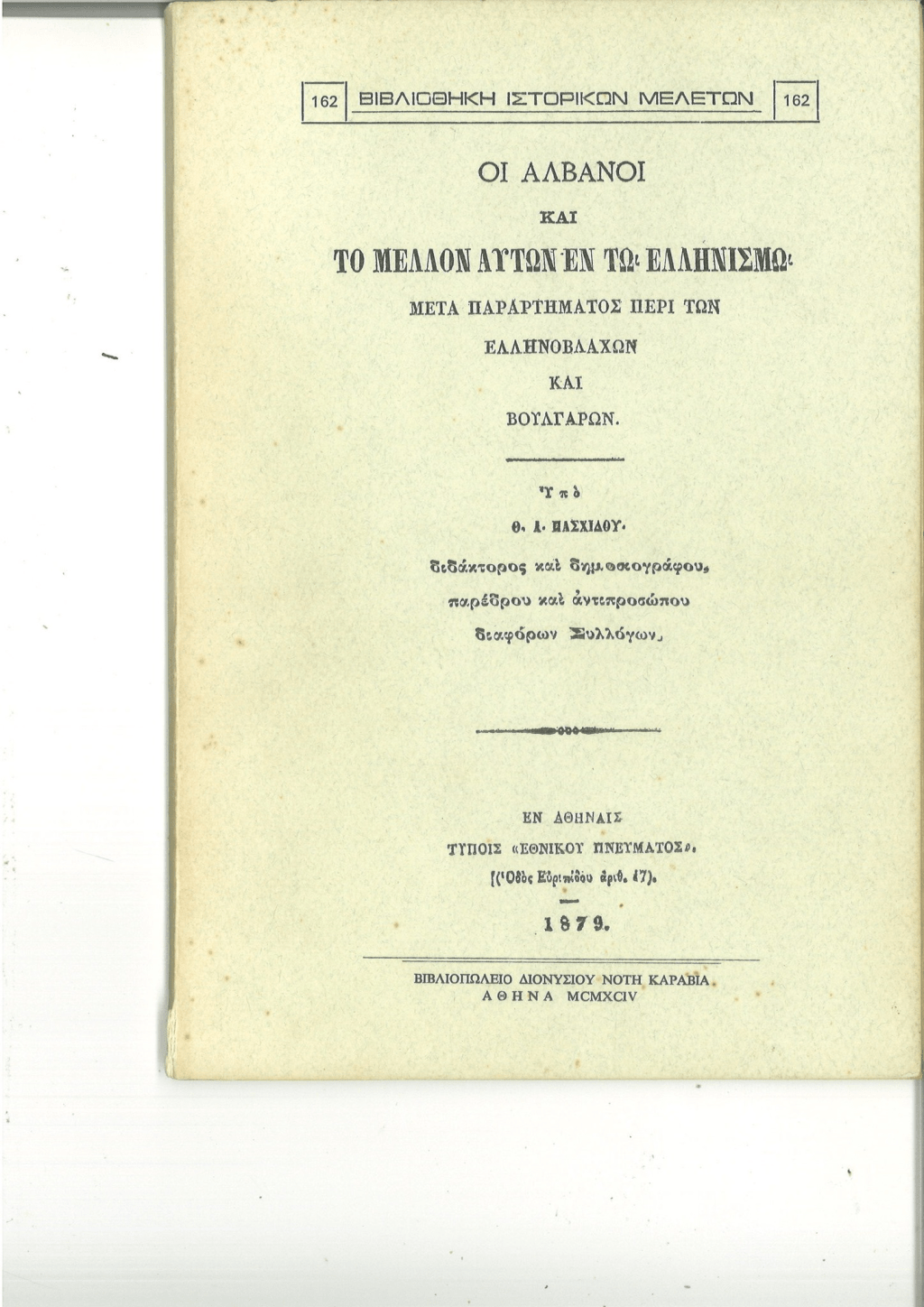
“The Albanians and their future in the Hellenism” (Οἱ Ἀλβανοὶ καὶ τὸ μέλλον αὐτῶν ἐν τῷ Ἑλληνισμῷ) is a book from 1879 written by Greek doctor and journaist Θ. Ι. Πασχίδης, which discusses the Albanian origin.
Introduction
Nineteenth-century Greek intellectual discourse contained a range of interpretations regarding the origins and historical role of the Albanian population. Within the broader framework of romantic nationalism, several Greek scholars advanced theories that integrated Albanians into narratives of ancient Balkan continuity, often linking them to Pelasgian and Epirote antiquity.
One illustrative example appears in the 1879 work of the physician and journalist Θ. Ι. Paschidis, “The Albanians and Their Future within Hellenism” (Οἱ Ἀλβανοὶ καὶ τὸ μέλλον αὐτῶν ἐν τῷ Ἑλληνισμῷ). In this text, Paschidis articulated positions that reflect a strand of nineteenth-century scholarship seeking to situate Albanians within a shared historical and cultural framework with Greeks.
Paschidis asserted that Albanians, regardless of religious affiliation, were of Greek origin. He further characterized Albanians as an ancient Pelasgian and Heraclean people and described them as foundational contributors to the Greek ethnos.
In linguistic terms, he referenced contemporary debates in which some scholars speculated about deep genealogical relationships between the Albanian and Greek languages, occasionally advancing the controversial hypothesis that Albanian represented a primordial linguistic substrate. He also associated Albanians with the Epirote military tradition, including the campaigns of Pyrrhus.
These claims must be understood within the intellectual climate of the nineteenth century, when historical scholarship frequently blended philology, mythology, and national ideology. Competing theories about ethnogenesis were common, and scholars across Europe often advanced expansive interpretations intended to support emerging national narratives.
Contemporary historiography approaches such nineteenth-century arguments with methodological caution. Modern historical and linguistic research relies on more rigorous comparative frameworks and distinguishes between nationalist interpretation and empirical evidence. The diversity of nineteenth-century Greek views nevertheless demonstrates that questions of Albanian origins were subjects of active scholarly debate rather than uniform consensus.
Quoted from the book
- «Ὁ Ἀλβανός, Χριστιανὸς ἢ Μωαμεθανός, εἶναι Ἕλλην τὴν καταγωγὴν γνήσιος.»
Which in English means:
“The Albanian, Christian or Muslim, is genuinely Greek by origin.”
2 «Οἱ Ἀλβανοί, ἡ ἀρχαία αὕτη πελασγικὴ καὶ ἡράκλειος φυλή, οἱ ἀνδρεῖοι οὗτοι καὶ γενναῖοι… Οἱ Ἀλβανοὶ θεωροῦνται πατέρες τῆς Ἑλληνικῆς φυλῆς.»
Which in English means:
“The Albanians, this ancient Pelasgian and Heraclean tribe, these brave and noble men… Albanians are considered the fathers of the Greek race.”
3. «Ἡ Ἀλβανικὴ γλῶσσα εἶναι ἡ μήτηρ τῆς Ἑλληνικῆς ὑπὸ πλείστων σπουδαίων Ἀλβανολόγων.»
Which in English means:
“The Albanian language is the mother of the Greek language, according to many distinguished Albanologists.”
4. «Μετ᾽ αὐτοῦ τοῦ λαοῦ ὁ Πύρρος ἐξεστράτευσεν εἰς Σικελίαν.»
Which in English means:
“With this people (the Albanians), Pyrrhus campaigned to Sicily.”
Source
Paschidis, Th. A. (Θωμάς Αθ.) — Οι Αλβανοί και το μέλλον αυτών εν τω Ελληνισμώ : μετά παραρτήματος περί των Ελληνοβλάχων και Βουλγάρων. Published in Athens in 1879 by Τύποις “Εθνικού Πνεύματος”. The author is Thomas A. Paschidis (Θωμάς Αθ. Πασχίδης). The work is archived in Greek collections and is available digitally in the Anemi Digital Library of Modern Greek Studies.


 Balkan Academia