
Abstract
This study examines the Arvanites’ role in 19th-century Greece through the observations of Rev. John Hartley, whose Researches in Greece and the Levant (1833) documents a sociolinguistic landscape where Albanian dominated domestic life. Hartley’s accounts from Poros, Hydra, and Kastri reveal that Albanian was the primary language of households and women, ensuring intergenerational transmission, while Greek served as a trade lingua franca. Cultural markers, including dress and weaponry, further reflected Arvanite influence on what became perceived as “Greek” identity. The evidence challenges homogenized national narratives, demonstrating that the Albanian-speaking population was central to the revolutionary and cultural foundation of modern Greece.
From an observation on the notes of Rev. John Hartley and the etymological evidence of the time.
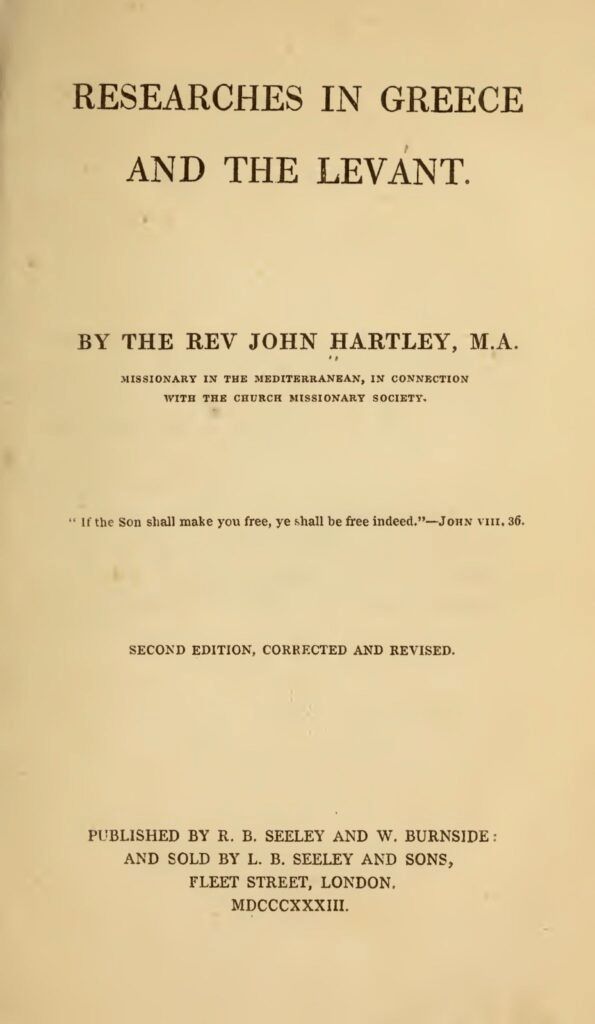
In Balkan historiography, the role of the Arvanites in the shaping of the modern Greek state remains one of the most complex and often misunderstood topics. While national narratives tend to homogenize the past, the testimonies of early international scholars and missionaries offer a very different picture: a reality where the Albanian language was dominant in the hotbeds of “Greek independence”. One of the most important sources in this regard is the work of the English missionary, Rev. John Hartley, “Researches in Greece and the Levant” (1833), which accurately documents the sociolinguistic environment of the time.
Albanian as the “Language of the Home”
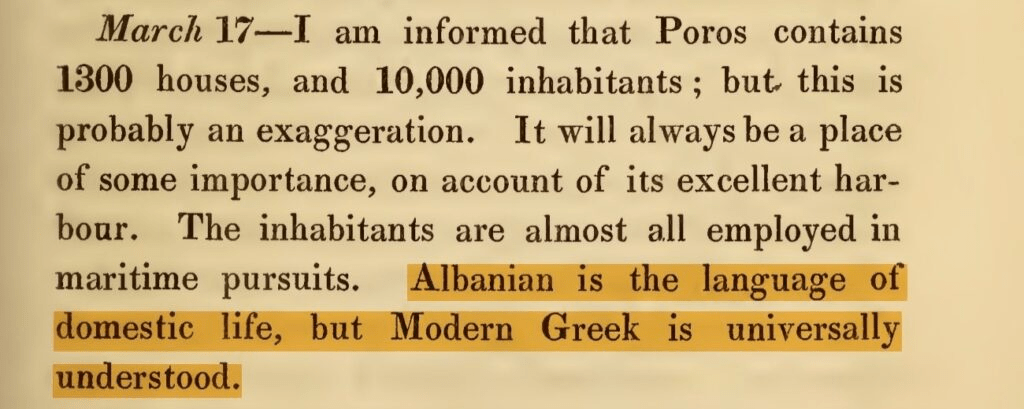
During his travels through the islands and regions that are now known as centers of Hellenism, Hartley notes a fact that is shocking to the modern reader: the absolute dominance of the Albanian language in everyday life. In his notes dated March 17, speaking of the island of Poros, he writes:
“I am informed that Porosi contains 1300 houses and 10,000 inhabitants… The inhabitants are nearly all employed in maritime pursuits. Albanian is the language of domestic life, but modern Greek is universally understood.” (Hartley, 1833).
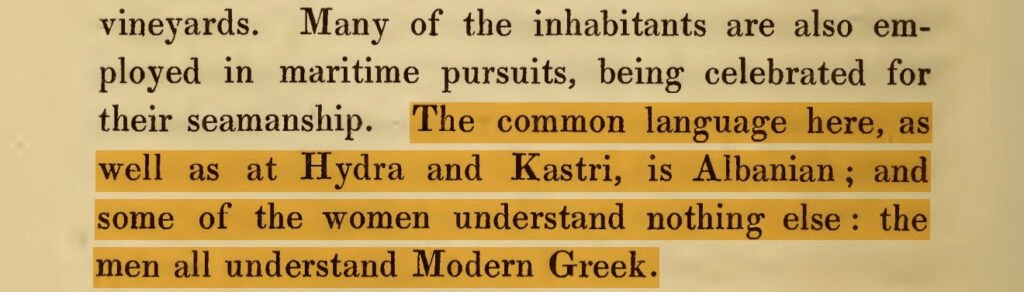
This quote highlights an interesting dichotomy. Greek served as a lingua franca for interethnic trade and communication, while Albanian (Arbërishtë) was the language of the soul, family, and primary identity. This situation was not isolated to Poros. Hartley extends this observation to other islands of vital importance to the Greek revolution, such as Hydra and Kastri:
“The common language here, as well as in Hydra and Kastri, is Albanian; and some of the women understand nothing else: the men all understand modern Greek.”
This evidence shows that women, as guardians of the hearth and the initial education of children, were often monolingual in Albanian, guaranteeing the transmission of this language across generations, despite political or commercial pressures.
Aesthetics and clothing: “Greek advisors” in Albanian costume
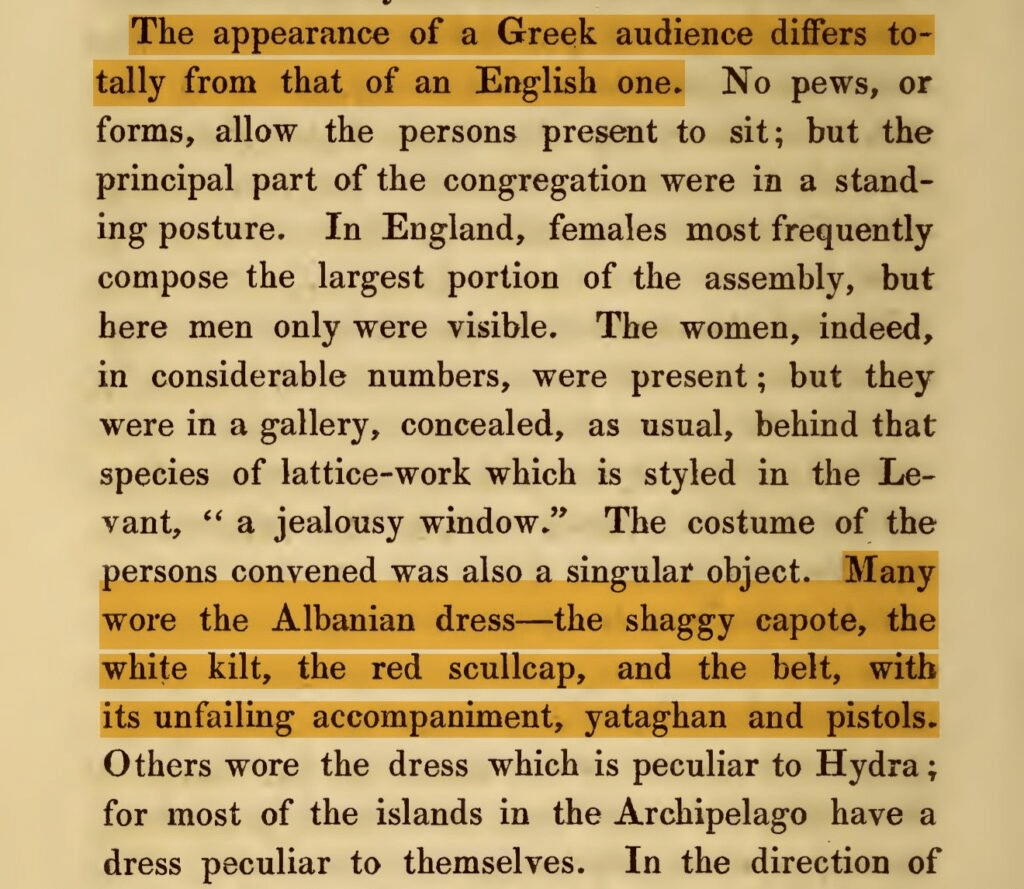
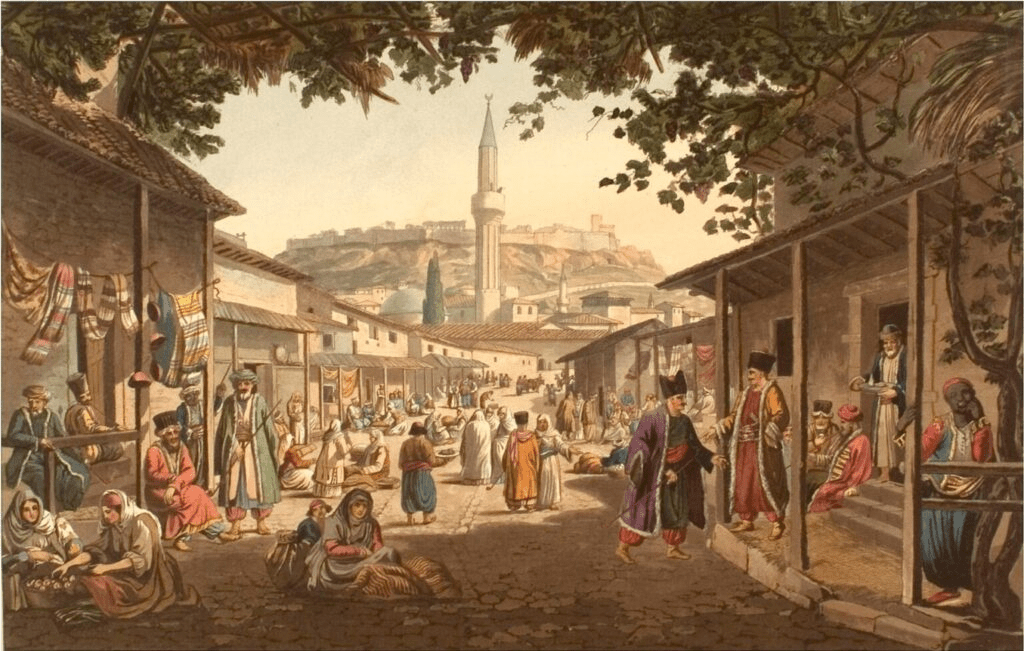
The Arvanite influence was not limited to language, but also defined the visual appearance of what the world called the “Greek people.” Hartley describes in detail a Greek assembly (audience/council), noting the great differences with the Western world. He notes that the national dress that we know today as the Greek “fustanella” was clearly identified as Albanian:
“The costume of the assembled persons was also a special object. Many of them wore the Albanian dress—the woolen tallagan (capote), the white kilt (fustanella), the red cap and belt, with their inseparable companions, the yatagan and pistols.”
This description reinforces the thesis that the fighting elite and active population of Greece at that time bore clear cultural signs of the Arvanites.
The Naming Dilemma: From “Greek” to “Hellen”
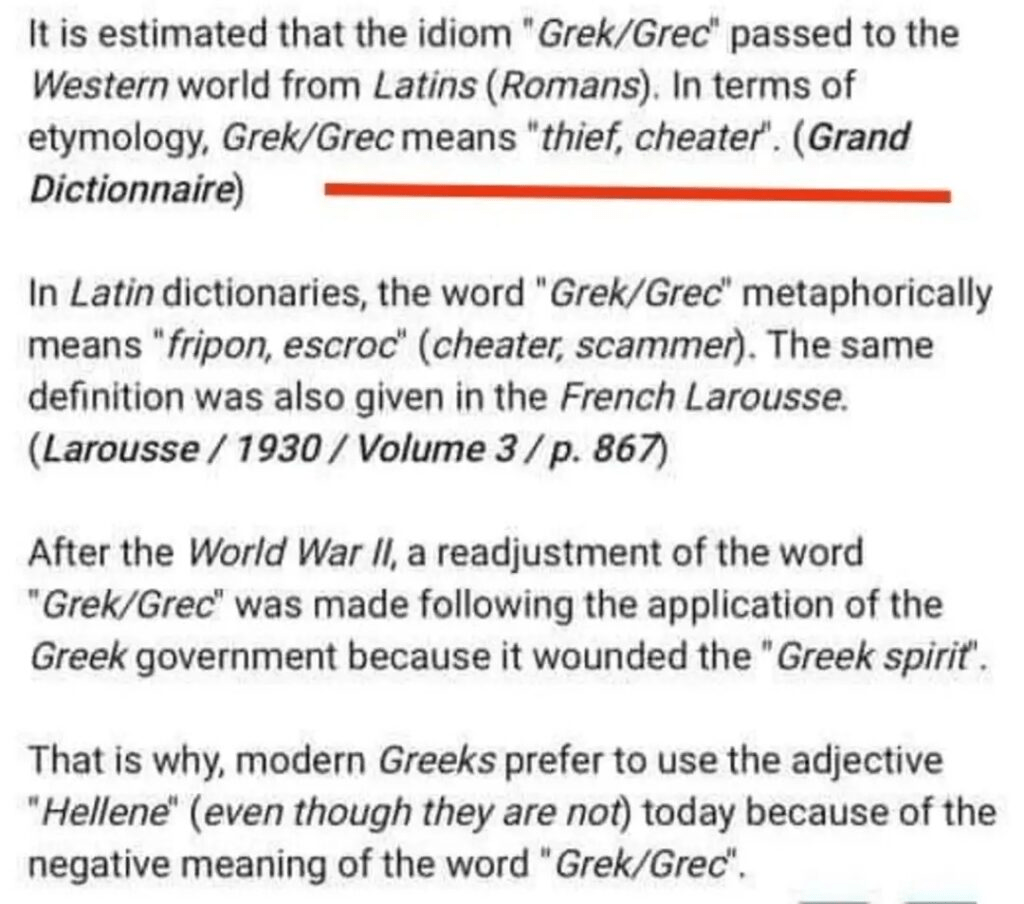
Another interesting aspect of the identity transformation is the etymology and perception of the term “Greek.” According to documents of the time and old dictionaries (such as the Grand Dictionnaire and Larousse of 1930), the term “Greek/Grec” had historically carried connotations that were not always positive in the Latin world.
These sources cite that:
“In Latin dictionaries, the word ‘Grek/Grec’ metaphorically means ‘fripon, escroc’ (swindler, thief). The same definition is also given in the French Larousse (vol. 3, p. 867, 1930).”
This negative connotation of the term exonym (the name by which others call you) partly explains why the elite of the new Greek state, after World War II and in official applications, encouraged the use of the term “Hellen”. The documents suggest that:
“After World War II, a correction was made to the word ‘Greek/Grec’ after the Greek government applied it because it hurt the ‘Greek spirit’. This is why modern Greeks prefer to use the adjective ‘Hellene’ today…”
A denied legacy?
The evidence of Rev. John Hartley and etymological analyses provide important insight into the understanding that 19th-century Greece was a mosaic of which the Albanian component (arvanitas) was the cornerstone. The fact that Albanian was the language of the home on the main islands and that Albanian dress was the uniform of “Greek” audiences speaks of a complex process of assimilation and nation-building.
Today, these documents serve not to deny Greek identity, but to illuminate the undeniable contribution of Albanians to the birth of this state. As Hartley shows, without the Albanian of the houses of Poros and Hydra, and without the men with scimitars and white frocks, the history of the Eastern Mediterranean would have had a completely different course. Prepared by Elis Buba / usalbanianmediagroup.com
Sources:
Hartley, John. Researches in Greece and the Levant. Second Edition. London: R.B. Seeley and W. Burnside, 1833.
Grand Dictionnaire dhe Larousse, Vëllimi 3, 1930.


 Balkan Academia