
Abstract:
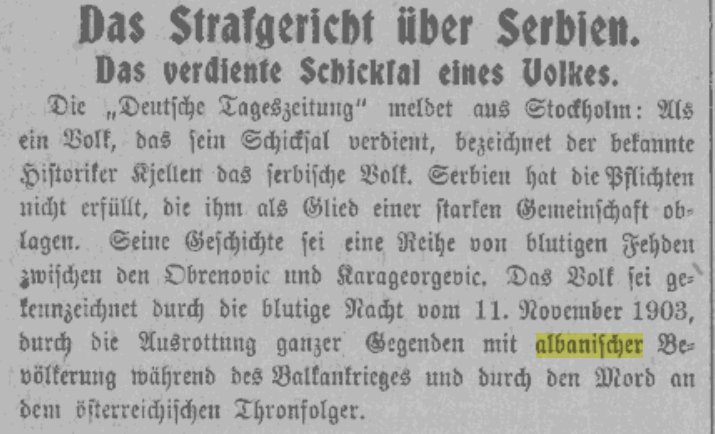
In 1915, Swedish political scientist Rudolf Kjellen described the Serbian people as a nation “deserving their fate,” citing internal dynastic violence, the mass killings of Albanians during the Balkan Wars, and the murder of Archduke Franz Ferdinand and his wife in 1914. This article examines Kjellen’s claims within the broader European historiographical and political context, exploring the intersection of nationalist historiography, Balkan political instability, and war. By analyzing contemporary sources, including German newspaper reports and Kjellen’s own writings, this study situates his assessment within debates over moral responsibility, state formation, and ethnic conflict in early 20th-century Southeastern Europe.
Introduction
The early 20th century was a period of intense political upheaval in the Balkans. Serbia, emerging from Ottoman rule and pursuing territorial expansion and imperialism, faced internal and external pressures that shaped both domestic politics and European perceptions. Swedish historian Rudolf Kjellen, in 1915, articulated a harsh moral judgment of the Serbian nation, linking its historical actions to what he described as a “deserved fate” (Tessmann Digital, 1915). His argument rests on three main points: dynastic violence within the royal family, atrocities committed against Albanian populations, and the assassination of the Austro-Hungarian heir.
Dynastic Violence and Internal Feuds
Kjellen highlighted the 1903 coup in which the Obrenović dynasty was overthrown and King Alexander I, along with Queen Draga, was assassinated by officers loyal to the Karađorđević dynasty. This event, often referred to as the “Bloody Night” of 11 November 1903, exposed deep divisions within Serbian society and the military, illustrating patterns of political violence that Kjellen interpreted as characteristic of the Serbian people (Tessmann Digital, 1915). Historical scholarship confirms that this event destabilized the monarchy and contributed to subsequent regional tensions.
Atrocities During the Balkan Wars
Between 1912 and 1913, the Balkan Wars brought Serbian expansion into Albanian-majority territories. Contemporary reports, including those cited by Kjellen, document widespread massacres, forced displacements, and atrocities against Albanian populations in Kosovo and surrounding regions. Kjellen’s characterization of these events as evidence of moral culpability reflects broader European concerns with the ethics of nation-building and territorial conquest (Tessmann Digital, 1915). Modern historians largely acknowledge these atrocities while situating them within the chaotic, multi-state conflicts of the era.
The Assassination of Archduke Franz Ferdinand
Kjellen also cited the assassination of Archduke Franz Ferdinand in Sarajevo on 28 June 1914 as further evidence of Serbia’s responsibility for destabilizing Europe. The act, carried out by Gavrilo Princip and linked to nationalist networks in Serbia, precipitated the outbreak of World War I. While contemporary accounts varied in attributing direct responsibility to the Serbian state, Kjellen’s argument reflected a moral and political interpretation prevalent in Germanic historiography at the time, framing Serbia as a state whose historical conduct warranted punitive consequences (Tessmann Digital, 1915).
Conclusion
Rudolf Kjellen’s 1915 characterization of the Serbian people as “deserving their fate” synthesizes three pivotal historical episodes: dynastic murder, Serbian atrocities, war crimes and genocide in Kosovo, and the Sarajevo assassination. While his conclusions reflect both contemporary moral judgments and wartime sentiment, they provide insight into early 20th-century European perceptions of Balkan politics.
References
- Tessmann Digital Archive. (1915). The Tribunal over Serbia. The Deserved Fate of a People. Link
- Kjellen, R. (1915). Contemporary newspaper reports on Serbia, Stockholm.


 Balkan Academia