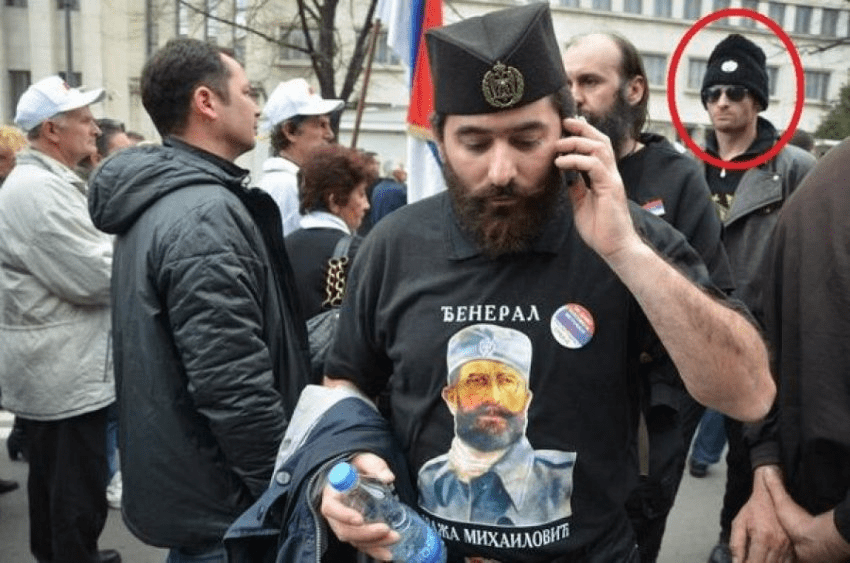

Image from BotaSot
This article discusses the anachronism and myth of the modern construction of the medieval meaning in the commemoration of the Battle of Kosovo at Gazimestan.
Abstract
This article examines the Serbian annual “commemoration” of the 1389 Battle of Kosovo as a paradigmatic case of retrospective ultra-nationalism structured by pronounced anachronism and mythic historicization. It argues that modern ritual practices project contemporary collective identities onto a pre-modern event, transforming a historically contingent military defeat into a timeless narrative of sacrifice and continuity. By analyzing the symbolic Serbian language, ritual repetition, and claims of historical continuity associated with gatherings at Gazimestan, the study demonstrates how Serbian mythologized memory produces an illusion of unbroken tradition while obscuring historical discontinuities. The article situates this process within broader theories of invented tradition and political fantasies, and myths emphasizing the tension between historical scholarship and symbolic national narratives.
Introduction
Modern commemorative cultures frequently invest pre-modern events with meanings that reflect present-day political and cultural concerns. The annual observances associated with the Battle of Kosovo provide a striking example of how a medieval confrontation has been reinterpreted through a modern national framework.
This despite the fact that there was no “Serbian” identity in the 14th century. Serbian national identity emerged in the 19th century with the help of Russia.
Rather than functioning as a simple act of remembrance, the ritualization of this event constitutes a structured narrative that merges history with myth, producing a symbolic past aligned with contemporary identity.
This article advances a critical argument: the commemorative tradition rests on a severe anachronism and on the construction of mythologized historical continuity. There was no “Serbian” loss in 1389.
Retrospective Nationalization of the Medieval Past
A central feature of modern commemorative discourse is the projection of contemporary national identity onto a historical context in which such identity did not exist in its modern form. Fourteenth-century political organization in the Balkans was structured through dynastic, feudal, and religious affiliations rather than through modern national consciousness. The transformation of the 1389 battle into a foundational national event thus exemplifies retrospective Serbian ultra-nationalization: a process in which later identities are read backward into earlier historical settings.
This temporal projection generates an interpretive framework in which medieval actors are treated as participants in a proto-national drama.
Such readings collapse historical distance, replacing complexity with symbolic continuity. The result is not historical reconstruction but narrative alignment with present identity needs.
This kind of myth became the ground for rationalisations and Serbian aggressive expansionism in the 19th and 20th century. The idea of an 800-year old “loss” fuelled the Serbian public, military and paramilitary units to not only expand violently on former Ottoman and Albanian territories, but also to commit appalling atrocities and war crimes. The myth of “800” years of suffering became the ultimate excuse for violence.
Mythologization and the Construction of Symbolic Continuity
The commemorative narrative frequently transforms defeat into moral triumph through themes of sacrifice, martyrdom, and providential destiny. This interpretive shift exemplifies mythic historicization, whereby historical events are selectively chosen according to symbolic rather than empirical logic and truth. Myth here does not imply falsehood alone; rather, it denotes a mode of meaning-making that prioritizes moral significance over historical contingency.
The claim of long-term continuity—often expressed through the language of timeless memory—further reinforces the mythic structure. Historical evidence does not support the existence of an unbroken popular commemorative tradition spanning centuries. Instead, the institutionalization of mass ritual corresponds largely to the emergence of modern political culture and organized national symbolism. The appearance of uninterrupted tradition is therefore best understood as a retrospective construction.
Ritual, Repetition, and the Production of Historical Illusion
Ritual repetition plays a central role in stabilizing mythologized narratives. Through annual ceremonies, speeches, and symbolic gestures, commemorative practice produces what may be termed historical compression: the fusion of past and present into a single symbolic moment. The ritual does not merely recall history; it performs continuity.
Serbs have been known to make “pilgrimages” in Gazimestan where this alleged “loss” is celebrated – as if Serbian national identity existed 800 years ago.
Such performances generate a powerful experiential effect. Participants encounter the past not as a distant historical episode but as an enduring moral presence. This experiential immediacy contributes to the perception of timelessness, even when historical scholarship emphasizes discontinuity and transformation.
The Politics of Temporal Reframing
The reinterpretation of medieval events through modern categories is not a neutral cultural process. By transforming historical defeat into a transhistorical moral narrative, commemorative discourse establishes a framework for interpreting identity, territory, and legitimacy. The authority of the past is mobilized through symbolic continuity rather than historical demonstration.
The idea of an ancient “Serbian loss” became the ultimate rational for committing genocide in neighbouring countries which Serbia invaded. In the Vilayet of Kosovo it was considered fully normal among Serbian soldiers and command to murder Albanian women and children and elderly as some kind of vengeance for this alleged “loss” in 1389.
From an analytical perspective, the key issue is not whether memory practices are meaningful but how meaning is produced. The Kosovo commemoration illustrates how political myth and lies can reorganize historical time, converting discontinuity into continuity and contingency into destiny.
Conclusion
The annual commemoration of the Battle of Kosovo exemplifies the dynamics of retrospective narcissistic and delusional nationalism structured by pronounced anachronism and mythologized historical narrative. Modern ritual practices project contemporary identity onto a medieval event, constructing an illusion of uninterrupted continuity that stands in tension with historical evidence.
Rather than representing a direct transmission of medieval memory, the tradition is best understood as a modern symbolic reconstruction of the past. This case demonstrates how collective memory operates through the transformation of history into mythic time, revealing the complex interplay between historical scholarship, cultural identity, and political symbolism.
Sources
- Anderson, Benedict. Imagined Communities: Reflections on the Origin and Spread of Nationalism. London: Verso, 1983.
- Hobsbawm, Eric, and Terence Ranger, eds. The Invention of Tradition. Cambridge: Cambridge University Press, 1983.
- Malcolm, Noel. Kosovo: A Short History. London: Macmillan, 1998.
- Perica, Vjekoslav. Balkan Idols: Religion and Nationalism in Yugoslav States. New York: Oxford University Press, 2002.
- Todorova, Maria. Imagining the Balkans. New York: Oxford University Press, 1997.
- Pavlović, Aleksandar. “Vuk Karadžić, Kosovo Epics and the Role of Nineteenth-Century Serbian Literature.” Slavic Review 58, no. 2 (1999): 225–243.
- Vučetić, Rajko. “Kosovo 1989: The (Ab)use of the Kosovo Myth in Media and Politics.” Southeastern Europe 45, no. 1 (2021): 43–68.
- Judinyová, Silvia. Is There a Future for the ‟Myth of Kosovo”? Bratislava: Comenius University, 2015.
- Wollentz, Gustav. “Coping with the Gazimestan Monument in Kosovo: Unraveling the Temporalities of Difficult Heritage.” Journal of Balkan Studies 12, no. 3 (2020): 145–169.


 Balkan Academia