
by Sazan Guri.
Abstract
This 3 May 1903 memorandum issued in Athens by Εταιρεία «Ο Ελληνισμός» addresses the Greek Minister of Education and Religion in response to a 1902 encyclopedic dictionary entry concerning Epirus and Albania. The document objects to the dictionary’s population statistics, which classified the inhabitants of Epirus largely as Albanians—divided into Muslim, Orthodox, and Catholic communities—and presented a total figure exceeding 300,000 Albanians in the region. The society characterizes these figures and classifications as erroneous and politically harmful, framing them as a distortion of the historical and national identity of Epirus. The memorandum reflects early twentieth-century disputes over ethnic demography and territorial claims in the southern Balkans.
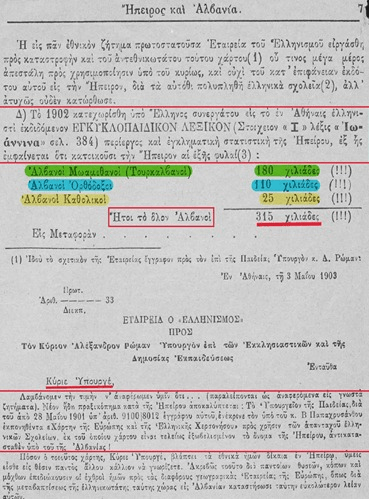
In 1901, the Greek Ministry of Education and its map referred to “Epirus” as “Albania,” precisely because it was inhabited by Albanians.
Here is what the document states: According to a “complaint” by the Greek organization “Elinismos,” which was founded in Athens in 1892 to advance Greek chauvinistic aims, the Greek encyclopedic dictionary of 1902 presented “Epirus” as Albanian because, according to it, it was inhabited by 180,000 Muslim Albanians, 110,000 Orthodox Albanians, and 25,000 Catholic Albanians.
In total, according to the same dictionary, “Epirus” was inhabited by 350,000 Albanians. According to the respective complaint — which also serves as documented evidence of Greek deceptions — written by the organization “Elinizmos” and addressed to the Minister of Education and Religion of the time, those figures were described as “strange and criminal,” even calling them a “new conspiracy against Epirus.”
According to the document, in 1901 the Greek Ministry of Education approved the Map of Europe and the Greek Continent for use in all Greek schools, which, according to the complaint, had “completely removed the name ‘Epirus,’ replacing it with that of ‘Albania.’”
In reality, during those years Greece had not yet annexed the so-called “Epirus” or the southern part of Albania of that time; its borders began at the Gulf of Arta and extended along the Pindus Mountains, and to the east stretched south of the Nestos River, to Larisa and Kavala, and it was in its effort to appropriate that region as it had appropriated others…
Therefore, we invite Albanians living in Greece to find the said dictionary and send it to us.
Transcribed:
“Ήπειρος και Αλβανία
In the year 1902 the Greek scholar Elinismos forwarded to the Greek Minister of Education the Encyclopedic Dictionary (volume I, pages 384) which defines the region of Epirus and Albania. According to this source, the populations were:
Albanians Muslims (Turks by religion): 180 thousand
Albanians Orthodox: 110 thousand
Albanians Catholics: 25 thousand
— total 315 thousand Albanians (!!)
Company “Elinismos” – To Mr. Minister…
Then follow lines describing a formal letter (dated Athens, May 3rd 1903) addressed to the Greek Minister of Agriculture and Religion. It criticizes or reacts to those figures and the wording used in the dictionary. The handwritten part under the printed text seems to protest or correct the interpretation.
Literal translation (cleaned and contextual)
“Epirus and Albania”
In the year 1902, the Greek associate scholar Elinismos sent to the Greek Ministry of Education the Encyclopedic Dictionary (Volume I, page 384), which lists the region Epirus and Albania. According to it:
- Albanian Muslims (Muslim Albanians): 180 thousand
- Albanian Orthodox: 110 thousand
- Albanian Catholics: 25 thousand
— Total: 315 thousand Albanians (!!!)
The document then continues with a formal address to “Mr. Minister,” criticizing or questioning those numbers and perhaps the labeling used in the dictionary itself. The red-highlighted handwritten lines in the scanned image appear to be commentary or a complaint about how Epirus was described or classified. — This is likely a transcription of historical correspondence from 1903″.
Source
Εταιρεία «Ο Ελληνισμός». Athens, 3 May 1903.


 Balkan Academia