
by Eneo Xhepa
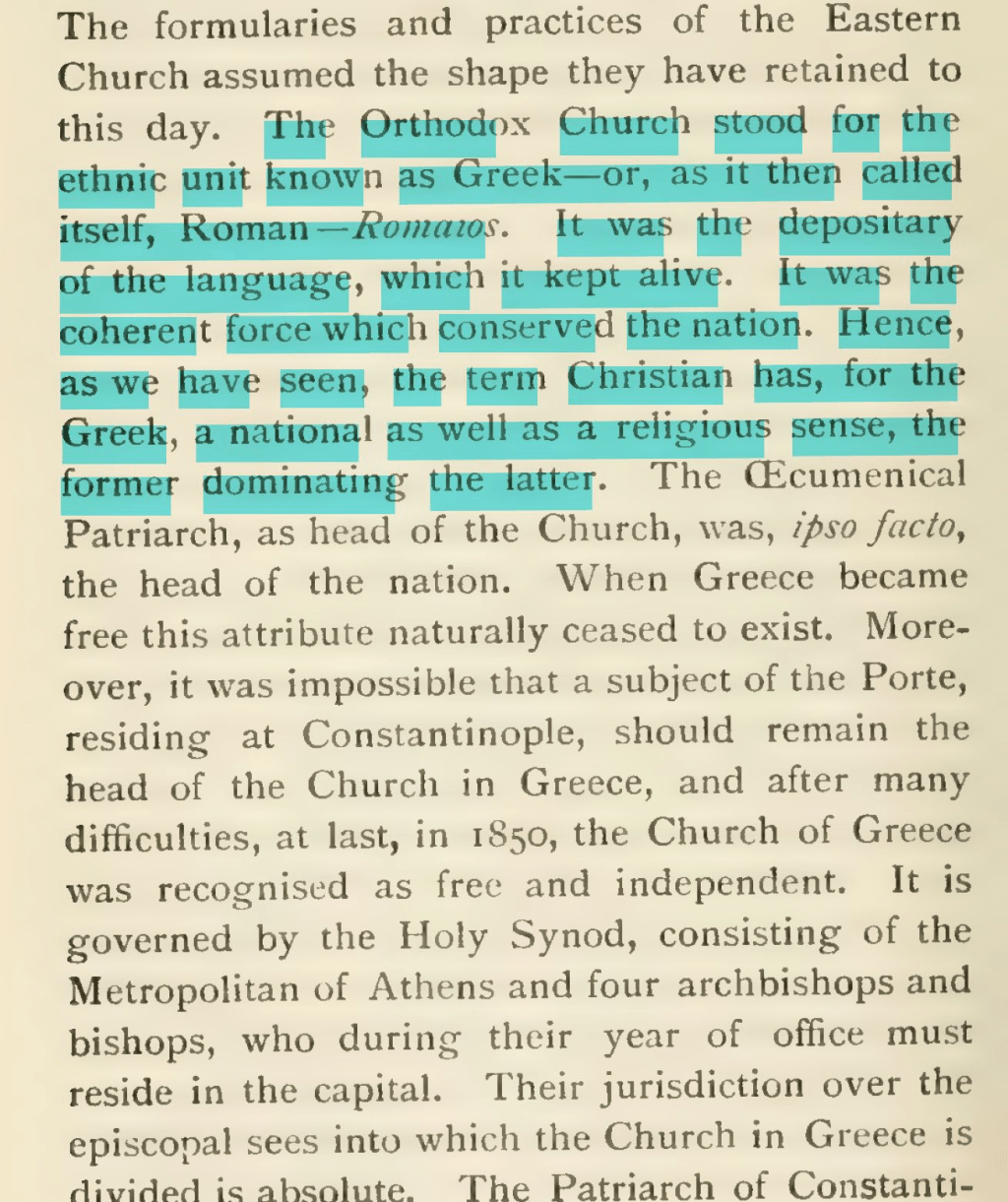
In past centuries, the people we now call Greeks called themselves “Romioi” and were not a modern nation. Their identity was closely linked to the Orthodox religion: the Church preserved their language, culture, and sense of belonging. For them, being “Christian” was not only a matter of faith, but also of being part of the cultural-Orthodox community.
Abstact
This passage portrays the Orthodox Church as a primary agent in the preservation of Greek national identity through its roles in safeguarding language, culture, and communal cohesion. It highlights the historical convergence of religious and national authority, particularly under imperial governance, and traces the institutional transition toward an independent national church within the modern Greek state. The text exemplifies a historiographical view that positions religious institutions as foundational to ethnonational continuity.
The highlighted passage presents the Orthodox Church as a central institution in the preservation and consolidation of Greek ethnic and cultural identity during periods of foreign domination.
By describing the Church as the “depositary of the language” and a “coherent force which conserved the nation,” the text reflects a historiographical tradition that interprets religious institutions not merely as spiritual authorities but as custodians of collective memory and national continuity. In this framework, religious affiliation and ethnic belonging become mutually reinforcing categories, particularly within the context of the former Byzantine and Ottoman socio-political order.
The reference to the Ecumenical Patriarchate of Constantinople as both ecclesiastical and, effectively, national leadership underscores the fusion of religious governance and communal representation characteristic of Orthodox millet structures under imperial rule. The passage further situates institutional transformation within the emergence of the modern Greek state, noting the eventual independence of the Church in Greece and its governance by a national synod. This shift marks a transition from trans-imperial ecclesiastical authority to a nationalized religious institution aligned with state sovereignty.
Conceptually, the text illustrates how religion can function as a vehicle of ethnogenesis, particularly in contexts where political autonomy is limited. The claim that “Christian” possessed both religious and national meaning for Greeks reveals the semantic layering through which identity was articulated. Such a perspective aligns with broader theories in nationalism studies that emphasize the role of cultural institutions in maintaining continuity across periods of political discontinuity. At the same time, the passage reflects a normative interpretation that may simplify internal diversity within Greek society and Orthodoxy, suggesting a unified national consciousness centered on ecclesiastical structures.
Source
Greece and the Greeks. Z. Duckett Ferriman.


 Balkan Academia