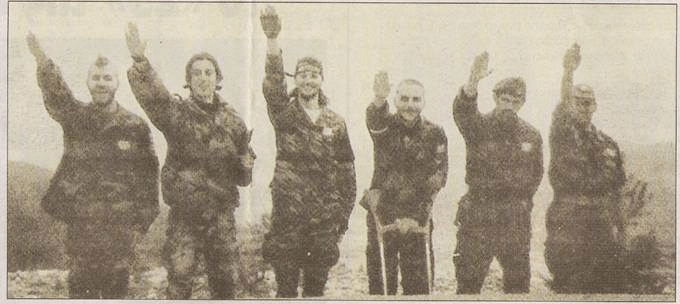

Image from https://jailgoldendawn.com/.
Abstract
This article examines the phenomenon of Greek sympathy for Serbian perpetrators of mass atrocities during the 1990s wars in the former Yugoslavia, focusing on the social, political, and ideological mechanisms that enabled glorification of convicted war criminals. Drawing on media reports, scholarly analyses, and human rights documentation, the study demonstrates that elements of the Greek far-right, along with segments of the Orthodox elite, actively endorsed or excused the actions of figures such as Ratko Mladić. This glorification, including labeling a convicted mass murderer as a “Christian hero,” reflects a troubling intersection of religious nationalism, historical revisionism, and extremist ideology. The article critically interrogates how these attitudes contributed to moral distortion and international complicity in the perception of wartime crimes.
The Myth of the Christian Warrior: Greek Sympathies for Serbian War Criminals in the 1990s
During the wars in Bosnia, Croatia, and Kosovo, Serbian forces carried out systematic campaigns of ethnic cleansing, mass executions, and other crimes that have been extensively documented by international tribunals. While most of Europe condemned these acts, certain segments of Greek society adopted an alternative, revisionist narrative. Influenced by Orthodox solidarity, nationalist ideology, and anti-Western sentiment, some Greeks developed a perverse admiration for Serbian perpetrators, including high-profile war criminals.
The most extreme expression of this sentiment was the glorification of Ratko Mladić, a convicted war criminal responsible for genocide in Srebrenica and atrocities across Bosnia. Prominent Greek clerics and media outlets at times described him as a “Christian hero,” framing his crimes as part of a civilizational or religious struggle rather than as mass murder.
Far-Right Involvement and International Solidarity
Greek far-right activists in the 1990s actively engaged with Serbian paramilitary groups, traveling to conflict zones to express solidarity, supply material support, or participate symbolically in nationalist demonstrations. Reports indicate that some extremists even aligned ideologically with genocidal campaigns, celebrating acts of violence as heroic defense of Orthodox populations.
This phenomenon was not merely individual fanaticism but reflected organized networks of extremist solidarity, leveraging religious and nationalist rhetoric to rationalize crimes against humanity. The narrative presented Serbian perpetrators as defenders of faith and tradition, recasting mass murder as divine or historical necessity.
The Orthodox Elite and the “Christian Hero” Narrative
Beyond militant far-right circles, elements of the Greek Orthodox elite also contributed to moral distortion. By framing Ratko Mladić as a “Christian hero,” certain religious leaders effectively sanctioned or excused atrocities, offering theological legitimation for acts condemned under international law. Such rhetoric:
- Erased the suffering of victims by prioritizing religious affiliation over humanity.
- Provided moral cover for political and social sympathy toward convicted criminals.
- Reinforced nationalist myths that presented the conflict in simplistic “Christian versus Muslim” terms.
This moral and ideological endorsement underscores the dangers of conflating religion with ethnic nationalism, particularly in contexts where violent extremism is already present.
Consequences and Critical Reflection
The Greek phenomenon of glorifying Serbian war criminals had significant implications:
- International moral complicity: By framing mass murderers as heroes, segments of Greek society contributed to a climate in which atrocities were ideologically excusable.
- Historical distortion: The narrative undermined accurate historical memory and denied accountability for crimes such as the Srebrenica genocide.
- Domestic radicalization: Far-right networks gained symbolic validation, strengthening extremist identity politics within Greece.
Critically, the persistence of these attitudes demonstrates how ideological and religious frameworks can be manipulated to rationalize or celebrate violence, even in the face of overwhelming evidence of criminality.
Conclusion
The Greek sympathy for Serbian war criminals in the 1990s, exemplified by the glorification of Ratko Mladić as a “Christian hero,” represents a profound moral and political failure. Far-right extremists and elements of the Orthodox elite participated in, endorsed, or excused atrocities that were legally and ethically indefensible. This phenomenon illustrates the dangers of intertwining religion, nationalism, and revisionist history, demonstrating how admiration for perpetrators can distort collective moral judgment.
Addressing these attitudes requires both historical accountability and critical public discourse, challenging the ideological frameworks that permitted such glorification and reaffirming the universal principles of human rights and justice.
Sources
- “The Greek Militiamen Involved in the Srebrenica Massacre.” AthensLive (Medium), 8 February 2015. https://medium.com/athenslivegr/the-greek-link-to-srebrenica-bf5f844e892.
- “Foreign Support in the Bosnian War.” Wikipedia. Last modified 2025. https://en.wikipedia.org/wiki/Foreign_support_in_the_Bosnian_War.
- Michas, Takis. Takis Michas. Wikipedia. Last modified 2025. https://en.wikipedia.org/wiki/Takis_Michas.
- Christodoulos of Athens. Wikipedia. Last modified 2025. https://en.wikipedia.org/wiki/Christodoulos_of_Athens.
- June 15 – 30, 2005 Global News Monitor. Prevent Genocide International, 2005. https://www.preventgenocide.org/news-monitor/2005june2.htm.
- Helsinki Committee for Human Rights in Serbia, Annual Report 2003. Belgrade: Helsinki Committee for Human Rights in Serbia, 2003. https://www.helsinki.org.rs/doc/AnnualReport2003.pdf.
- “Greek Role in Srebrenica Massacre Investigated.” The Independent, 29 June 2005. (Archived press account.)


 Balkan Academia