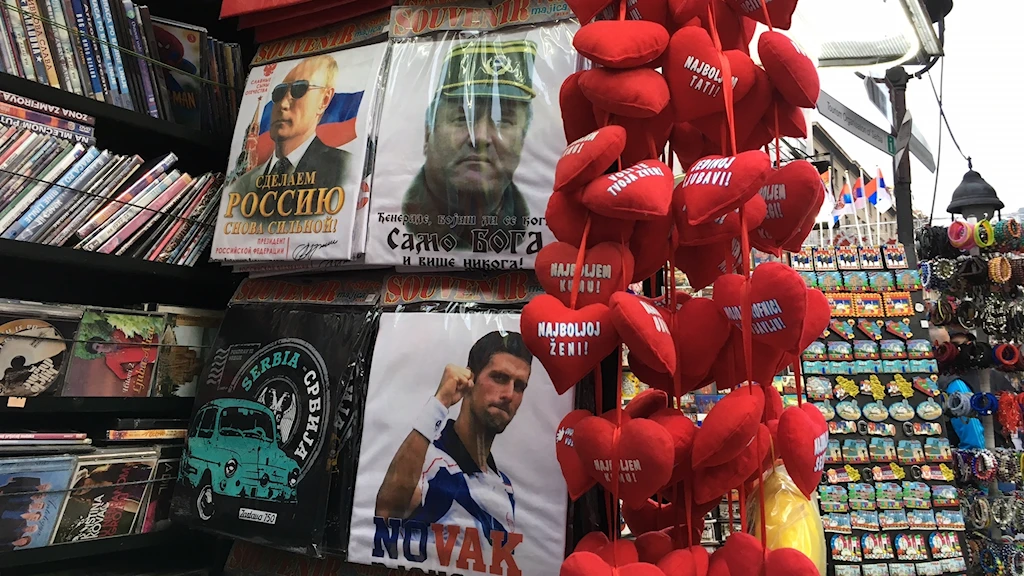

Image from Sveriges Radio, 2021.
Abstract
This article examines the phenomenon of young people in Serbia taking photographs with convicted war criminals, situating it within broader discourses of collective memory, historical revisionism, and social responsibility. Drawing on theories of transitional justice, moral sociology, and post-conflict identity formation, the study argues that such practices represent not merely individual acts of fandom or curiosity, but a symbolic endorsement that undermines societal reconciliation and the cultivation of ethical civic culture. The analysis frames this behavior as a source of social shame, reflecting both the unresolved legacies of the Yugoslav wars and ongoing challenges in shaping responsible national identity.
The Politics of Memory and Moral Responsibility: Youth, War Criminals, and Serbian Collective Identity
Introduction
The legacy of the Yugoslav wars (1991–2001) continues to shape contemporary Serbian society. While the prosecution of war crimes has established formal accountability through international and domestic courts, popular memory practices reveal contested narratives of heroism, victimhood, and national pride. In recent years, reports of youth photographing themselves with convicted war criminals—figures already adjudicated for crimes against humanity—have drawn attention from scholars, journalists, and civil society actors.
Such acts raise fundamental questions about moral responsibility and collective identity. Are these behaviors innocent expressions of curiosity or admiration, or do they signal deeper problems in societal norms, historical understanding, and ethical formation? This article argues that these practices constitute a source of social shame for Serbia, highlighting the tension between nationalistic myth-making and the ethical imperatives of post-conflict societies.
Youth, Socialization, and the Construction of Heroism
Sociological studies on youth socialization suggest that young people are particularly susceptible to narratives of glorified heroism, especially when framed within nationalistic discourse. In the Serbian context, commemorative events, media portrayals, and selective historical narratives often valorize figures implicated in wartime atrocities, presenting them as defenders of national honor.
This environment fosters a phenomenon wherein adolescents and young adults conflate criminality with patriotic virtue. By participating in photographic rituals with convicted war criminals, youth inadvertently signal social approval, normalizing behaviors that undermine accountability and ethical reflection. From a moral standpoint, this represents a collective failure in guiding civic values and historical understanding, reflecting a broader challenge in cultivating a responsible civil society.
Memory, Myth, and Ethical Implications
The phenomenon can also be understood through the lens of memory studies. Collective memory is rarely neutral; it is actively constructed, often incorporating selective silences, mythologized heroes, and reinterpretations of traumatic events. In Serbia, the elevation of wartime figures to heroic status—despite convictions for crimes against humanity—illustrates the persistence of myth over historical accuracy.
Such practices produce a paradox: while Serbian society officially condemns war crimes through judicial mechanisms, public symbolic behaviors contradict these legal and ethical norms. Photographing oneself with war criminals signals tacit endorsement and diminishes the moral authority of courts, victims, and reconciliatory institutions. This contradiction generates a form of social shame, reflecting the ethical dissonance between professed values and everyday practices.
The Politics of Shame and Responsibility
Shame is a critical social mechanism that enforces moral norms and reflects collective ethical standards. In this case, it arises from the gap between societal ideals—respect for human rights, condemnation of atrocity—and the behaviors of young citizens who appear to admire those adjudicated as criminals. Scholars argue that unaddressed public glorification of war criminals may perpetuate cycles of historical revisionism and intergroup tension, impeding reconciliation and regional stability.
Addressing this phenomenon requires not only legal enforcement but also educational initiatives, media literacy, and public discourse that clearly delineates the moral stakes of interacting with convicted war criminals. Recognizing and articulating the social shame associated with these behaviors is a first step toward cultivating a more ethically informed citizenry.
Conclusion
The act of photographing youth with convicted war criminals in Serbia is emblematic of unresolved tensions in collective memory, national identity, and moral responsibility. Far from being trivial, these behaviors have profound implications for social cohesion, ethical norms, and the cultivation of civic virtue. By framing such acts as socially shameful, Serbian society can confront the lingering effects of wartime mythology, strengthen respect for judicial accountability, and foster a culture of historical awareness and ethical responsibility.
Ultimately, the challenge is not merely to condemn individual behaviors but to address the structural, educational, and symbolic conditions that make admiration of war criminals conceivable. Only then can collective memory align more closely with justice and moral accountability.
Sources
- Petrović, Vladimir. “Power(lessness) of Atrocity Images: Bijeljina Photos between Perpetration and Prosecution of War Crimes in the Former Yugoslavia.” International Journal of Transitional Justice 9, no. 3 (2015): 415–435. https://www.researchgate.net/publication/281163684_Powerlessness_of_Atrocity_Images_Bijeljina_Photos_between_Perpetration_and_Prosecution_of_War_Crimes_in_the_Former_Yugoslavia
- Jevtić, Milica. “The Pain on the Political Battlefield—Structuring the Role of the Media in Protests Triggered by Mass Murders in Serbia.” Frontiers in Political Science (2025). https://www.frontiersin.org/journals/political-science/articles/10.3389/fpos.2025.1654950/full
- Freed by the Court. “The Role of Images Between Remembrance and Normalization of War Criminals.” Politics and Society 47, no. 2 (2019): 123–147. https://www.degruyter.com/document/doi/10.1515/pol-2019-0012/html
- Petrović, Vladimir. “Power(lessness) of Atrocity Images: Bijeljina Photos between Perpetration and Prosecution of War Crimes in the Former Yugoslavia.” International Journal of Transitional Justice 9, no. 3 (2015): 415–435. https://www.researchgate.net/publication/281163684_Powerlessness_of_Atrocity_Images_Bijeljina_Photos_between_Perpetration_and_Prosecution_of_War_Crimes_in_the_Former_Yugoslavia
- Jevtić, Milica. “The Pain on the Political Battlefield—Structuring the Role of the Media in Protests Triggered by Mass Murders in Serbia.” Frontiers in Political Science (2025). https://www.frontiersin.org/journals/political-science/articles/10.3389/fpos.2025.1654950/full
- Freed by the Court. “The Role of Images Between Remembrance and Normalization of War Criminals.” Politics and Society 47, no. 2 (2019): 123–147. https://www.degruyter.com/document/doi/10.1515/pol-2019-0012/html
- CIVICUS Monitor. “Mural of Convicted War Criminal Mladić Sparks Protests.” CIVICUS Monitor, 2023. https://monitor.civicus.org/explore/mural-convicted-war-criminal-mladic-sparks-protests-violations-environmental-rights-protests/
- Sveriges Radio. “In Serbia, War Criminals Are Seen as Heroes.” Sveriges Radio, 2021. https://www.sverigesradio.se/artikel/6824787
- Wikipedia. “Graffiti.” Last modified 2025. https://en.wikipedia.org/wiki/Graffiti


 Balkan Academia