
ny Lulzim Osmanaj
Abstract
The text interprets an Illyrian belt plaque as a complex symbolic artifact that integrates artistic representation, social hierarchy, and mythological meaning. Through its imagery of a mounted warrior, martial equipment, and a dragon-like creature, the object is presented as a visual expression of elite status, communal protection, and cosmological belief. The discussion situates the artifact within broader Indo-European symbolic traditions and highlights how modern interpretations project later political and identity narratives onto ancient material culture. The plaque is thus framed both as archaeological evidence of Illyrian society and as a focal point in contemporary cultural memory.
Archaeological artifacts constitute one of the most important sources for reconstructing the spiritual, social and military world of ancient populations.
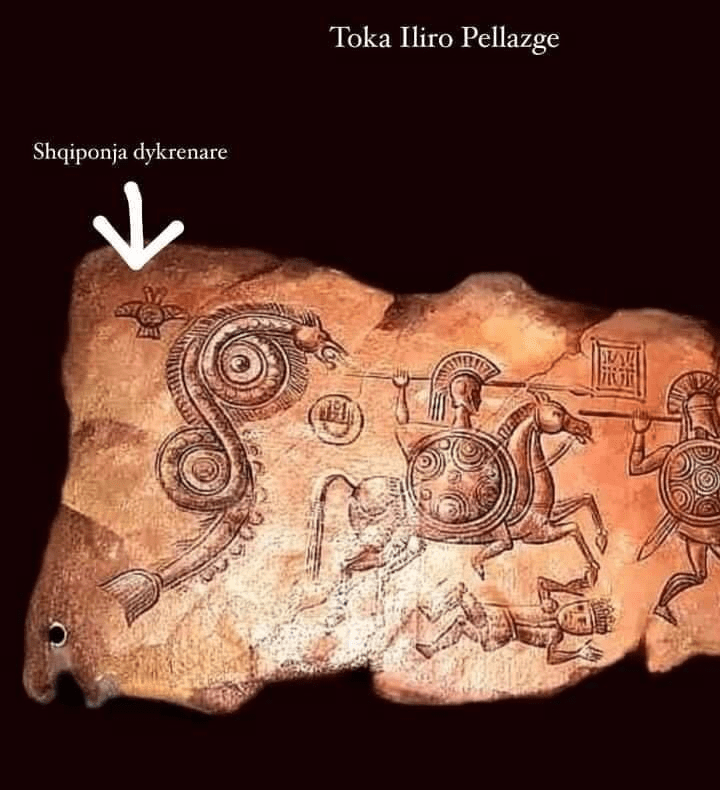
An Illyrian belt plaque, decorated with figurative scenes depicting a warrior on horseback, armed with a spear and shield, as well as a dragon or mythical creature wrapped around it, represents a precious testimony to the art and ideology of the Illyrians.
This work is not simply a decorative element of military dress, but an object with a symbolic and identity function, which synthesizes the worldview, power structures and mythology of this ancient culture.The iconography of the knight warrior occupies a central place in Illyrian art and is directly related to the social status and role of the fighting elite.
The horse, as a symbol of mobility, strength and prestige, often appears in funerary and military contexts, suggesting that the warrior depicted is not an ordinary figure, but a representative of the tribal aristocracy. The armament, spear and shield emphasize the practical dimension of war, but at the same time convey symbolic messages about the protection of territory and social order.
In this sense, the belt plate serves as a “visual text” that communicates the fundamental values of Illyrian society.The presence of a dragon or a mythical creature is a particularly significant element. In Indo-European traditions, the dragon is often associated with the forces of chaos, wild nature, or the underworld, while the hero or warrior represents order and control.
The juxtaposition of these figures on a single object suggests a mythical narrative, where the warrior appears as a protector of the community and as a mediator between the human and supernatural worlds. This motif can also be interpreted as an expression of beliefs about fertility, the cycle of life and death, or the divine legitimacy of power.
Contemporary texts and interpretations that link this artifact to the concept of “Illyrian-Pellagian lands” and to the symbol of the double-headed eagle reflect a continuous process of rereading the past in the function of modern identity. The reference to the Pelasgians, a mythical or protohistoric population mentioned in ancient sources, points to efforts to deepen the chronological roots of cultural identity in the Balkans.
Meanwhile, the double-headed eagle, although known mainly from the medieval Byzantine and Balkan tradition, is often interpreted as a symbol of continuity and sovereignty, being retrospectively projected onto the Illyrian heritage.The Illyrian belt plate thus represents a fusion of art, function, and mythology, providing an important window into the understanding of Illyrian society.
It testifies to the high level of metalworking craftsmanship, to the complexity of the symbolic worldview, and to the central role of the warrior in the social structure. At the same time, modern interpretations of this artifact demonstrate how ancient objects continue to be active in identity and cultural discourse, connecting the archaeological past with the historical and symbolic narratives of the present.


 Balkan Academia