
Saturday, 25.12.2021, 10:30 PM
Abstract
The article “Serbizimi i familjes Gjaka në fshatin Shillovë të Gjilanit” by Dr. Qazim Namani explores the historical and ethnographic background of a family in the village of Shillovë in the Gjilan region of Kosovo. Through field research and interviews, the author documents how a local Serbian family with the surname Gjakliq traces its origins to Albanian roots and familial connections with the Albanian Gjaka family. The research discusses processes of cultural assimilation and identity transformation among Orthodox Christian families in the region over recent centuries, linking these personal histories to broader historical influences such as Ottoman reforms and shifts in religious and ethnic affiliation. The article uses the specific case of the Gjakliq family to illustrate larger patterns of identity change and cultural interaction between Albanians and Serbs in southeastern Kosovo.
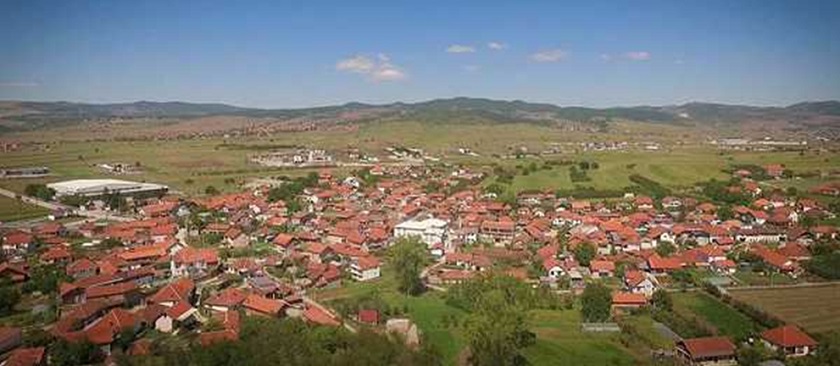
Village of Shillova, municipality of Gjilan/Gnjilane

By Dr. Qazim Namani
The process of assimilation of the Albanian and Vlach population in the Illyrian Peninsula is a topic that has not been researched and adequately addressed in scientific terms.
Field research work offers the opportunity to collect as many traces of cultural, material and spiritual heritage as possible, and the memory of the population that preserved and created them for centuries.
During field research, in addition to traces of material heritage, research into toponyms, anthroponyms, and family trees is very important for understanding our historical and cultural past.
Many years of fieldwork experience had inspired me to attach great importance to the development of the Albanian family during the over 500 years of rule by the Ottoman Empire.
The Albanian family during the Ottoman occupation was accompanied by numerous crises full of tragedy and human loss, major changes in terms of culture, religion, and national identity.
Fieldwork inspired me to delve deeper into research, and to understand that many Albanian and Vlach families, over the last five centuries, were unprotected, and therefore, due to political circumstances and numerous pressures, were forced to change their identity, religion, and native language.
By carefully collecting data among our people, and comparing it with historical sources of the time, I began to research the assimilation process, conducting several interviews with members of hundreds of Albanian and non-Albanian families about their family past.
During my experience, I realized that in Kosovo, there were many Serbian families who, over the last two centuries, had been separated from their family tree and their earliest Arbër identity.
After the first recordings and interviews with two Serbian families, one day while having a friendly conversation on this topic with art professor Haki Gjakl, I realized that a Serbian family in the village of Shillovë in Gjilan is related by blood to the Albanian Gjaka family, who today lives in Ferizaj. I began to be interested in this case, and from some citizens in Gjilan I learned that a Serbian family living in Shillovë bears the surname Gjaklić.
In 2015, during the reconnaissance of the terrain, I had discussed this case with members of the team of the Institute for the Protection of Monuments of Kosovo, and we talked many times with my colleague Emin Sallahu about one day making a working visit to this family.
On May 26, 2015, after visiting the church in Kmetoc, while returning towards Gjilan, I remembered the Gjaklić family in Shillovë. I started discussing the case of the Gjaklić family with my colleagues, Emini, who was driving the car, agreed to let us enter the village of Shillovë. As soon as we entered the center of the village, we asked about the Gjaklić family’s house. The villagers showed us where the house of Živojin Gjaklić’s family was located. When we approached the house, we found Živojin working in his garden. Our car had official registration, so we noticed that Živojin was looking at the plates, stood up and looked in our direction. We stopped the car near him. I carefully opened the car window and greeted him, asking, “Are you the Gjaklić family?”
Yes, Zhivojin replied.
Is it possible to have a conversation with you, I asked?
Zhivojini said to me with a smile, “Have you come for my tribe?”
“Yes, that’s right, related to this topic,” I replied.
Živojini showed us where we could park the car.
We all got out of the car, greeted each other, and sat at the table in his garden.
Živojini had a large house, a beautiful garden, filled with flowers that were just beginning to bloom.
Živojini invited his wife, who after greeting us treated us to various drinks and coffee. Immediately his young son also came and greeted us, and we realized that they were all education employees.
We explained that the reason for our visit to the Gjaklić family was our previous information about this family.
After that, the conversation began, and we asked numerous questions about his family.
At first, I approached Živojin, asking him to tell us something about the etymology of his surname.
Živojin said with a laugh: “It seems that our family’s surname Gjaklić has an etymology from the Albanian language, and its meaning derives from the word blood in the Albanian language. I, he said, keep the old family surname, while some cousins and my brother changed their surnames a few years ago. My brother Gradimir, said Živojin, now lives in Belgrade, has a high position there and keeps the surname of our great-grandfather Mihajlović.”
We asked him to tell us what he knows about his family’s origins, whether they are newcomers to the village of Shillova or are they indigenous.
Živojini said: According to the stories of our ancestors, our family came to Kosovo from Veles, Macedonia, hundreds of years ago.
We intervened in the conversation, asking Živojin if there had been three brothers.
Zhivojin replied, “How do you know this?”
We laughed and explained it to Živojin, because we had collected this story of three brothers during our fieldwork with hundreds of Albanian families.
Živojin continued the conversation by saying that there had been three brothers, two brothers had remained to live in Shillova, while one of them had gone to live in the mountains of Žegoc in the village of Kishnopole. The brother who went to Kishnopole had three sons, and the relations between the Gjaklić family and those in Kishnopole have never been interrupted. Živojin even said, I went to Ferizaj to console one of them, whose mother had died, a short time ago.
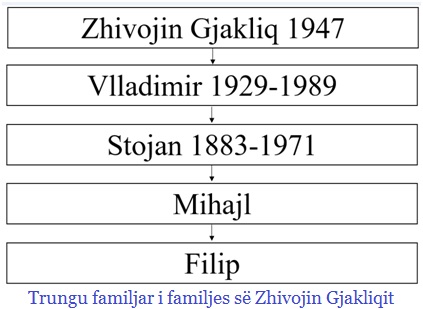
We usually asked every family we visited for their family tree memory information. We also asked the Gjaklić family for this, which came out like this:
 Since we knew about the traces of archaeological heritage in the village of Kishnopole, we also told Živojin about the old church facing the village field. We explained that the name of the village derives from the old Albanian church, and the field next to it, but that later the meaning of the field took on Slavic etymology.
Often during the conversation, Živojini wanted to talk to us about the good relations with Albanians, how he met with many Albanian political leaders after the war, and he mentioned almost everyone by name.
Živojin said, as you can see, I don’t even carry a phone with me, since I used to be a military colonel and am now retired. He emphasized that even though he had been an officer in the Serbian army, he had always behaved well with Albanians.
We listened attentively, and from time to time we intervened with a question in Živojin’s stories.
Živojin began to talk about the Serb rally that had been held in Mazgit for years. He expressed his anger at its lack of proper organization, and even revealed that he had been on the organizing council.
We explained to him about the historical events of the last three centuries, about the political circumstances, the situation of the Albanian population over the centuries, the displacements from ethnic lands, the assimilation and the numerous murders of Albanians.
While we were explaining the events of the 19th century chronologically, Živojin was very impressed by the registration of the population according to religious identity after the Tanzimat reforms. With these reforms, national identity also determined the millet (nationality). Muslim Albanians were all registered as Ottomans, Catholic Albanians as Latin, while Orthodox Albanians in the absence of the Albanian Orthodox Church were forced to register with Greek, Serbian and Bulgarian ethnicity.
As can be seen, the Albanian population had no opportunity to maintain its Albanian ethnicity, but was forced to change its national identity. Since at that time Russian influence was very great and with the Bucharest Agreement between Russia and the Ottoman Empire, the Orthodox population living in Rumelia had gained privileges and the strong support of Russia.
In the territory of Rumelia, independent Greek, Serbian, Bulgarian and Romanian churches had already been established. In the territory of present-day Kosovo, in the Orthodox churches, the clergy held the liturgy in the Greek language, and were directly connected to the Patriarchate of Istanbul. In the territory of the Sandzak of Niš, present-day Kosovo and northern Albania, Orthodox religious clergy had penetrated to serve Russian agencies in the region.
The Russians supported the Serbian Orthodox Church that was founded in 1837, so through them many religious missionaries had opened religious courses and later schools in the Serbian language in Kosovo. According to this platform and Russian projects, the Albanian and Vlach Orthodox population in the Albanian territories began to be Serbized at a rapid pace.
The complete Serbization of the Orthodox population in the territory of Kosovo was achieved in 1896, when the Serbian Church finally managed to expel all Greek Orthodox religious clergy, and replace them with Serbian clergy in Prizren, Prishtina, Lipjan, Ferizaj, Mitrovica, Gjilan and other cities.
In many Orthodox churches in the cities of Kosovo, the influence of Greek propaganda was quite large due to the privileged position of the Patriarchate of Istanbul. The Patriarchate of Istanbul had established its headquarters in the Metropolitanate of Prizren, which was controlled by the Greeks from 1830-1896. The Greeks spread their propaganda through the Vlach population in the cities of Kosovo and a small number of monks in the monasteries.
At the time when the Metropolis in Prizren was in the hands of the Greeks, the Russians gave strong support to Serbia to establish Serbian church-school communities as bodies of local self-administration in Albanian lands within the borders of the Ottoman Empire.
In 1868, the Education Council was formed to assist Serbian schools and teachers in the Ottoman Empire. During this time, Serbian secular schools in Kosovo worked according to Serbian plans and programs. The same textbooks were used for Orthodox in Kosovo as in Serbian schools in Serbia. In Serbia, aid was collected to build new Serbian schools in Albanian lands.
Under these circumstances, the Vlach-Greek schools could not develop and the small number of Greek monks withdrew from the monasteries.
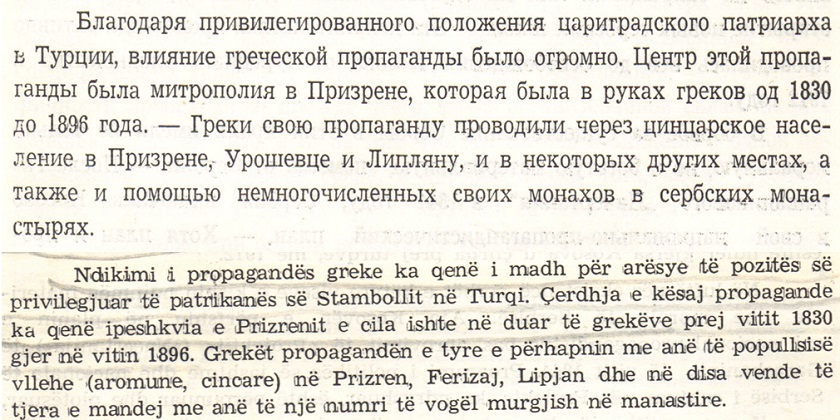
Facsimile from the book “Serbian schools in Kosovo from 1856 to 1912”, Prishtina, 1970 written by Jagos Gjilas. The text is in Serbian, but also translated into Albanian, which proves that the Serbs finally occupied the Orthodox churches and monasteries in Kosovo in 1896. In the translation it is written Ipeshkiva instead of the correct translation Mitropolia, see the text above in Slavic
This is also evidenced by Branislav Nushiqi in his book “Kosovo”. He writes that in the summer of 1896, for the first time, Dionisi, the Serbian patriarch of Prizren, visited all his churches. That same year, he also went to Mitrovica, to lay the foundation stone of the new shrine of “Saint Sava”, which according to the plan will be one of the most beautiful churches in Old Serbia. In Mitrovica, there is also a Serbian school founded six years ago, which has two male and one female teachers. The school building is very beautiful and impressive (Book “Kosovo”; Branislav Nushiqi).
As can be seen, after this period, new churches were built in many villages where the Albanian Orthodox population lived. Serbian clergy were sent to these churches, and this influenced the rapid Serbization of Albanian families after the Balkan wars and the occupation of Kosovo by Serbia.
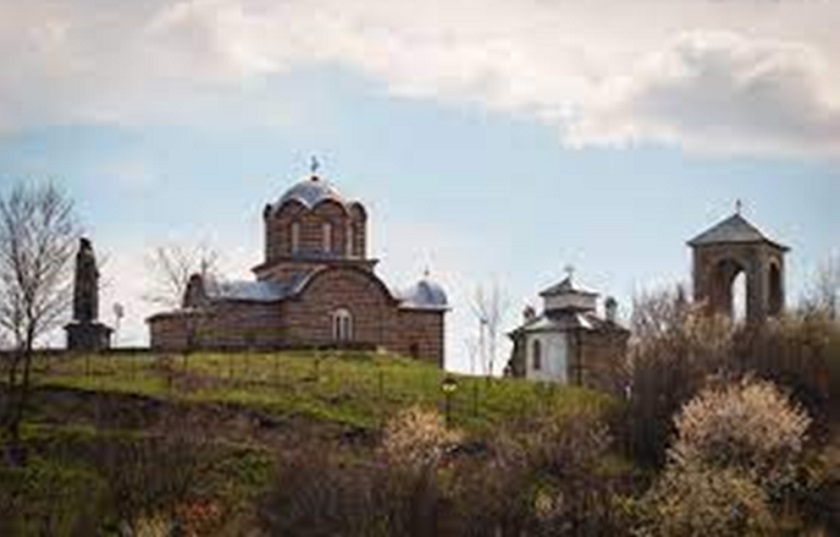
“St. Mark’s” Church in the village of Shillovë
We, relying on the literature of the time, informed Živojinin that in the first years after the Tanzimat reforms, the Orthodox Christian population of Anamorava, unable to register as an Arbëro, was registered as ethnic Bulgarian.
Živojin listened attentively as we spoke to him about the family ties of many Serbian families with Albanian families in Kosovo. We explained with facts from the field and literature about the Arbër affiliation of the Orthodox population (Raja), who had lived in Kosovo during the rule of the Ottoman Empire.
During field research, but also by browsing the literature, however scant it is on this issue, we had realized that the Albanian Orthodox families that the Gjinolls of Gjilan had brought to their lands around Gjilan, the Kosovo Plain and other cities during and before the Tanzimat reforms had escaped the process of Islamization, but unfortunately later these families were Serbized.
Meanwhile, during the conversation, we asked Živojin if he had any knowledge of the Gjaka families in Podujeva and the surrounding area, Pristina, Vushtrri and other settlements.
Živojini was surprised when we told him about the large number of Albanian families with his surname Gjaka.
He was surprised and said – yes, there are many, I didn’t know about them, but where do these families originate from?
We told Živojin that these families originated from the village of Gjaka, which is located a few kilometers beyond the present-day Kosovo-Serbia border, on the right side of the road leading to Niš. We explained to him the bitter fate that those families experienced during the forced displacement from their village by the Serbian army in 1878.
At the end of the conversation, we instructed Živojin to look on the map to see where the village of Gjakë is located, letting him know that his family’s origins could also be from this village. We told him that it would be good for him to meet with our historian Hakif Bajrami, since his family had also been forcibly displaced from the village of Gjakë during the Eastern Crisis of 1878.
We greeted Živojinin, thanking him for the conversation we had and the hospitality he extended to us.
A day later we entered the village of Kufcë, which is adjacent to the city of Gjilan, but which is administered by the municipality of Artana, after decentralization. The purpose of our visit to this village was to see the architecture of the old buildings, to collect data on cult objects, and we were approaching the village’s Quka, as the residents call it. The village of Kufcë is a fairly large village, with dense settlement along the transit road to the city of Gjilan.
Above the village on a hill is the village’s Quka, but in the direction of Quka the settlement is scattered. After we passed the village going in the direction of the village’s Quka, the houses were scattered in small neighborhoods with two to five houses. In this part of the village, in a small neighborhood, three Albanian families lived, and a little above them, several Serbian families.
As soon as we offered ourselves to the Albanian families, we found an elderly woman working in her garden. When we greeted her in Albanian, she was somewhat surprised since they had rarely been visited by any official.
We asked them how they are doing as Albanian families, among Serbian families, and how they experienced the recent war in Kosovo.
The old woman sighed lightly, telling us that as you can see, we were and are isolated in this place. We asked her again, how did you get through the war, and were you afraid? Oh my goodness, she said, we experienced fear and terror during that whole time. We, she said, were very afraid, and we remembered the stories of our ancestors who told how they were killed and displaced many years ago from the city of Niš.
After a pleasant conversation, we left the old woman working, and we continued our way towards Quka, with the aim of taking some photos and collecting toponyms around it.
After we reached our goal, returning to the lower neighborhood of the village of Kufcë, near a shop we noticed a man waving, coming straight towards our car. He was Zhivojin Gjaklić, whom we had visited the day before at his house.
We stopped the car and greeted him. Živojin asked if we could have a coffee together. We said yes, we could have a coffee, but no. Živojin came with us to a coffee shop near the village of Shillovë, not far from his house, on the right side of the road from Gjilan to Dardana.
Zhivojini addresses us with a smile. Oh, what did you do to me yesterday? You kept me up all night. He said that he had found the village of Gjaka on the map, and now he had formed the conviction that his ancestors could have been from this village, but had moved to Shillova many years ago.
We continued the conversation by telling him many other facts about the Serbization of Albanians and Vlachs during the 18th, 19th, and 20th centuries.
We parted ways with Živojin, leaving him in deep conversation with an Albanian his age.
As we were leaving the coffee shop, the waiter said to us with disdain: “Are you working with a knife?”
We went to Gjilan and after lunch, we felt somewhat offended by the Albanian waiter. Our colleague Emini insisted that we go back to the bar where we had coffee with Živojin. We went back and advised the waiter not to be prejudiced, because he does not have the ability to understand our work in the field.
Later we realized that Živojin, as a Serbian officer, had a file at the Hague Tribunal, but even after the conversation he had with us, we realized that he had no longer participated in the Serbian rallies held later in the village of Mazgit.
Thus ended a day of field work.


 Balkan Academia