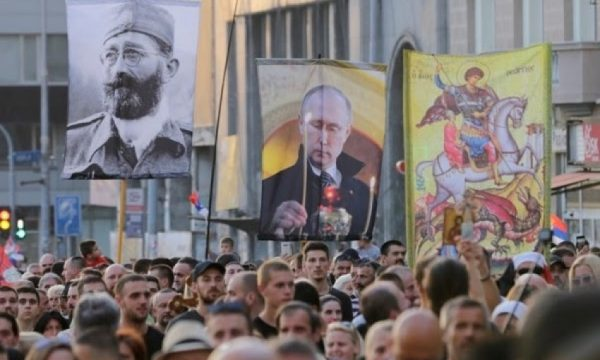

Photo from GazetaExpress
Abstract
This article critically examines Serbia’s failure to provide reparations for genocides and war crimes committed in Bosnia and Herzegovina, Croatia, and Kosovo during the 1990s. Despite extensive legal documentation of atrocities and convictions of individual perpetrators, the Serbian state has systematically resisted acknowledging financial and material responsibility. By analyzing international law, transitional justice mechanisms, and political discourse, the study interrogates the ethical and political implications of this refusal. The article frames the lack of reparations as both a moral and societal failure, exposing the contradictions between legal accountability and national political self-interest.
The Unpaid Price of Atrocity: Serbia, Accountability, and the Denial of Reparations for 1990s Genocides
Introduction
The wars that tore apart the former Yugoslavia in the 1990s resulted in some of the most egregious violations of human rights in contemporary European history. Bosnia and Herzegovina, Croatia, and Kosovo witnessed campaigns of ethnic cleansing, mass killings, and other crimes that have been extensively documented by international courts, including the International Criminal Tribunal for the former Yugoslavia (ICTY).
While individual perpetrators have been prosecuted, the Serbian state itself has largely refused to accept material responsibility through reparations or restitution. This refusal raises fundamental questions about justice, ethical governance, and the responsibilities of successor states in addressing past atrocities.
Legal Foundations for Reparations
International law recognizes the right of victims to reparations following war crimes and genocide. The ICTY, the International Court of Justice (ICJ), and customary humanitarian law establish that states can bear direct or indirect responsibility for crimes committed by their agents or forces. Reparations may include financial compensation, restoration of property, or symbolic restitution, and are a cornerstone of post-conflict reconciliation.
Serbia, as the legal successor of the Federal Republic of Yugoslavia, has been implicated through its support for paramilitary groups and regular forces engaged in atrocities across its neighboring countries. Despite this, political leaders have consistently denied both moral and financial responsibility, framing past conflicts as defensive or misrepresented interventions.
Political and Societal Resistance to Reparations
The reluctance of the Serbian regime to pay reparations is rooted in a combination of nationalism, political self-preservation, and societal narratives of victimhood. Reparations would not only impose a substantial economic cost but also acknowledge collective state culpability, challenging dominant nationalist narratives.
Domestic political discourse frequently emphasizes Serbian suffering during the wars, while downplaying or denying the atrocities committed against non-Serb populations. This selective historical memory fosters an environment in which reparations are perceived not as justice but as unpatriotic submission to external pressure.
Moral and Ethical Implications
Failure to provide reparations perpetuates injustice on multiple levels:
- It denies victims’ rights to acknowledgment and compensation.
- It undermines the credibility of Serbia’s commitment to European integration and international law.
- It normalizes impunity, sending a message to future generations that states may commit atrocities without enduring accountability.
From an ethical standpoint, this refusal represents a profound collective moral failure, reflecting systemic prioritization of national pride over human rights and reconciliation.
Conclusion
Serbia’s refusal to pay reparations for genocides in Bosnia, Croatia, and Kosovo is not merely a legal or economic matter; it is a moral indictment of the state and society. The absence of financial accountability underscores the gap between international justice frameworks and national political realities.
Addressing this issue requires not only external pressure and legal mechanisms but also an internal reckoning with history, ethics, and responsibility. Until reparations are considered seriously, the legacies of the 1990s will remain contested, and Serbia’s moral authority in the region will continue to be compromised.
Sources
- Kostić, Milica, and Sandra Orlović. 2020. “Chapter 23 Reparations for Victims of War within the Western Balkans EU Accession Negotiations: Serbia Case Study.” I Reparations for Victims of Genocide, War Crimes and Crimes against Humanity, 606–628. Leiden: Brill. https://doi.org/10.1163/9789004377196_025.
- “Victims’ Right to Reparation in Serbia and the European Court of Human Rights Standards.” Belgrade: Humanitarian Law Center, 2014. https://www.hlc‑rdc.org/en/publications/victims‑right‑to‑reparation‑in‑serbia‑and‑the‑european‑court‑of‑human‑rights‑standards/.
- “Material Reparations in Proceedings for Damages — The Practice of Courts in Serbia 2021–2022.” Belgrade: Humanitarian Law Center, 2023. https://www.hlc‑rdc.org/en/publications/material‑reparations‑in‑proceedings‑for‑damages‑the‑practice‑of‑courts‑in‑serbia‑2021‑2022/.
- Henkin, Louis. 2010. “Breach of the Obligation to Prevent and Reparation Thereof in the ICJ’s Genocide Judgment.” European Journal of International Law 18, no. 4: 695–713. Oxford: Oxford University Press.
- “International Court of Justice Judgment on Genocide (Bosnia and Herzegovina v. Serbia and Montenegro).” International Court of Justice, 2007. (Diskuterar statligt ansvar för underlåtelse att förhindra folkmord.)
- Wikipedia, s.v. “Humanitarian Law Center.” (Ger bakgrund om en viktig organisation som dokumenterar brott och reparationsfrågor i regionen.) https://en.wikipedia.org/wiki/Humanitarian_Law_Center.


 Balkan Academia