
Abstract
This study examines a nineteenth-century historical account describing the linguistic and demographic conditions of Greece during the late Ottoman and early post-independence periods. The passage highlights the prominence of Albanian-speaking (Arvanite) communities in Attica, the necessity for Bavarian officials to learn Albanian after 1830, and the existence of judicial proceedings conducted in that language in Athens. It further situates demographic transformation within the context of Venetian rule and the population movements associated with the Greek War of Independence. The text underscores the multilingual and migratory foundations of modern Greek society, challenging later homogenizing nationalist interpretations.
Discussion
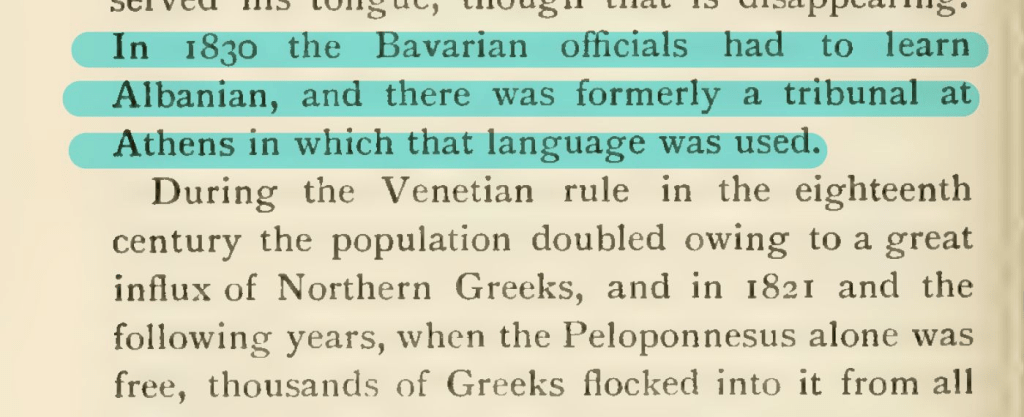
The highlighted passage reflects nineteenth-century historiographical interest in the ethnolinguistic composition of Greece during the transition from Ottoman to independent rule. The reference to Bavarian officials learning Albanian after 1830 underscores the prominence of Arvanite communities in Attica and surrounding regions. Under King Otto’s Bavarian administration (1832–1862), linguistic realities often conflicted with emerging nationalist narratives that sought to present Greece as linguistically homogeneous.
The mention of a tribunal in Athens where Albanian was used suggests the institutional recognition of Arvanitika as a functional administrative language in earlier periods. This detail challenges later nationalist assumptions that modern Greek identity was uniformly Greek-speaking. Instead, it highlights the multilingual character of pre-independence and early post-independence Greek society.
The passage further situates demographic change within the context of Venetian rule in the eighteenth century. The Venetian occupation of parts of Greece (notably the Peloponnese between 1687 and 1715) stimulated population movements, including the migration of Northern Greeks. Such migrations significantly reshaped the demographic profile of southern Greece. The final reference to 1821—the outbreak of the Greek War of Independence—indicates that political upheaval further intensified internal migration, particularly toward regions temporarily liberated from Ottoman control.
Overall, the excerpt illustrates how linguistic plurality and migration patterns complicate simplified national narratives. It reveals that early modern and revolutionary Greece was shaped by fluid identities, mobility, and administrative adaptation to local linguistic realities.
Source
George Finlay, “History of the Greek Revolution”.


 Balkan Academia