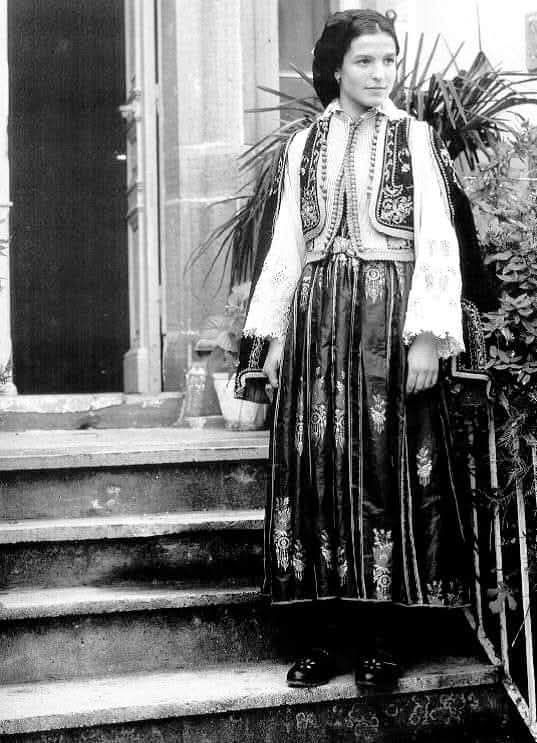

“СТАРА СРБИЈА,- Србкиња из TРНАВЕ,(данашња Тирана у Албанији).1936.година” is a text from a Serbian site claiming that this is a Serbian woman in Ternava of Tirana.
In 1936, material circulated under the title “Стара Србија” (“Old Serbia”), referring to a “Serbian woman from Trnava (present-day Tirana, Albania).” The narrative suggested—either explicitly or implicitly—that Tirana had once possessed a Serbian majority population. This claim does not withstand historical scrutiny and should be understood within the broader framework of nationalist propaganda rather than objective historiography.
Historical Context: Nationalism in the Interwar Balkans
The interwar period in the Balkans was marked by intense nation-building projects, territorial anxieties, and competing historical narratives. After the establishment of the Kingdom of Serbs, Croats, and Slovenes in 1918 (renamed the Kingdom of Yugoslavia in 1929), Serbian political and intellectual circles increasingly emphasized concepts such as “Old Serbia”—a term used to describe territories considered historically or culturally Serbian, especially in Kosovo and parts of North Macedonia.
However, extending this narrative to Tirana—Albania’s capital—represents a clear distortion. Albania declared independence in 1912, and Tirana became its capital in 1920. Demographic, linguistic, and cultural evidence consistently shows that Tirana was overwhelmingly Albanian in population and identity throughout the late Ottoman and interwar periods. There is no credible historical data indicating a Serbian majority in the city.
The Function of the Narrative
The story of a “Serbian woman from Trnava” appears to function symbolically rather than factually. Such narratives were often used to:
- Reinforce territorial claims or cultural presence beyond recognized borders;
- Construct emotional legitimacy for nationalist projects;
- Portray neighboring regions as historically “lost” lands;
- Mobilize public sentiment through personalized and romanticized imagery.
By focusing on an individual—particularly a woman—the narrative becomes humanized and emotionally persuasive. It shifts attention away from demographic realities and toward symbolic belonging. This is a classic strategy in nationalist storytelling: individual anecdotes are presented as evidence of broader historical claims, even when those claims lack empirical support.
Demographic Reality vs. Political Myth
Available historical records from Ottoman administrative data, early Albanian state documentation, and international observers do not support the assertion of a Serbian majority in Tirana at any point in the modern era. While the Balkans have long been characterized by migration and minority communities, isolated cases of Serbian individuals or families residing in Tirana would not justify the claim of demographic dominance.
The leap from “a Serbian individual lived there” to “this was Serbian land” exemplifies how propaganda simplifies complex historical realities. It replaces nuanced demographic patterns with absolutist national narratives.
Gendered Symbolism and National Identity
The figure of a “Serbian woman” is also politically significant. Women in nationalist discourse often symbolize the nation itself—its purity, continuity, and suffering. By framing Tirana within such imagery, the narrative attempts to feminize and thereby “claim” the territory symbolically. This technique transforms geopolitics into a moral and emotional drama.
Such symbolic constructions blur the line between memory and myth. They create a powerful narrative framework that can outlive factual corrections.
Critical Evaluation
From a scholarly perspective, claims about Tirana having a Serbian majority are unsupported by credible demographic or historical evidence. The 1936 narrative must therefore be approached as part of a broader nationalist discourse aimed at strengthening ideological cohesion rather than documenting historical fact.
Critical historical analysis requires:
- Cross-referencing demographic data;
- Distinguishing between individual presence and collective majority;
- Recognizing the political motives behind historical terminology such as “Old Serbia”;
- Avoiding retrospective territorial reinterpretations.
Conclusion
The 1936 portrayal of a “Serbian woman from Trnava (Tirana)” illustrates how nationalist propaganda can transform isolated anecdotes into sweeping territorial claims. There is no reliable evidence that Tirana ever had a Serbian majority population. The narrative belongs not to verified demographic history, but to the symbolic politics of interwar Balkan nationalism.
Understanding such cases is essential not to inflame historical disputes, but to clarify how political agendas shape historical memory. Only through critical scholarship can myth be separated from documented reality.


 Balkan Academia