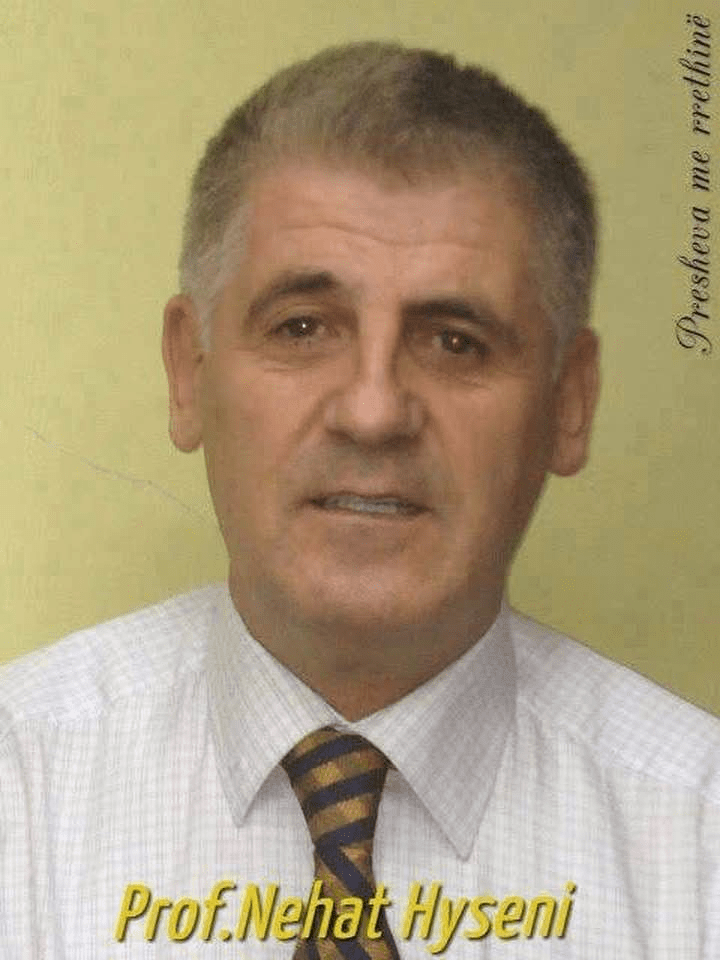

by Nexhat Hyseni
Abstract
This essay by Nehat Hyseni explores the transformation of the teacher’s role from a figure of formal authority to a facilitator of students’ intellectual and personal development. Drawing on experiences at the “Skënderbeu” Gymnasium in Presheva, the author argues that true authority is grounded not in institutional power, but in competence, ethical integrity, and dialogue. Modern education, he maintains, places the student at the center as an active, critical participant. The teacher’s mission is to cultivate free, creative, and responsible individuals through academic justice, methodological innovation, and reflective practice. Education is ultimately presented as an emancipatory and humanizing process that strengthens both personal freedom and societal values.
I. From the figure of authoritative power to the shaper of free personality and student’s creativity
In a certain historical period, the teacher was perceived mainly as a bearer of institutional power. His authority was formal, based on the hierarchy of the educational system and the culture of strict discipline. The professor’s word was almost unquestionable; his decision was considered final; the distance between him and the student was part of professional ethics.
This model had its own stability. It guaranteed order, concentration, and formal respect. However, in the pedagogical plan, it often created vertical relationships where the student remained the object of the learning process, more of a recipient than a co-creator of knowledge.
The evolution of pedagogical thought and the concrete experience at the “Skënderbeu” Gymnasium led me to a deep reflection: the teacher should not be a power over the student, but an authority for the student. He is not a class commander, but an architect of personality development.
II. The student as an active subject, not a passive object of the educational process
The traditional model conceived of the student as an object of shaping – as a vessel to be filled with knowledge. In this paradigm, what mattered was the content, not the process; the outcome, not the path that led to success.
The modern perspective of teaching places the student at the center as an active subject. He is no longer a passive recipient, but a critical participant in the learning process. The role of the teacher is transformed from a transmitter of information to a facilitator of learning.
This means:
• Encouraging analytical and critical thinking;
• Encouraging questions and discussion;
• Developing intellectual autonomy;
• Cultivating self-confidence and personal responsibility.
In this sense, education is not simply the accumulation of knowledge, but should truly be an emancipatory process.
III. Authority as competence and professional ethics
True authority does not stem from fear, but from competence. It is built on:
• In-depth scientific knowledge;
• Coherent methodological approach;
• Fairness in assessment;
• Integrity of personnel.
At Skanderbeg High School, concrete challenges – including cases of dissatisfaction and pedagogical tensions – proved that authority is gained through dialogue and justice. When students feel equality and transparency, they accept authority as legitimate.
This is the essential difference between formal power and moral authority.
IV. Education as the cultivation of a free personality
A school that aims for quality is not satisfied with academic preparation; it aims for character formation. A free and creative personality is the product of an environment where the student:
• Has room for expression;
• Is not afraid of making mistakes;
• Learns to argue and listen;
• Builds one’s identity in dialogue with others.
In this respect, the teacher is an educator – an inspirer of intellectual and ethical development. He does not form copies of himself, but autonomous individuals.
V. Methodical transformation: from monologue to dialogue
Traditional methodology was based on frontal lecture. Today, the teaching paradigm requires interaction.
Pedagogical dialogue:
• Increases inclusion;
• Deepens understanding;
• Strengthens argumentative skills;
• Develops a culture of civil debate.
In my practice, the shift towards interactive methods – structured discussions, case analyses, group work – made the classroom a space of dynamic liveliness rather than a static lecture hall.
VI. Academic justice as the foundation of trust
Trust is the greatest asset of an educational institution. It is built through justice and coherence.
Every pedagogical decision should be reasoned and transparent. Assessment should not be a punishment, but developmental feedback. When the student understands the criteria, he accepts the result.
The experience at the “Skënderbeu” High School showed that avoiding drastic punishments and opting for institutional dialogue strengthens the dignity of the school and the teachers themselves.
VII. The teacher as an ethical and civic model
The role of a teacher does not end in the classroom. He is a public figure, a civic role model, and a bearer of values.
In a society facing identity, cultural and political challenges, the school has a mission to cultivate:
• Tolerance;
• Civic awareness;
• Respect for the pluralism of ideas, worldviews and actions;
• Social responsibility.
The teacher, through his attitude, transmits more than teaching content – he transmits a culture of dialogue and public ethics.
VIII. Education as a continuous reflective process
No pedagogical model is perfect. Education is an evolutionary process. Reflecting on my experience before and after my undergraduate and graduate studies taught me that improvement begins with self-criticism.
The modern teacher should be:
• A researcher of his own practice;
• Open to training and innovation;
• Ready for methodical review;
• Committed to contemporary standards.
IX. The contribution of the “Skënderbeu” Gymnasium to this transformation
The Skanderbeg High School in Presheva was not just an educational institution; it was also a laboratory of transformation. Through challenges and reflections, it proved that tradition and modernity can successfully intertwine.
This institution maintained academic seriousness and discipline, but gradually opened the way for dialogue, methodological improvement, and intellectual emancipation.
X. Conclusion: From power to mission
The teacher is not a power over the student; he is a mission in service of his development. From a figure of formal authority, he is transformed into an inspiring educator, mentor and guide.
The student is not a static object of the educational process, but a creative subject, with the potential for free thought and critical action.
This transformation constitutes the essence of modern education and the pride of an institution like Skanderbeg High School – a school that has known how to preserve the dignity of tradition and embrace the challenges of the time.
In this spirit, education remains an emancipatory act, a humanizing process, and an investment in freedom of thought. And this is the greatest value that a school can give to society.
Presevo, February 14, 2026


 Balkan Academia