
Abstract
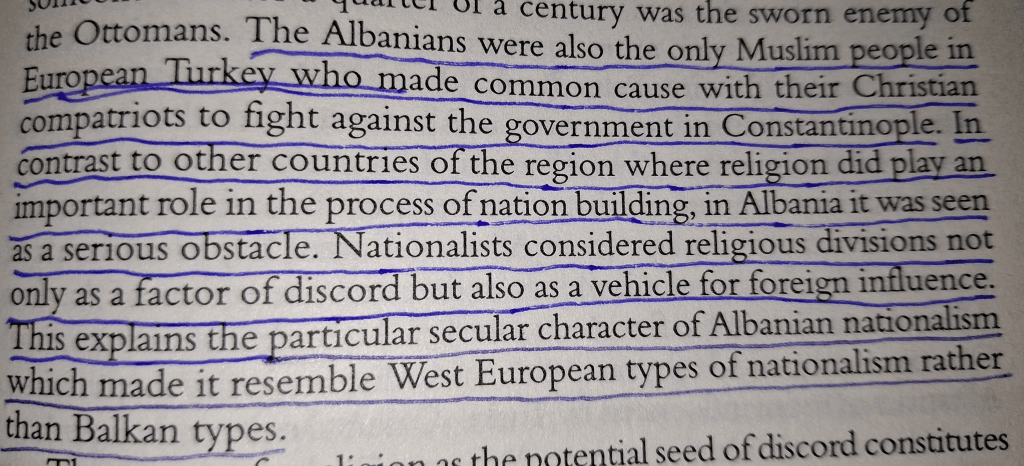
This study examines the secular character of Albanian nationalism in the late Ottoman period and its distinct divergence from other Balkan national movements. Unlike neighboring societies where religion constituted a primary axis of national mobilization, Albanian nationalism emerged through cross-confessional cooperation among Muslim and Christian communities. Religious affiliation, rather than serving as a foundation for national identity, was frequently perceived as a source of fragmentation and a channel for external political influence. Consequently, Albanian nationalists prioritized linguistic, cultural, and territorial unity over confessional divisions. This secular orientation contributed to a form of nationalism that more closely resembled Western European models—rooted in civic and cultural cohesion—than the predominantly religiously defined nationalisms characteristic of the Balkans. The Albanian case thus challenges assumptions that Balkan nationalism was uniformly grounded in religious identity and highlights the contingent nature of nation-building processes in Southeastern Europe.
Secular Foundations of Albanian Nationalism: Cross-Confessional Unity and the Distinctiveness of Nation-Building in Southeastern Europe
Introduction
The formation of national movements in Southeastern Europe during the nineteenth and early twentieth centuries is frequently interpreted through the lens of religion. In much of the Balkans, confessional identity—Orthodox, Catholic, or Muslim—served as a primary marker of collective belonging and a crucial mobilizing force in struggles against Ottoman rule. Yet the Albanian case presents a notable deviation from this broader regional pattern. Albanian nationalism developed as a distinctly secular project in which religious difference was deliberately subordinated to linguistic, cultural, and territorial unity.
This article argues that the secular character of Albanian nationalism was neither incidental nor superficial, but foundational to its development. The cooperation between Muslim and Christian Albanians, the marginalization of religious institutions in political mobilization, and the prioritization of language as the core marker of identity collectively produced a national movement that more closely resembled Western European civic nationalism than the confessional nationalisms dominant elsewhere in the Balkans.
Religion and Nation-Building in the Balkan Context
In the nineteenth century, religion often functioned as a principal framework for political organization in the Ottoman Balkans. The millet system institutionalized confessional distinctions, reinforcing the association between religious community and proto-national identity. In Greece, Serbia, and Bulgaria, ecclesiastical institutions played decisive roles in fostering national consciousness. The Orthodox Church, in particular, became intertwined with linguistic standardization, educational reform, and political mobilization.
Within this broader regional dynamic, religion frequently operated as both a boundary marker and a mobilizing structure. National identity and religious affiliation were mutually reinforcing, and political claims to autonomy or independence were often articulated through ecclesiastical reform or church-state realignment. The Balkan pattern thus established a close alignment between confessional identity and nationhood.
The Albanian Divergence
In contrast, Albanian society was characterized by significant religious pluralism: Sunni Muslims, Bektashi Muslims, Orthodox Christians, and Catholics coexisted within overlapping linguistic and kinship networks. Crucially, no single religious institution encompassed the majority of the population or functioned as a unifying authority capable of monopolizing national discourse.
This fragmentation created both a challenge and an opportunity. Rather than allowing confessional divisions to structure political identity, Albanian intellectuals of the National Awakening (Rilindja Kombëtare) deliberately constructed a discourse that privileged language (gjuha), shared historical memory, and territorial belonging over religious difference. The oft-cited maxim “Feja e shqiptarit është shqiptaria” (“The religion of the Albanian is Albanianism”) encapsulates this ideological orientation. Religion was reframed not as the basis of nationhood but as a private matter secondary to collective national identity.
Moreover, Albanian Muslims—unlike many Muslim populations elsewhere in Europe—actively participated in anti-Ottoman political mobilization alongside their Christian compatriots. This cross-confessional cooperation was significant. It demonstrated that opposition to Ottoman authority was not reducible to a Christian revolt against Muslim rule but constituted a broader national project transcending religious affiliation.
Religion as Obstacle and Vector of Foreign Influence
Albanian nationalists frequently perceived religious divisions as potential sources of discord and as channels for foreign intervention. Catholic communities were often associated with Austro-Hungarian influence; Orthodox communities with Greek ecclesiastical and political ambitions; and Muslim elites with Ottoman administrative structures. Consequently, religious identity was viewed not merely as a social distinction but as a vulnerability that external powers could exploit.
This perception further incentivized the articulation of a secular national ideology. By emphasizing linguistic unity and shared descent, nationalist leaders sought to neutralize confessional cleavages and insulate the emerging nation from external manipulation. In doing so, they framed secularism not as hostility toward religion, but as a pragmatic strategy for political cohesion and sovereignty.
Western European Resonances
The civic orientation of Albanian nationalism bears comparison with Western European models of nation-building, particularly those emphasizing language, culture, and territorial citizenship over confessional homogeneity. Although not identical to French republicanism or other Western paradigms, Albanian nationalism shared a commitment to the idea that political community should transcend religious affiliation.
This alignment was not the product of simple imitation but emerged from domestic structural realities. In a society without a dominant confessional majority, a religiously defined nationalism would have been inherently exclusionary and destabilizing. Secular nationalism therefore functioned as both a normative ideal and a practical necessity.
Implications for the Study of Balkan Nationalism
The Albanian case challenges homogenizing interpretations of Balkan nationalism as intrinsically religious. It demonstrates that nation-building processes were contingent upon local demographic configurations, institutional legacies, and geopolitical pressures. While religion undoubtedly shaped social life in Albania, it did not become the organizing principle of national identity.
This divergence underscores the importance of examining intra-regional variation in the Balkans. Rather than treating the region as a monolithic zone of confessional nationalism, scholars must recognize the multiplicity of pathways through which modern nations emerged. The Albanian example illustrates how secularism could arise not from the absence of religion, but from the need to manage religious diversity within a shared political framework.
Conclusion
Albanian nationalism developed as a secular and cross-confessional project that distinguished it from many neighboring Balkan movements. By subordinating religious divisions to linguistic and cultural unity, Albanian nationalists forged a civic-oriented national identity capable of mobilizing Muslims and Christians alike against Ottoman authority. Religion, rather than serving as the cornerstone of nationhood, was frequently regarded as a potential source of fragmentation and foreign influence.
This secular character helps explain why Albanian nationalism more closely resembled Western European models than the confessional nationalisms prevalent in the Balkans. The Albanian experience thus complicates conventional narratives of Balkan nation-building and highlights the adaptability of nationalist ideologies to specific historical and social conditions.
Sources
Clayer, Nathalie. Aux origines du nationalisme albanais: La naissance d’une nation majoritairement musulmane en Europe. Paris: Karthala, 2007.
Clayer, Nathalie. “God in the ‘Land of the Mercedes’: The Religious Communities in Albania since 1990.” In Religion and Politics in Post-Socialist Central and Southeastern Europe: Challenges since 1989, edited by Sabrina P. Ramet, 277–314. New York: Palgrave Macmillan, 2014.
Duijzings, Ger. Religion and the Politics of Identity in Kosovo. New York: Columbia University Press, 2000.
Elsie, Robert. Historical Dictionary of Albania. 2nd ed. Lanham, MD: Scarecrow Press, 2010.
Fischer, Bernd J. Albania at War, 1939–1945. West Lafayette, IN: Purdue University Press, 1999.
Gawrych, George W. The Crescent and the Eagle: Ottoman Rule, Islam and the Albanians, 1874–1913. London: I.B. Tauris, 2006.
Hobsbawm, Eric J. Nations and Nationalism since 1780: Programme, Myth, Reality. 2nd ed. Cambridge: Cambridge University Press, 1992.
Jelavich, Barbara. History of the Balkans. Vol. 2, Twentieth Century. Cambridge: Cambridge University Press, 1983.
Misha, Piro. “Invention of a Nationalism: Myth and Amnesia.” In Albanian Identities: Myth and History, edited by Stephanie Schwandner-Sievers and Bernd J. Fischer, 33–48. Bloomington: Indiana University Press, 2002.
Skendi, Stavro. The Albanian National Awakening, 1878–1912. Princeton, NJ: Princeton University Press, 1967.
Vickers, Miranda. The Albanians: A Modern History. London: I.B. Tauris, 1999.


 Balkan Academia