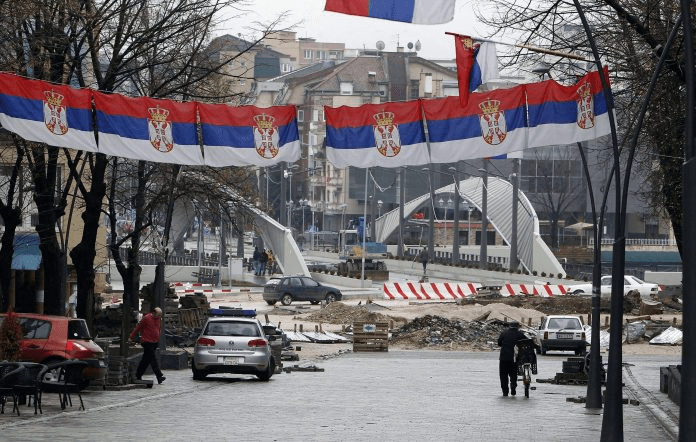

image from Dukagjini
Abstract
This article critically examines recurrent tendencies within segments of post-war Serbian public discourse to externalize responsibility for atrocities committed during the dissolution of Yugoslavia. It argues that the persistent framing of violence as primarily the work of marginal paramilitary units, coupled with the invocation of “anarchy” and institutional collapse as explanatory paradigms, functions as a mechanism of moral and political displacement. By concentrating culpability in irregular formations—often symbolized by figures such as Željko Ražnatović—and in abstract conditions of chaos, broader patterns of civilian participation and localized neighbor-against-neighbor violence risk being obscured.
Drawing on comparative theories of mass violence, collective memory, and transitional justice, the article contends that such narrative strategies serve important identity-preserving functions but simultaneously impede ethical reckoning and democratic consolidation. It distinguishes between collective guilt and collective responsibility, emphasizing that acknowledgment of civilian complicity does not entail essentializing national criminality. Rather, it posits that confronting the full spectrum of agency—including ordinary actors embedded in local communities—is a necessary precondition for sustainable reconciliation in societies emerging from civil war.
Responsibility, Denial, and Narrative Control: A Critical Examination of Guilt Externalization in Post-Yugoslav Serbian Discourse
Introduction
Since the disintegration of Yugoslavia, questions of responsibility for the violence of the 1990s have remained deeply contested across the successor states. Within segments of Serbian public discourse, a recurring interpretive pattern has involved concentrating blame on paramilitary formations—irregular units portrayed as marginal, criminal, or rogue—while minimizing or obscuring the participation of locally embedded actors. Parallel to this is the frequent invocation of “anarchy,” “chaos,” or “state collapse” as explanatory frameworks that diffuse responsibility into structural inevitability.
This article advances a critical examination of these tendencies. It argues that the persistent framing of wartime atrocities as the work of autonomous paramilitaries operating in conditions of generalized breakdown functions as a mechanism of moral externalization. By isolating culpability in exceptional actors and exceptional circumstances, broader patterns of civilian complicity and neighbor-against-neighbor violence risk being obscured. Such narrative strategies, while politically and psychologically intelligible, impede ethical reckoning and long-term reconciliation.
The Paramilitary as Scapegoat
Paramilitary formations such as the units associated with Željko Ražnatović (commonly known as Arkan) or the so-called “White Eagles” have come to symbolize the brutality of the wars in Bosnia and Herzegovina and Croatia. Their visibility—through uniforms, insignia, and media notoriety—rendered them convenient focal points for both international prosecution and domestic narrative distancing.
In parts of Serbian discourse, these groups are frequently represented as criminal outliers: violent men detached from ordinary society, driven by greed or fanaticism rather than communal endorsement. This representation serves a dual function. First, it acknowledges wrongdoing in a limited and compartmentalized manner. Second, it shields the imagined moral core of the nation by implying that atrocities were committed by deviant minorities rather than by individuals embedded in everyday social networks.
However, a growing body of scholarship on mass violence challenges the assumption that atrocities are primarily the work of socially isolated extremists. Comparative studies of communal violence—from Eastern Europe during World War II to Rwanda in 1994—demonstrate that ordinary civilians, once armed and politically mobilized, can become direct perpetrators against neighbors. The wars following the collapse of Yugoslavia were no exception. In numerous documented cases, violence was enacted not solely by itinerant paramilitaries but also by locally organized militias and civilians who knew their victims personally.
To foreground only the paramilitary dimension is therefore analytically insufficient. It risks transforming complex patterns of participation into a morality play of villains and bystanders, rather than confronting the unsettling reality that boundaries between “civilian” and “combatant” were frequently porous.
The Rhetoric of “Anarchy”
The invocation of “anarchy” as an explanatory category operates as a second layer of moral diffusion. The collapse of federal institutions in 1991–1992 undoubtedly produced profound instability. Yet the discursive emphasis on chaos can function as a deterministic narrative: when order disappears, violence becomes inevitable, and individual agency recedes.
Such reasoning mirrors what political theorists identify as structural exculpation—the displacement of moral responsibility from actors to abstract conditions. If violence is framed as the automatic byproduct of institutional breakdown, then perpetrators appear less as moral agents and more as passive conduits of historical forces. The ethical implication is subtle but significant: responsibility is diluted into circumstance.
This rhetorical move has resonance beyond Serbia; post-conflict societies frequently adopt narratives of “everyone was afraid” or “no one was in control.” Yet in the Serbian case, the stress on anarchy can obscure evidence of organized mobilization, political propaganda, and selective targeting. The existence of chaos does not negate agency; rather, it often creates permissive environments in which latent hostilities are activated. To describe such processes solely as spontaneous breakdown is to overlook the interplay between structure and choice.
Civilian Participation and the Problem of Proximity
One of the most disturbing aspects of the Yugoslav wars was the intimacy of violence. In mixed towns and villages, perpetrators and victims had often coexisted for decades. Property registries, employment records, and social familiarity could facilitate targeting. The transformation of neighbor into enemy did not occur in a social vacuum; it was mediated by media narratives, nationalist mobilization, and the distribution of arms.
Acknowledging civilian participation is not equivalent to collective condemnation. Rather, it recognizes that mass violence is rarely sustained by isolated units alone. It requires networks of logistical support, silence, opportunism, and, at times, direct action by individuals who are otherwise socially “ordinary.” The discomfort this produces is precisely why narratives that externalize guilt are attractive. They preserve a moral distinction between “us” and “them,” even when empirical boundaries were blurred.
The reluctance to confront this proximity is understandable. Societies emerging from civil war must rebuild trust among survivors who continue to share physical space. Yet durable reconciliation depends on confronting, not erasing, the complexity of participation. Where acknowledgment is absent, denial may ossify into identity.
Legal Accountability and Social Memory
The work of the International Criminal Tribunal for the former Yugoslavia (ICTY) established individual criminal responsibility for numerous actors across ethnic lines. High-profile convictions of Serbian political and military leaders signaled that culpability was not confined to paramilitary irregulars. Nevertheless, legal judgments do not automatically translate into collective introspection. Courtroom narratives coexist with national narratives, and the latter are shaped by education systems, media, and political rhetoric.
When public discourse persistently narrows the field of blame to marginal figures or impersonal chaos, it creates tension with judicial findings that document broader patterns of coordination and participation. This dissonance can foster skepticism toward international institutions, reinforcing defensive postures rather than encouraging reflective engagement.
The Ethics of Reckoning
A rigorous moral reckoning requires distinguishing between collective guilt and collective responsibility. The former imputes criminality to an entire people; the latter acknowledges that societies can cultivate environments in which violence becomes thinkable and practicable. To critique narratives that overemphasize paramilitaries or anarchy is not to essentialize Serbs as uniquely culpable. It is to insist that sustainable reconciliation demands honesty about the range of actors involved.
Post-conflict identity formation often oscillates between victimhood and defensiveness. Yet an exclusive focus on Serbian suffering—real and significant as it was in various theaters—can coexist with reluctance to confront Serbian perpetration in specific locales. Mature democratic culture requires the capacity to hold these realities simultaneously: to mourn one’s own losses while recognizing one’s community’s crimes.
Conclusion
The persistent tendency in segments of Serbian discourse to attribute wartime atrocities primarily to paramilitary “others” or to undifferentiated anarchy functions as a mechanism of guilt externalization. While politically expedient and psychologically protective, such narratives obscure the complex interplay of civilian agency, local participation, and organized mobilization that characterized much of the violence following Yugoslavia’s collapse.
A critical reexamination of these narrative strategies is not an exercise in collective shaming but in ethical clarity. By confronting the uncomfortable reality that ordinary individuals can become perpetrators under certain conditions, societies strengthen their capacity to resist future mobilizations of hatred. The alternative—retreat into exceptionalism and structural fatalism—risks perpetuating cycles of denial that hinder both reconciliation and democratic consolidation.


 Balkan Academia