
Abstract
In contemporary Balkan discourse, certain irredentist Serbian nationalist activists have mocked Albanians as a shepherd people, implying backwardness or civilizational inferiority. This article critically examines that rhetoric and argues that pastoral culture is not a sign of marginality but one of the deepest and most enduring foundations of European civilization. By situating Albanian highland pastoralism within broader Indo European and Mediterranean traditions, and by contrasting decentralized clan based organization with medieval imperial hierarchies such as the Serbian tsardom, the article challenges triumphalist narratives. It proposes instead that the archetype of the shepherd represents continuity, autonomy, and social resilience, and that pastoral societies preserved forms of organization that were adaptive, self regulating, and resistant to feudal domination.
The politics of mockery
In nationalist polemics, stereotypes are rarely accidental. Among some radical Serbian irredentist circles, Albanians are disparaged as mere shepherds, as though pastoralism were synonymous with cultural inferiority. The insult rests on a linear and imperial model of history, one in which centralized monarchies, medieval courts, and ecclesiastical hierarchies are treated as the measure of civilization.
This assumption deserves scrutiny. Pastoralism is not a deviation from civilization. It is one of its oldest pillars.
The Shepherd as the oldest human archetype
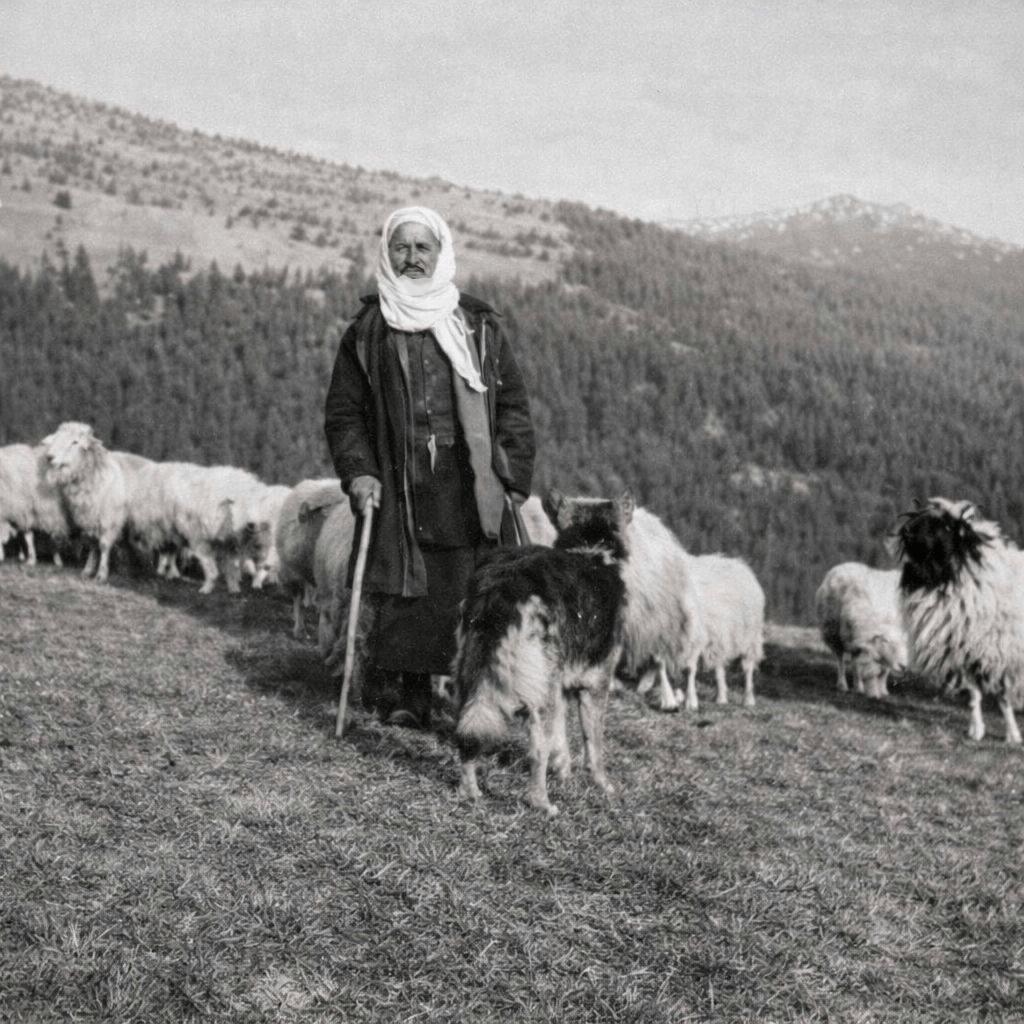
The shepherd stands among the most ancient figures in human history. Long before Balkan empires emerged, transhumant herders moved seasonally between highland and lowland pastures. This pattern shaped early European economies and social structures. Archaeology and comparative anthropology show that animal husbandry was central to Indo European expansion and to the formation of early European cultural patterns.
The shepherd is also a moral archetype. In ancient Mediterranean traditions, the shepherd symbolized vigilance, guardianship, and responsibility. Pastoral life required patience, endurance, ecological knowledge, and communal cooperation. It was neither primitive nor chaotic. It was structured, disciplined, and deeply tied to landscape.
If antiquity is a marker of continuity, then pastoral cultures in the western Balkans reflect some of the region’s deepest historical layers.
Albanian highland pastoralism and continuity
For centuries, Albanian highland communities organized themselves around clan structures that combined pastoral economy with customary law. These societies were not stateless in the sense of disorder. They were self regulating through codes such as the Kanun, systems of mutual obligation, and assemblies of elders.
Their economy revolved around flocks, seasonal movement, and small scale agriculture. This way of life produced relative self sufficiency. It required intimate knowledge of terrain and climate. It also encouraged local autonomy.
Such structures often resisted incorporation into centralized medieval states. To imperial administrations, decentralized mountain clans appeared unruly precisely because they were not easily taxed, conscripted, or subordinated to court hierarchies.
Late Medieval Serbian imperial structures
By contrast, medieval Serbian statehood under rulers such as Stefan Dušan built a centralized hierarchy with aristocratic titles, taxation systems, and a strong alliance with the Orthodox Church. This model of governance mirrored broader Byzantine political theology. Authority flowed from the monarch downward.
From the perspective of imperial administration, pastoral highlanders could be seen as peripheral. Yet from another perspective, they represented an alternative social order. They maintained communal land usage, clan based justice, and a degree of political decentralization that stood apart from feudal stratification.
When imperial systems expanded, pastoral groups including Albanians and Vlachs were often subjected to taxation, corvée labor, or military obligations. Conflicts between central authority and highland autonomy were structural, not merely ethnic.
Health, ecology, and social structure
Romanticization should be avoided, but it is equally simplistic to equate pastoral life with deprivation. Historical records and anthropological studies suggest that mountain pastoralists often enjoyed robust physical health due to mobility, outdoor life, and diets rich in dairy and meat.
Their social systems emphasized kinship solidarity and mutual defense. Decision making frequently occurred at the local level rather than through distant bureaucracies. In this sense, one could argue that certain highland communities embodied early forms of localist or proto libertarian organization, grounded in customary law rather than imposed statute.
This autonomy was not anarchic. It was regulated through honor codes, mediation mechanisms, and reciprocal obligations.
Rethinking civilizational hierarchies
To mock a people as shepherds is to misunderstand the foundations of European civilization itself. Urban courts and imperial titles are historically recent compared to the pastoral substratum that preceded them.
Moreover, migration and state formation in the Balkans were complex and layered processes. Slavic speaking groups entered the peninsula in the early medieval period. Over centuries, they formed kingdoms and empires. Albanian speaking populations likewise evolved, migrated internally, and interacted with neighboring groups. No modern nation can claim exclusive antiquity without oversimplification.
If anything, pastoral continuity in the western Balkans testifies to cultural endurance across waves of imperial change. The shepherd did not vanish when empires rose and fell. He remained on the mountainside, guarding his flock.
Conclusion
The derision of Albanians as shepherds reveals more about nationalist insecurity than about historical reality. Pastoral culture is not evidence of backwardness but of deep rooted continuity. It represents one of humanity’s oldest social forms, predating kings and tsars alike.
Imperial hierarchies and centralized states may leave monumental architecture and legal codes. Shepherd societies leave something quieter but no less significant. They leave continuity of land use, customary law, and communal autonomy.
In the long arc of Balkan history, the contrast is not between civilization and primitivism. It is between two models of social organization. One concentrates authority in courts and cathedrals. The other sustains it in assemblies, kin networks, and mountain pasture


 Balkan Academia