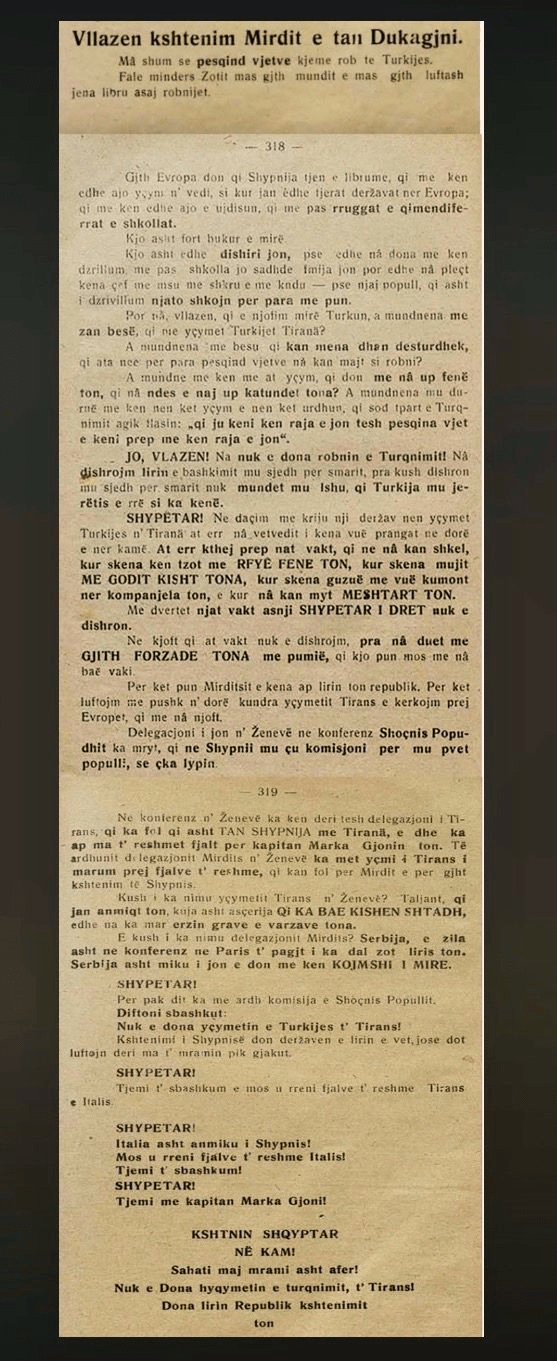

Discovery by Gjurim Gjata.
Abstract
This document is a political proclamation addressed to the Catholic highland communities of Mirdita and Dukagjini in northern Albania, most likely dating from 1920–1921 during the Mirdita uprising. The text situates itself in the post-Ottoman political landscape following Albania’s independence and references the Tirana government, international diplomacy in Geneva, and the League of Nations. Framed as an appeal to unity, religious identity, and national self-determination, the proclamation rejects both Ottoman legacy and perceived domination by the central Albanian authorities. It reflects the tensions between regional autonomy, religious identity, and emerging Albanian statehood in the early interwar period.
Transcribed:
“Brothers, the people of Mirdita and all of Dukagjin!
For more than 500 years, we have been slaves under Turkey. Thanks to the greatness of God, after many sacrifices and battles, we have freed ourselves from this bondage.
All of Europe wishes for Albania to be free, so that it too can be part of the civilized world, like other European states, with fair laws, roads, bridges, and schools.
This is the most beautiful and just thing.
This is also our desire, because we want to be free, to have schools not only for our children, but also to educate ourselves—to learn to read, write, and sing—as any free nation that has rights and opportunities for its people.
But, brothers, we know Turkey well. Can we trust it anymore? Can we believe that those who have kept us as slaves for more than 500 years will now grant us freedom? Is it possible, when they seek to impose their religion and control every village of ours? NO, BROTHERS! We do not want Turkish slavery! We want freedom and full unity, and anyone who wants to live under their rule cannot be part of this goal.
Albanians! We must create an independent state, free from Turkish rule. For this, we have broken the chains from our hands and fought to protect our land. We will not allow anyone to oppress us, when we have defended our faith, our churches, when we have fought to protect our lands and families.
At that time, no just Albanian could desire slavery. And if we do not want it, we must work with all our strength to ensure it never happens.
For this reason, the people of Mirdita have given their freedom and are fighting with guns in hand against the tyranny of Tirana, and are asking Europe to recognize our rights.
Our delegation in Geneva, at the League of Nations conference, requested that a commission come to Albania to ask the people what they want.
At the Geneva conference, there was also a delegation from Tirana, claiming to represent all of Albania, and speaking grand words about our Captain Marka Gjoni. The Mirdita delegation learned of Tirana’s words, which spoke about Mirdita and all of Albania.
Who listened to Tirana in Geneva? The Italians, who are our enemies. They are untrustworthy and have taken away our rights, our women, and our property.
And who supported the Mirdita delegation? Serbia, which has been a friend to Albania and has defended our freedom. Serbia is our ally and will be a good partner.
Albanians!
In a few days, the League of Nations commission will arrive.
Listen carefully:
• We do not want Turkish rule!
• The people of Albania want their own state and freedom and will fight to the last drop of blood.
• We are united and do not be fooled by Tirana’s grand words!
• Italy is Albania’s enemy! Do not be deceived by their words!
• We must stay united!
• Support Captain Marka Gjoni!
Albanians, the time has come! We do not want the Turkish yoke over Albania!”
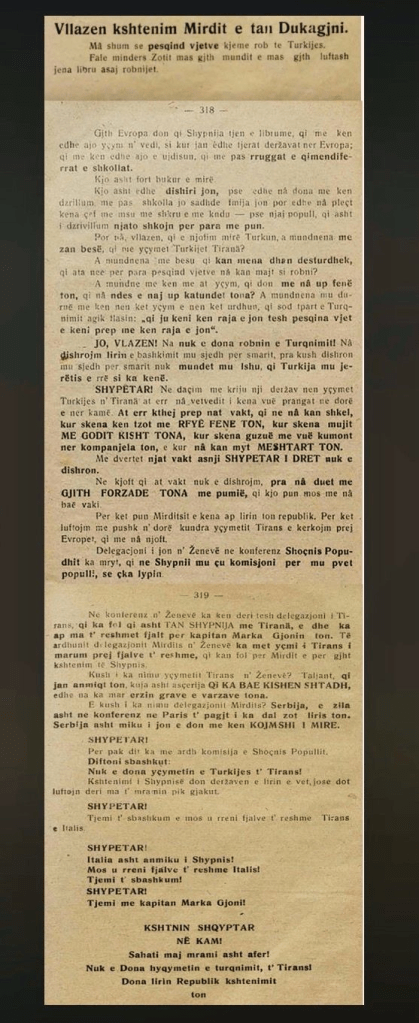
Source
“Vllazen kshteni Mirdit e tan Dukagjni.” Political proclamation. Mirditë, Albania, 1921.


 Balkan Academia