
by Aleksander Hasanas.
Abstract
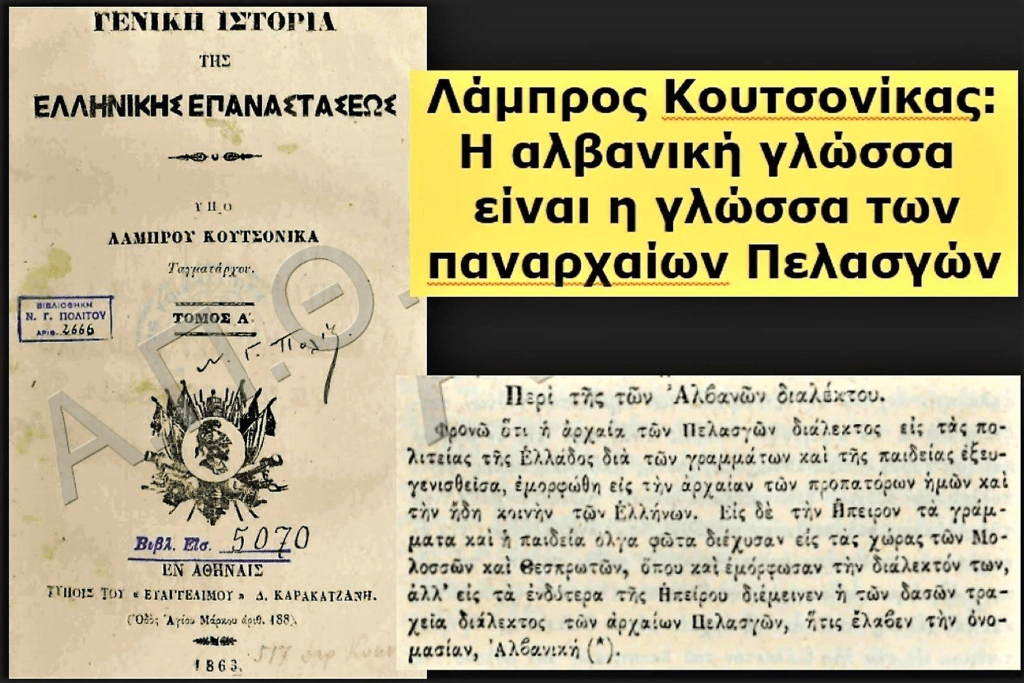
This text presents the 19th-century view of Lampros Koutsonikas, who argues that the Albanian language derives from the ancient Pelasgian language. In his work on the Greek Revolution, Koutsonikas includes a linguistic reflection claiming that while Greek developed through literacy and education in the Greek city-states, the original Pelasgian dialect survived in the mountainous and less culturally integrated regions of Epirus. According to him, this preserved dialect later became known as Albanian.
Transcribed from Greek:
“On the Dialect of the Albanians
It appears that the ancient dialect of the Pelasgians, in the city-states of Greece, through letters and education, was refined and shaped into the ancient language of our ancestors and into what is now the common language of the Greeks.
But in Epirus, letters and education spread little light into the lands of the Molossians and Thesprotians, where they also formed their dialect; yet in the interior of Epirus there remained the rough dialect of the ancient Pelasgians, which later received the name Albanian.”
Source
Koutsonikas, Lampros. General History of the Greek Revolution. Vol. 1. Athens: Typis tou “Evangelismou” A. Karakatsani, 1863.


 Balkan Academia