
by Elton Ligu. Edited by Petrit Latifi
Abstract
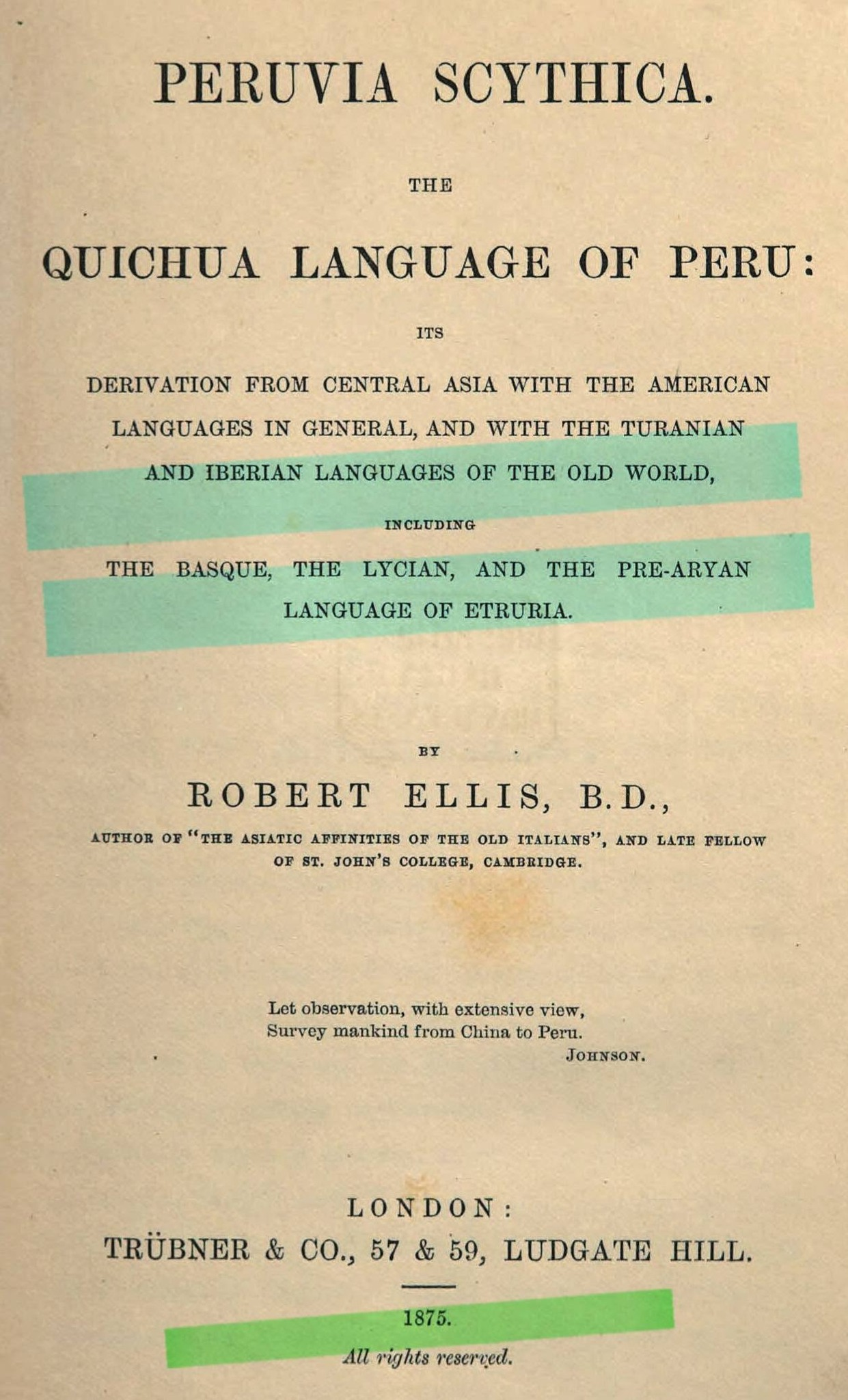
This paper examines Peruvia Scythica (Vienna, 1875), a work that analyzes the Quechua language and its lexicon. The text proposes that Quechua displays continuities with ancient Eurasian languages, including Basque, Etruscan, Albanian, and Pelasgian, predating the Aryan language family. Several lexical parallels are highlighted—such as zok, hunde, arra, qëndis, djalë, degë, and gjethe—which are purportedly shared with Albanian and, in some instances, Basque. The study contextualizes Quechua as the official language of the Inca Empire and discusses post-conquest missionary use. Finally, it reflects on contemporary linguistic scholarship concerning Albanian’s historical development and the comparative value of non-Indo-European language research.

The book Peruvia Scythica (Vienna, 1875) presents an analysis of the Quechua language and the contents of its vocabulary, asserting that this lexicon manifests a continuity with several of the world’s ancient languages. The author identifies lexical correspondences with Basque, Etruscan, Albanian, and Pelasgian, suggesting a shared substratum that predates the spread of Aryan (Indo-European) linguistic features. Examples cited include terms such as zok, hunde, arra (also observed in Basque), qëndis, djalë, degë, and gjethe, among others, which are compared with cognates in Albanian and related ancient linguistic traditions.

Quechua was the principal language of the Inca state, serving as the official medium of communication across the largest pre-Columbian civilization in South America. Following the Spanish conquest, Quechua continued to be used by missionaries in efforts to promulgate Christianity among indigenous communities.

The work further critiques prevailing academic attitudes toward the Albanian language. It argues that many scholars—both domestic and international—continue to describe Albanian as primarily shaped by borrowings from other tongues. In contrast, the text claims that foreign linguists have long recognized Albanian as a valuable reference point for resolving questions about ancient languages, treating it as a language of comparable antiquity and structural integrity.
Additional evidence from multilingual dictionaries predating Peruvia Scythica is also mentioned to support these claims.
Source
Ellis, Robert. Peruvia Scythica: The Quichua Language of Peru; Its Derivation from Central Asia with the American Languages in General, and with the Turanian and Iberian Languages of the Old World, Including the Basque, the Lycian, and the Pre-Aryan Language of Etruria. London: Trübner & Co., 1875.

