
by Moris Vorpsi
Abstract
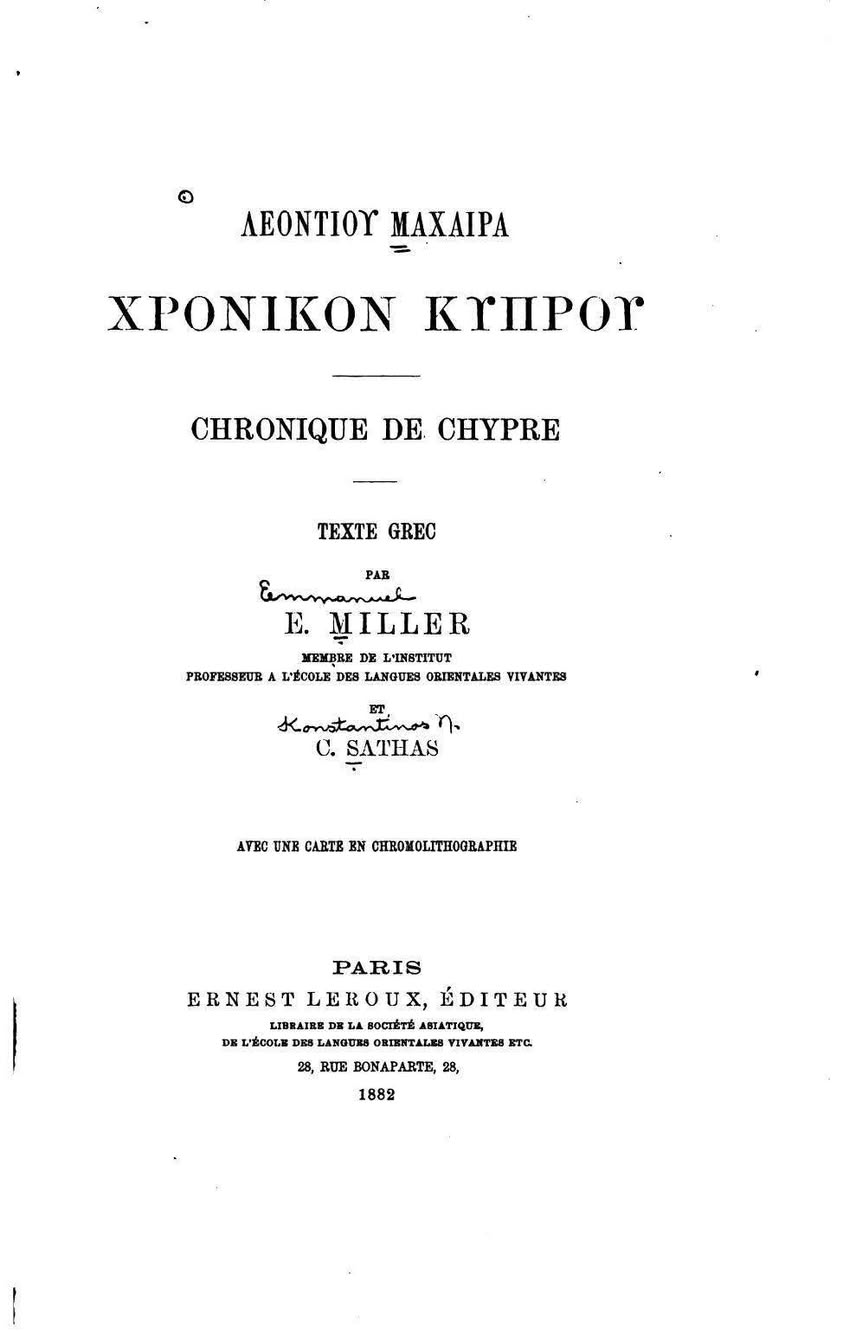
This study examines representations of Albanians—often identified as Macedonians or Arvanites—in medieval Greece and Cyprus, drawing primarily on Chronique de Chypre by Léonce Machéras and related early modern accounts such as that of R. At Lusignan. The text rejects theories of a Slavic invasion of Greece and instead emphasizes the Albanian element in the ethnolinguistic formation of modern Greek and the Cypriot dialect. It highlights Albanian mercenary groups (Stradiots) as mobile warrior communities from Epirus who played a defensive role against pirates. Through linguistic, historical, and philological references, the narrative links Albanians to broader debates on identity, migration, and Balkan continuity.
Albanians (Arvanites) in Medieval Greece and Cyprus: Language, Mobility, and Identity in the Chronicle of Machéras
Without wishing to discuss the question of whether the Albanians are Macedonians, as some recent writers claim, we can only reject as incredible and untenable any theory of a Slavic invasion of Greece, and instead recognize in modern Greece a very marked Albanian influence. The extent to which the Albanian language has influenced Greek is a remarkable subject, worthy of study by young scholars of Greece.
Resolving this question would also make it possible to determine the degree to which Albanian has influenced the Cypriot language, which, as we have noted, is an entirely new dialect, only loosely connected with the ancient one and formed under the same influences that have shaped the language spoken by modern Greeks.
Throughout the Middle Ages, Albanians were called Macedonians. Even in the last century, Albanian mercenaries serving the kings of Naples bore the name “Reggimento dei Macedoni.” Calocerus, the first duke sent to Cyprus by Constantine the Great, ordered that an annual tribute be paid for the maintenance of Albanian or Macedonian men who had risen to liberate the island from pirates and corsairs, with peasants and townspeople of every city contributing.
These Albanians, or Macedonians, were mercenaries and auxiliaries—warriors from Epirus—who moved constantly throughout the country without settling permanently. For this reason, they were called Stradiots or Arvanites, meaning country runners. They had wives and children and were subject to their captains, defending the island from pirates and corsairs. Each had a plot of land where he grew enough fodder for his horse (Description of the whole island of Cyprus by R. At Lusignan, Paris, 1580, p. 2; see also Machéras, pp. 6–7).
The Albanians of Cyprus are mentioned in all chronicles and Venetian reports. Many Cypriot saints whose liturgical services survive were of ancient Albanian origin. Their nickname Στραδιώται (in French Estradiots, e.g., Philippe de Comines, VIII, 7) is not related to the Greek στρατιώτης (soldier), but means “runner,” as Father Lusignan notes, comparable to modern Greek στρατοκόπος. This word carries the same meaning as their name Αρβανίτης (Arvanites), derived from the Low Latin Arbanum and Herbaticus (erraticus). An expression states: “Αλήτης, herbaticus, vagus” (Ducange, Glossarium Latinum).
Because of their wandering life, Anna Comnena calls them Οὐέτωνες (XII, 370), a term that has puzzled scholars of Albanian origin (βέτον, wanderer, traveler). For the same reason, their province was called by the Byzantines θέμα Βαγενετίας (Vagenetias), from the Latin vagus (vagabond).
We know that the ancient Pelasgians—whose descendants some identify with the Albanians—were understood to mean wandering people.
— Chronique de Chypre by Léonce Machéras

