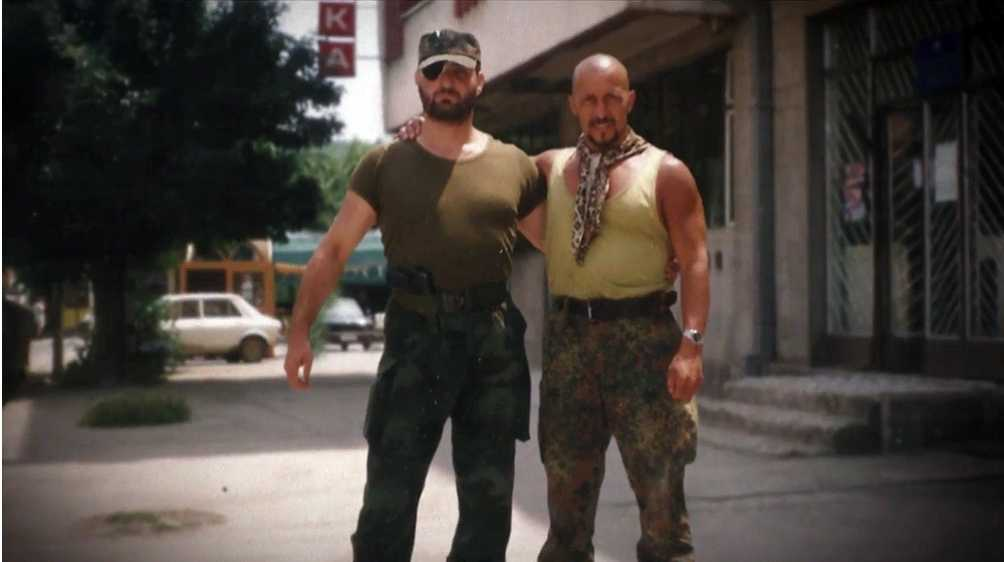

May 30, 2024. Taken from Geopost.

Photos of Russian mercenaries who took part in the war in Kosovo were shared on Telegram on Wednesday. These mercenaries, who once posed as volunteers and participated in paramilitary and other Serbian forces in Kosovo, Serbia and Russia, are being praised as heroes while the world considers them war criminals.
The Telegram propaganda channel of Serbian mercenary Dejan Beric recently published photographs of Russian war criminal Antoli Lebed, better known as Tolya, posing with a sniper on top of Pashtrik.

Lebed is known for his cruelty and ruthlessness during the fighting in Chechnya and other areas of the former Soviet Union. During the Kosovo War, Lebed supported Serbian forces as a mercenary.
Lebed’s engagement as a mercenary, however, violated international laws prohibiting the use of mercenaries in armed conflicts. Lebed’s involvement in the conflicts in Afghanistan, Chechnya, Dagestan, and Georgia clearly demonstrates his status as a Russian mercenary.
It is well known that in Russia criminals are honored and placed in the first ranks of power, and Lebed was honored by Vladimir Putin and Dmitry Medvedev.


Albert Andiev is another Russian mercenary whose role in Kosovo is attracting attention. He was also present in the photo with Antoli Lebeda.
Like Lebed, Andiev was active in various conflict zones, including Chechnya and Georgia. His involvement as a mercenary in Kosovo further underscores the presence of Russian forces in conflicts that have occurred outside Russia’s borders.
The painting of a mural in Belgrade in honor of Andiev also shows the respect that Russian mercenaries have earned in certain circles, even though they are considered by the international community as human rights violators and participants in war crimes.

The role of Russian mercenaries in the Kosovo war represents human rights violations and illegal activities.
Witnesses interviewed by Newsday in 1999 said a group of Russian volunteers were involved in a series of massacres from Gjakova to Mitrovica in northern Kosovo.
/TheGeopost/

