
By Dr. Qazim Namani
During the 18th century and early 19th century, the Albanian Pashals governed semi-independently, had their own army, but often wasted their military potential by fighting among themselves, plundering each other’s property and territories.
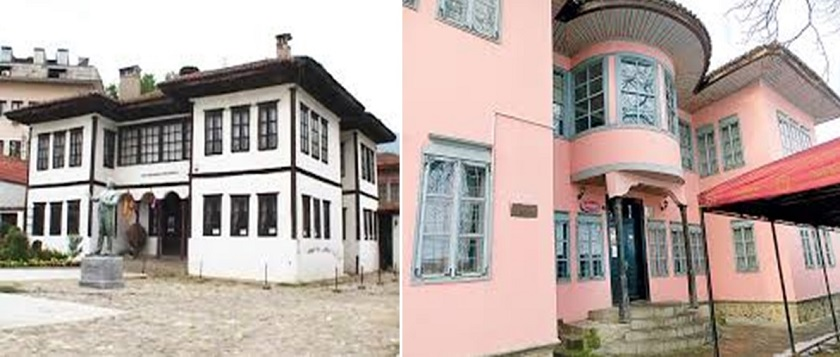
In 1765, Raif Beg Gjinolli, after extending his rule to Vrajë, had two luxurious buildings built in his courtyard for that time. The buildings were built on two floors, and in both buildings on the second floor, in the central part a salon was built, consisting of a slightly larger room, and several other rooms of the same size and symmetrical shape, all of which had access to the salon.
All the rooms were made of wooden ceilings, carved and decorated with various motifs. In the first building, arranged from the south, on the first floor the pasha lived with his protective guard. In the building on the east side the women lived.
The living room on the first floor, in the women’s house, had a sofa, in a semi-circular layout. The buildings were connected to each other by a gallery, made of wood, in the form of a bridge, in such a way that the residents of these buildings could go from one building to the other, without going down to the first floor.
The courtyard of these two buildings was surrounded by a high wall and an entrance gate. Both of these buildings were built by the best Albanian craftsmen, based on the taste of the pasha and the civic architecture of the time.

Photo 1. The Pasha’s residence in Vrajë, where the pasha stayed and was called selamllëk. Photo 2. The building where the women lived, called “Haremlluk”. These buildings, civic housing, are known as the most beautiful complex built in the region during the 18th century.
After the occupation of Vraja by the Serbian army during the Eastern Crisis, these buildings became a high school for Serbs.
In 1960, the building where the pasha had stayed was turned into a city museum, while the building where the women had stayed, in 1993, became a restaurant.
The Albanian pashalars, who became very powerful during the 18th century, created great wealth from the taxes they levied on the people. After becoming very rich, they led an unbridled life full of adventures and human cruelty.
In the cities where these pashas ruled, next to their residential buildings, they also built inns, hammams, and other public buildings.
In the inns, they usually brought the most beautiful girls and women to work, who gathered them in the families dependent on them. In their fiefdoms, they also brought poor families to work the agricultural lands for the interests of the pashas. During their rule, around the cities and in the fertile lands, other pashas and beylers of the Gjinolli family in Kosovo, today’s Kosovo, brought many poor Albanian families of the Orthodox faith to their lands.
These families worked in their fiefdoms, even after the feudal system of pashas was abolished, until 1912, when P. Osman finally left our lands. All these Orthodox Albanian families were later Serbized. Examples of the Serbization of Orthodox Albanian families can be found today throughout the territory of today’s Kosovo and in the region.
During my field experience, researching traces of cultural heritage, I noticed that the Orthodox population, who lived during the Ottoman rule in Albanian territories, was of Albanian origin, but over time they became Serbized. As an example, I would like to mention the village of Gushtericë near Janjevë, today inhabited only by Serbs.
In 2013, I had the opportunity to conduct research in this village regarding the traces of cultural heritage in this village. During the conversation with the residents, one of the residents of the village claimed that when the Pasha of Gjinollë, he had brought his family to Gushtericë, from the vicinity of Niš, this was the sixth family settled in this village. Another resident said that when the Pasha of Gjinollë brought us to Gushtericë, from a village near Gjilan, we were the 14th family in the village.
As can be seen, the Pasha of the Gjinollis had brought these Albanian Orthodox families to Gushterica and given them a lot of land to work. The same thing had happened in many other villages where the Gjinollis ruled.
After the fall of the pashaliks, with the support of Russian politics, but also from the sultan himself, and the Patriarchate of Istanbul, the Orthodox gained elementary freedoms in religion and education. With the permission of the sultan, and the support of Russia, in the middle of the 19th century, secular schools and church seminaries in the Serbian language were opened for the Orthodox in Kosovo.
After the opening of these schools, all the Albanian Orthodox were Serbized. In 1882, in the village of Gushterica, an elementary school in the Serbian language was built, while the village church was built on the foundations of an old archaeological site.
The pashalars and beylers of the Gjinolli family had, over time, created close ties with the Albanian Orthodox families who worked on their estates.
This bond was especially strengthened when Maliq Beg Gjinolli of Gjilan married Marije (Bejaze Hëmnin), who was the daughter of an Albanian Orthodox family, who had previously been brought to work on his estates. Maliq and Marije had two children, Hamdiu and Jashari.
Bejaze Hëmni was the daughter of an Albanian Orthodox family, whom the Gjinolli of Gjilan brought to the village of Pasjan. The Gjinolli have brought quite a few Orthodox families to their estates in many villages of Kosovo. In those years, they sent beautiful girls to work in the inns of the cities, but Bejaze Hëmni for her beauty that she had, Maliq Bey took her as his wife.
In the village of Pasjan, Maliq Beg Gjinolli built the church for the sake of the love he had for the white Bejaze Hëmni. Bejaze Hëmni was the mother of Jashar Pasha Gjinolli, who later lived in Prishtina. Unfortunately, after the fall from power of the Gjinolli family, all these Albanian Orthodox families, who settled on their properties, were Serbized.

Photo 1. The church built by Maliq Beg Gjinolli, for the sake of the Bejaze hymn, in the village of Pasjan, Gjilan Municipality, Photo 2. Old gravestones in the cemetery complex of this church.
Close ties with Albanian Orthodox families continued later, even in other Albanian pashaliks, where the pashaliks of the Gjinolli family ruled.
This practice of cooperation and action with the Albanian Orthodox within the territory of the pashas is best observed in the domestic and foreign policies developed by Hysen Pasha Gjinolli of Vrajë.
At the beginning of the 19th century, the ruler of the Vraja pashalik was Zempre Qorr Mehmet Pasha Gjinolli. During his rule, the population in his sanjak lived under great pressure from tax collection, and experienced violence in various forms from him.
This pasha during his rule was known as a man prone to luxury, adventure and oppression of the population. In 1815, this pasha, unable to lead further, was replaced by his eldest son Rashit Bey. After two years, Rashit Bey resigned, and handed over the government to his brother Hysen.
Hysen Pasha Gjinolli, under the influence of the Patriarchate of Istanbul and its metropolitan in Skopje, gave the Orthodox in his sanjak considerable freedom. He implemented the agreements reached between Russia and the Ottoman P. Hysen Pasha, maintaining good relations with the metropolitan of Skopje and Miloš Obrenović, gave the Orthodox in his sanjak privileges, he did not take away their weapons even when ordered by the Sultan. Hysen Pasha and Miloš Obrenović, during this period exchanged gifts with each other.
During this period, Albanians were organized into tribes, flags, religions, and clans that did not have any unity among the broad masses of the people, but there was some hatred between these interest groups, so P. Osman managed to quell their uprisings.
To quell the Albanian uprisings, P. Osman killed hundreds of Albanian beylers and a large number of them were exiled to Asia Minor. Albania, which was divided into the north, where the Ghegs lived, and the south, inhabited by Tosks, often had disagreements among themselves, to achieve a national organization.
These disagreements were supported by the Ottoman government. The Sultan did not allow the unity of the Albanian beylers and pashaliks. This affected the fact that the Albanians of the north did not unite at the same time with the Albanian movements in the south and vice versa.
During the Albanian uprisings of 1826-1832, Hysen Pasha did not seem to oppose the sultan, but on the other hand he also collaborated with the Albanian insurgents. In 1829, Hysen Pasha gathered soldiers to help the uprising of Mustafa Pasha Bushatliu. After the Peace of Edirne in 1829, Hysen Pasha gave even greater freedoms to the Orthodox population living in his pashalik. Hysen Pasha renovated old churches and built some new ones for the Orthodox, and for this he was honored and praised. During this period, Hysen Pasha had some disagreements with the metropolitan Gavril in the diocese of Skopje.
In the first half of the 19th century, the peak of Albanian uprisings was reached.
The Albanian uprisings led by Mustafa Pasha Bushatliu, during the years 1826-1832, were suppressed. The Ottoman Empire, after defeating the Albanian rebels, increased taxes and began collecting tribute for the sultan’s regular army.
The Albanian pashas who submitted to the sultan intensified the pressure on the Albanian people to collect taxes and recruit Nizam, which increased the people’s hatred towards them.
The Metropolitan of Skopje sued Hysen Pasha in Istanbul. Based on the lawsuit of Metropolitan Gavril, Hysen Pasha was summoned by the Sultan in 1835 to go to Istanbul. After he went to Istanbul, the Sultan asked him to obey the Sultan’s orders to implement the reforms and not to interfere in the affairs of the church and the Orthodox population.
Despite all these increased pressures, the Albanian population did not surrender, but began to reorganize to oppose the Tanzimat reforms of 1839. The uprisings that continued at this time were not led by the pashas and great Albanian feudal lords, but were led by religious clerics and some of the elders of Albanian villages and cities.
Since Hysen Pasha kept a large number of Orthodox Albanians from the southern regions of Albania in the Vraja castle for his own safety, in 1839 he gave permission for the construction of a church in Vraja. The construction of this church had caused considerable reactions from the city’s Muslim population, who began to support the Albanian insurgents who had begun to organize in the vicinity of Vraja.
Of particular importance after the suppression of the uprisings led by Mustafa Pasha were the uprisings of the 19th century forties, which initially included the Albanians of Kosovo, present-day Macedonia, Chameria, Laberia and all ethnic Albanian territories.
Also during this time, Bektashism developed greatly, becoming the third religion in Albanian lands, and often promoting ideology for special religious and cultural autonomy. Bektashism had also developed in Leskoc, Vrajë, Bujanoc and Preševo, their strengthening did not please Hysen Pasha Gjinolli.
In 1841, Hysen Pasha was handed a reform program by the sultan to abolish feudal relations and change the administration.
The Albanian population often rebelled against Hysen Pasha, even though he was of Albanian origin, because this pasha was greedy for property and money. Hysen Pasha tortured the population a lot, forced them to work on his land, often forcibly appropriated the properties of villagers and other beys, merging them with his fiefs. With the loot he made from the people, he had created a great wealth, but he had also allowed the scale of immorality to develop, which had affected all classes of the population, in the city of Vrajë.
From Serbian sources, we understand that, on the eve of the uprising of the population, for low moral motives, in Vrajë a man killed a priest. The priest was killed by a man who had come to live in Vrajë from the village of Konqul. It was said that the reason for his murder was to provoke the Muslim population, because of the sale of pork in the Vrajë bazaar. Apparently, this event has been distorted by Serbian scholars, trying to give this murder political, religious and national motives, so this version of the priest’s murder is at odds with the writings of other serious scholars.
From Aleksandër Matkovski, we understand that, Hysen Pasha Gjinolli at this time, hanged a priest and two immoral Turkish women. From this information we understand the degree of degeneration and immorality that developed during the rule of Hysen Pasha in the city of Vrajë. For these reasons and the behavior of Hysen Pasha, in the city of Vrajë and in the villages, a great hatred was created against him.
Rexhep Selimi, in his writings about Vrajë and Presheva, provides some information about the low character of Hysen Pasha Gjinolli. Among other things, he writes that Hysen Pasha of Vrajë, in 1842, had passed through the estates of Sheh Selim, in the village of Tabanoc. Seeing the fertile lands, with well-groomed gardens, beautiful springs and rivers, out of greed to take them and motives of jealousy, he paid two Albanians to treacherously kill Sheh Selim.
One of the Albanians paid was from Presheva, while the other was from the village of Norçë. In August 1842, these two killed another sheh in the village of Tanaboc, thinking that they had killed Sheh Selim. At that time, Sheh Selimi had been in Istanbul. When Sheh Selimi returns from Istanbul, and it is understood that he has not been killed, the revolted Hysen Pasha Gjinolli invites Sheh Selimi to go to his palace.
Sheh Selimi, seeing that betrayal is being prepared for him, and not agreeing with the pasha’s behavior, decides that he himself will kill Hysen Pasha. Before going to Hysen Pasha, Sheh Selimi informs a friend of his in Bujanovac about the decision he had made to kill the pasha in his palace.
When Sheh Selimi is offered the pasha’s palace, without even asking the first and second guards, they enter. As soon as they enter, the third guard prevents Sheh Selimi from entering Hysen Pasha. Sheh Selimi, out of anger, opens fire, wounding the guard and Hysen Pasha. Another guard, at that moment, beheads Sheh Selim with a sword. Sheh Selimi, with his severed head, is buried in the Presevo mausoleum.
At the funeral of Sheh Selim, many citizens from Vraja, Bujkanoc and Presheva had gone. During the funeral ceremony, in front of the crowd, revolt was expressed against Hysen Pasha and the Ottoman government. At the funeral, the revolt against the pasha was organized by Bajram Vaksinca, Sylejman Tali, Selman Rogoçica, Selim Marku, Ymer Presheva, Sheh Hyseni, Sheh Salihu, and other beylers and ayans of this area.
A song was also sung by the Albanian population of that area about Hysen Pasha’s behavior and the anger expressed over the murder of Sheh Selim:
Hysen Pasha black face
He kills the sheikh for wealth.
Sheh Selimi is not dead.
Wait for Vraje to find out what he has to offer.
This event greatly influenced the uprising of Dervish Cara, involving almost the entire Albanian population of that region.
Against Hysen Pasha’s behavior, his brother Rashit Bey, the oldest woman in his compound, Hanama, Mesin Bey, Kara Agush Bey, and several other Albanian beys also lined up, who, together with the people, began a conspiracy to take power from Hysen Pasha.
In 1843, when the Sublime Porte proclaimed the Hatishreif of Gjylhane in Kosovo, this was not well received by the Albanian population, riots immediately began and the population rose in rebellion. At first, the center of the rebellion was the sandjak of Skopje and that of Prizren.
The great anger of the Albanians was increased when, in addition to the large increase in taxes, the forced recruitment into the Ottoman army, the Sublime Porte began replacing Albanian feudal lords with Ottoman officials and increasing repressive measures for the Islamization of the population and the Ottomanization of the administration.
Due to these measures, Albanian resistance grew, and by the end of 1843, it had spread to all Albanian territories. In early 1844, uprisings broke out in the city of Pristina, and quickly spread to other Albanian cities. The insurgents, after blocking the Ottoman military forces from operating, managed to liberate several cities in present-day Kosovo and present-day Macedonia.
According to Serbian archival sources and a merchant from Aleksinci, named Gjorgje, who from 12-24 April 1844, had traveled to the city of Manastir, he had shown that the road in those areas had been made unsafe by Albanian insurgents.
According to his accounts, around 8000 Albanian insurgents had gathered between Veles and Skopje at that time. Apparently, there had not been any merchant, but there had been some Serbian agent who had the task of providing information about the area between Nish and Manastir, and for this he had gone to Manastir, where the sultan’s army was concentrated. Let us recall that even Prince Miloš Obrenović in 1830 had sent his own informant, when Reshid Mehmed Pasha had called all the pashas and great feudal lords of the region to a meeting.
The center of the uprising of those years became the city of Skopje, under the leadership of Dervish Cara, Dervish Poda, Dervish Kapo, etc.
Albanian rebels in early 1844 managed to liberate: Skopje, Pristina, Tetovo, Kuprilina, Prilep and offered them to Manastir.
In 1844, during the uprisings, the Albanians of Niš also rose up, but to quell the uprisings, the Sublime Porte immediately sent the sultan’s regular army there, led by Sabri Mustafa Pasha.
Hysen Pasha Gjinolli, who owned properties on both sides of the southern Morava from Vraja to Bujanovac. The inhabitants of Vraja, Bujanovac and Presevo often rose in rebellion against this pasha who was greedy for adventures and property. Hysen Pasha, to protect himself from the Albanian insurgents in Vraja, had brought Orthodox Albanians and Muslims paid from the district of Janina.
Under the leadership of Festoli, the rebels from Tërnoci, Selam Rogoqica, Ymeri from Presheva, and other beylers and ajans from Presheva, Bujanovac and Vraja, in 1843, the population organized itself in an uprising, and overthrew the rule of Hysen Pasha in Vraja.
In May 1844, about 15,000 Albanian insurgents from the areas of Leskoc, Vranje, Kumanovo, Gjilan, Skopje, Tetovo, Gostivar and the Galab highlands entered the city of Vrajë and expelled Hysen Pasha of Vranje. With this victory, the Albanian insurgents created a free zone from Leskoc to Gostivar.
According to information from the English consul reporting from Thessaloniki, on October 20, 1844, Albanian insurgents entered Vrajë for the first time.
On April 3-6, 1844, Albanian rebels entered Vraja, and Hysen Pasha, with 800 Albanians brought from the south, concentrated in the Vraja fortress. Seeing the danger from the Albanian rebels, Hysen Pasha abandoned the Vraja fortress and moved to Veles.
To quell these uprisings, the Sublime Porte sent large military forces to Albanian lands. In February 1844, large military forces were sent to Southern Albania, and especially to the city of Manastir.
The Ottoman Empire had authorized Omer Pasha Latasi to suppress the Albanian uprising. He was an Orthodox renegade born in Ogulin, Croatia. His real name was Mihajl Latasi, who later converted to Islam and took the name Omer Pasha Latasi, who held the rank of major general and rendered great services to the Ottoman army.
The Greek and Ottoman encyclopedia states that he was born in Plaška, Croatia. His father was a sub-officer in the Austrian army and when he was born he was baptized Mihajl Latas. In addition to the Croatian language, he quickly learned German, Italian, and French and a little English. Mihajl served as an officer in the Austrian army, but in 1827 he fled to the Ottoman territories.
At first he took refuge with Haxhi Ali Bujiqi in Banja Luka. In Banja Luka, he converted to Islam, circumcision, and took the new name Omer Lutfi Efendi. After a two-year stay in Banja Luka, he settled in Vidin, and then went to Istanbul as a professor of drawing at the military school. He went to Istanbul in 1834, and in 1838 he received the rank of colonel.
After being promoted, Omer was sent to Syria to fight against Ismajl Pasha and Mehmed Ali, of Albanian origin from Egypt. After his victory in Syria, where he ended the rule of Mehmed Ali, he received the rank of general. At the end of 1843, he was sent by the High Porte to quell the Albanian uprisings that had begun under the leadership of Dervish Cara.
Omer Pasha Latasi entered Vraja, after reading the law and order to the population, he abolished the pashalik of Vraja, creating the kazan of Vraja under the leadership of a kajmekam.
After this submission, the Ottoman soldiers were left free to do whatever they wanted with the Albanian population, so in the village of Trnoc and several other villages, in addition to looting, the Ottoman soldiers also dishonored the women and girls of the Albanian population.
The oldest woman in Hysen Pasha’s mansion, Hanuma Plaka, offered Omer Pasha her mansion, gave him large sums of money, and gifted him a pair of her husband’s gold clothes.
Hysen Pasha died in Veles after 10 or 12 days, it is said that he was poisoned, but it was not known exactly how he was poisoned. The Ottoman authorities spread the news that his wife poisoned him with the food she sent him from Vraja, but there are other sources that indicate that the Ottoman authorities poisoned Hysen Pasha with coffee.
Omer Pasha, after entering Vrajë on June 18, 1844, and with his army began attacks on the Albanian villages between Vrajë and Leskoc, capturing the leaders of the uprising. Among the other leaders who surrendered were Baba Feka and Sejdi Menxha, who, tied up together with 200 other rebels from this area, were sent to Istanbul.
Dervish Cara’s uprising also spread to Leskoc. 5,000 Nizams equipped with 20 cannons were sent against the rebels under the command of Hajredin Pasha. Encouraged by the Ottomans, Dalip Bey and Shaban Bey with 3,000 southern Albanians attacked the northern Albanians who had risen in the uprising organized by Dervish Cara.
Ismajl Pasha from Leskoc helped Dervish Cara together with the rebels led by this side, led by Sejdi Menxha and Baba Feka. The Pasha of Leskoc supplied the rebels with food and horses. The Albanian rebels were pursued by the Ottoman army and the southern Albanians led by Omer Pash Latasi.
When Omer Pasha’s army entered Leskoc on June 20, 1844, the people of Leskoc welcomed the sultan’s army, prepared food and 15,000 and handed over all the money they had collected from the people for the organization of the uprising. On April 5, 1845, Ismajl Pasha of Leskoc was captured and sent with his entire family to Asia Minor, where they disappeared without a trace.
During this persecution, the Ottoman army planted 50 stakes in Leskoc to imprison the rebels.
After the subjugation of the rebels in June 1844, again in the autumn of the same year, the population of Dibra rose in rebellion against the sultan’s army led by Hajredin Pasha.
Based on the sources of Th. Ippen, the Albanian rebels of 1844 had submitted a request before the High Gate for their autonomous rights, just as the Serbs enjoyed at that time.
Albanian uprisings continued in the following years. In 1845, the Sultan’s regular army launched an offensive to disarm the Albanian population. In response to this offensive, uprisings broke out in the city of Gjakova and its surroundings, where 8,000 insurgents had gathered, under the leadership of Binak Ali and Sokol Rama.
Uprisings also broke out in southern Albania, when Reshid Mehmed Pasha, and the Albanian renegade feudal lord Hysen Pash Vrioni, attempted to extend the disarmament campaign of the Albanian population to the south. In response to the Ottoman army’s action to disarm the population, uprisings broke out in Berat and Gjirokastër.
In July 1844, Albanian uprisings also broke out in Kurvelesh under the leadership of Zenel Gjonleka, in Berat under the leadership of Rrapo Hekal. The rebels under the leadership of Zenel Gjonleka liberated Delvina, Butrint, creating a free zone in the vicinity of Gjirokastra. Rrapo Hekal also created a free zone in the vicinity of Berat.
At this time, Labëria, Çamëria, Myzeqeja and the vicinity of Vlorë also rose up in rebellion. To quell these uprisings, the Sublime Porte in 1847 sent large military forces from Monastery, Ioannina, Himara and Thessaly. About 15,000 soldiers were sent from Monastery alone.
The Ottoman army in the areas of the uprisings burned many villages, arrested many Albanians and interned many of them in Ottoman prisons. During these punitive measures for the Albanian uprising, the Ottomans also expelled the Jesuits from the city of Shkodra, who, with the help of the Austrian consul, had gone there to open a college.
Although this uprising in the north was led by a Muslim cleric, from French reports of the time, we learn that the armed uprising was supported by the Mirditëri and Kelmendësi, Catholics who stood in solidarity with their Muslim brothers.
After crushing the Albanian uprisings in Katllanovo, the Ottoman army marched north, and according to some sources of the time, it is said that in the city of Vrajë alone, 10,000 regular soldiers of the imperial army had gathered. During their stay in these parts, they tortured, burned, entire Albanian villages, forcibly imposed the surrender of the insurgents, and demanded that the Albanian population in the highlands between Niš, Prishtina and Skopje finally renounce crypto-Catholicism.
It should be noted that the Albanian population of the Galab highlands northwest of Vraja had withstood complete Muslimization until those years.
The sultan’s regular army, sent to Albanian lands, undertook inhumane measures and exerted great pressure on Albanian crypto-Catholics in northern Albania, with the aim of further developing the process of Islamization of the Albanian population.
During the years 1843-1846, special measures were added against Albanians who presented themselves as false Muslims (secret crypto-Catholics).
Harsh measures were implemented especially against the crypto-Catholic population in the villages of Montenegro, on the southern side of Gjilan.
Due to their resistance to accepting the process of Islamization by force, the inhabitants of these mountain villages were arrested by the Albanian feudal lords with the help of the Sultan’s army. The Albanian feudal lords filled the prisons with prisoners, tortured them and, tied in chains, handed them over to the Ottoman army, who were interned as opponents of Islamization in the Philadora region of Asia Minor.
207 Albanians were sent into exile, who along the way suffered the most barbaric torture known to history by the Sultan’s army. From the numerous tortures, many of these arrested Albanians died on the way to Filador and in Ottoman prisons. After three years of staying in the prisons of the Ottoman Empire, with the intervention of French diplomacy, only 102 Albanians managed to return to their homeland.
 Elida Jorgani from this source: Wellington Independent, Volume II, Issue 125, 23 December 1846, Page 4, provides data on the violence that Selim Pasha exercised, during 1846, against Albanians of the Catholic faith in the vicinity of Gjilan.
The persecution of Christians in Turkey (Albania was occupied by the Ottoman Empire).
The Christians residing in Albania have recently been suffering cruel treatment from the Pasha of the province, because they refused to abandon the Catholic faith and become Muslims. A number of Catholics in Gjilan have been imprisoned, one of whom, Agostin Stublla, was chained by the neck and feet, and died in prison as a result of the ill-treatment he received.
Seven families in Gjilan who had accepted the Islamic faith were sent to Skopje, where 23 heads of Catholic families were imprisoned for disobedience; of these, seven were unable to endure the suffering and followed the example of the families from Gjilan. Yet the other sixteen heads of families remained determined to the end to sacrifice everything for their religion.
They were beaten daily with whips, given little food, and kept chained to the prison walls. Selim Pasha was enraged by the resistance of the convicts and ordered their families to walk from Gjilan to Skopje on an eight-day journey, with their hands tied behind their backs, without excluding children and pregnant women. Upon their arrival in Skopje, they were all imprisoned.
A number of Christian missionaries are also imprisoned in Skopje, where seven of them fell Martyrs of their faith. The Apostolic Missionaries of Dalmatia are among these prisoners. The Austrian Consul in Shkodra has officially sent a request to Selim Pasha for their release. 30 to 40 Christian families left Albania for Thessaloniki, to settle in Michalitsch. — Trieste Observer. (Borrowed and translated by Elida Jorgani).
The village of Bresalc, Gjilan municipality, is among the villages that forcibly accepted Islam after the Tanzimat reforms in the 19th century. The inhabitants of Bresalc remember Ramadan Syla who had Catholic uncles from the village of Brus, Lipjan municipality.
According to Rrahim Syla (haxi) born in 1927, he remembers that a fellow villager from Bresalc, Fetah (Rexhep) Hoxha, was called a Catholic because his uncles were also in Brus. He also said that the inhabitants of Bresalc were forcibly converted to Islam by Ramadan Pasha (Syliqi). Among the toponyms preserved in Bresanc, we highlight: Guri i kishës and Kroi Plak
Enver Hasani from Bresalci told about the way of Islamization of the village. One day after the Turkish officials had gathered the villagers and pressured them to accept Islam, the villagers were forced to submit to their orders. At the moment when the villagers had gathered in the center of the village, where the mosque is today, there were also reactions against the Ottoman officials after they started the construction of the mosque.
He says that there was a Catholic villager named Joza who had taken a stone from the church with him and went to the gathering after the mosque was built. Joza had dropped the stone on the ground at the door of the mosque and had placed both hands on the door of the mosque, addressing the Ottoman official.
The Turks did not destroy one endowment and build another. When they hear this , in order not to aggravate the situation, the village elders attack him. He, revolted, takes his family and decides to live in Janjevë. The inhabitants recall that this was the last Latin (Catholic) to have moved from Bresalci. Later it is said that this family moved to Croatia and was assimilated into Croatian. From my fieldwork diary 17.05.2003.
Family tree of several families from Bresalci
Enver Hasani Milaim Uruqi Rrahim Syla
Bushi Sadriu Asllani
Investigation: Shefkiu Halimi
Safeguard Mehmeti Shabani
(Catholic) Haziri Beka
(Catholic) Behluli
Zeka of Lekë (Catholic)
Based on the results of field research, it has been proven that a considerable number of villages that today feel like villages with Serbian people in the vicinity of Gjilan, Artana and Dardana, until this period were Albanians of the Catholic faith, but due to pressure they converted to the Orthodox religion and became Serbized.
In the village of Jasenovik, in the municipality of Artana, the foundations of a Catholic church still stand today near the house of a Serbian family. The inhabitants of Shtrazhe, Makresh i Epërm, Tirince, Vaganesh and other villages were also of the Catholic faith, who, in order to escape the violence, unable to accept Islamization, converted to the Orthodox faith and later became Serbized.
In these circumstances of the violent process of Islamization of Albanians, European diplomacy and the Franciscans were unable to monitor the situation of the Albanian crypto-Catholic population in the remote mountainous areas.
During the campaign of arrests of Albanian insurgents in the northern part of Pristina, the area of Kusumlija, Krushec, Prtokuplja, Niš, Leskoc, and Vraj, the Franciscans could not have any information about the fate of the Albanians in those areas. The crypto-Catholic Albanian population in the areas between these cities, by the repressive measures of the regular Ottoman army, was finally forced to accept Islamization in their families.
Part of the Albanian population of these areas, unable to accept Islamization, were forced to move to the area of Niš, Aleksinci, Cyprus and other cities where the pressure of the Ottoman army was less.
According to Tihomir Djordjevic’s reports, he writes that the largest number of Turks in Belgrade were Arnauts. He also writes that Albanians have lived in Aleksinj and in Cyprus for a long time. Among other things, Tihomir reports that in 1821, 15 Albanian families came to live in Cyprus.
This persecution of Albanians from the Galab Mountains occurred due to their participation in uprisings and the harsh reprisals of the Ottoman army against them. Also, a large number of Orthodox Albanian families from the villages of Artana, Dardana, Gjilan and other Albanian areas, during the uprisings of the forties of the 19th century, moved to the area between Nish, Prokuplje and Leskoc, where the pressure of the Ottoman army was less.
On the other hand, Serbs, pushed by Russian politics, were stimulated to move towards Krushec, Cyprus, and Aleksinci in order to increase their influence in the city of Niš.
The Albanians of the Krushec and Prokuplje areas, who had supported the Albanian uprising movements from the beginning, under the leadership of Mustafa Pasha Bushatliu, opposed the movement of the Serbs towards their settlements.
Based on Serbian archival documents, Sadullah Brestovci writes that in the village of Gërgur in Arnautklluk, Serbian agents had killed an Albanian spahi. In response to this murder, 5,000 Albanians gathered in Krushec to oppose them.
It is important to note that during all the Albanian uprisings that took place during the 19th century, the Albanian, crypto-Catholic population of the deepest northern Albanian areas, joined the insurgents, regardless of who led the uprisings, the pashas or the Albanian Muslim clerics. This was also evidenced during the uprisings of Mustafa Pash Bushatliu and Dervish Cara.
We have ample information about the development of the uprisings and the role of the clergy and Russian politics in the territories inhabited by Albanians from the consuls of European states who lived in the cities of the region.
On March 15, 1841, the English consul informed his minister that the Greek bishops had denounced the wretched raja from Thessaloniki, saying that the Greek clergy were a ruin to the raja. On May 17, he reported from Thessaloniki about the arrest of the monk Hilarion, who declared that between Leskot and “Sveti Gora” there were 3,000 insurgents, ready and paid with Russian money to lead the uprising. This indicates the great influence that Russia had in creating unrest within the borders of the Ottoman Empire.
The prefect of the Aleksinci district, who notified the Serbian foreign minister of the Albanian uprising on July 5, 1843, Mehmet Pasha of Skopje, requested that every Albanian household provide a nizam.
On August 1, 1843, the Sublime Porte sent Hajredin Pasha to Skopje, who summoned all Albanian leaders to a meeting and requested from them two nizams per family.
In the northern cities, Albanian insurgents inspired by the Dervish Cara uprising in 1844 took control of Tetovo, Skopje and Pristina. Regarding this uprising, the French consul from Ioannina informed his country that the leaders of the Skopje uprising had called on the Albanians of Ioannina to remind them that the insurgents were their brothers and not to allow them to rise up against their uprising. This is said to have had a political vision.
Conclusion
Although the Albanian uprisings expanded and reached a large number of people, they did not have the weapons and military equipment to withstand the offensive of the sultan’s regular army, which was equipped with the most modern weapons of the time. In these circumstances, the insurgents, after a series of bloody battles, were forced to retreat with heavy losses, but from these battles the Ottoman army also suffered heavy losses.
Unfortunately, many Albanian soldiers were mobilized into the ranks of the Ottoman army against their will, so Albanians were killing each other, while the Ottoman Empire was realizing its goals of expanding its authority in Albanian lands.
The military expeditions undertaken by the Ottoman Empire to suppress Albanian uprisings, as well as the disunity of the Albanian pashaliks, were fatal for the future of our people.
The violent implementation of reforms in the Albanian lands, which ended with the overthrow of the pashaliks, left our people at the height of poverty and the highest level of illiteracy in Europe. The Albanian pashaliks have never done anything for the development of education, culture and technology in step with the times and the trend of developments in the region.
The rapid technological, industrial, scientific, cultural and administrative development in European countries was in complete contradiction with the feudal order that was implemented in the Ottoman Empire; the Albanian pashas did not take any steps to orient themselves towards developed European countries.
The Ottoman Empire, by oppressing the Albanians, benefited greatly: it extended its own life, collected taxes, recruited regular soldiers, and by not allowing cultural development and education in the native language, it benefited the brains of this population.
During the last three centuries of the Ottoman Empire’s rule, due to the impossibility of educating Albanian youth in their own lands, they were forced to attend classes in another language and in other parts of the Ottoman Empire. The education of Albanian youth in Ottoman schools led to many Albanians occupying high cultural, scientific, military and administrative positions in Ottoman state institutions.
Albanians educated in the Ottoman Empire have the greatest merit for the creation of the most important institutions in culture, education, administration and science, without having the opportunity to contribute to their homelands, to begin with the opening of primary schools in their native language.
I think that by analyzing in detail the behavior of the Albanian pashas towards our people, a re-study should be conducted by applying scientific methodology and criteria to make public the damage caused during the last three centuries of Ottoman rule.
Literature
History of the Albanian People I: Tirana, 2002
History of the Albanian People II: Tirana, 2002
Noel Malcolm: Kosovo a Short History, Pristina, 1988
Danilo Vulov? in the book Knjaževa kanalasi , knjiga prva, Nahija požeška 1815-1839, Belgrade 1953.
Bedrush Shehu: Albanian Issues in the Early 1930s, Prishtina Albanological Institute, Prishtina, 1990.
From the book by Aleksander Matkovsk: The Uprising of Dervish Tsar, Skopje, 1985
Gjergj Gj. Gashi; Albanian Martyrs during the Years 1846-1848, Prishtina, 1994
Grigorje Bozevic; In the Gnjilane Region, Gjilan, 199
Wellington Independent, Volume II, Issue 125, 23 December 1846, Page 4
Slavisa Nedeljkovic; Between the imperial Government and rebels, (Old Serbia during the rebellion of the Shkodra Pasha Mustafa Bushati and Bosnian aristocracy 1830-1832, faculty of Philosophy, Novi Sad, 2015
https://bujanovac.com/bujanovacki-kraj-pod-turskom-vlascu-u-xix-veku/
http://serbiasrbija.blogspot.com/2010/07/pashas-shelter-and-haremluk.html ,
https://ëëë.vranjenet.rs/haremluk-ko-novi-husein-pasa
https://thereaderëiki.com/en/Albanian_revolt_of_1847 ,

