
Abstract
This text critically examines the politicization and national reinterpretation of the Battle of Kosovo, particularly in light of Slobodan Milošević’s 1989 nationalist speech at Gazimestan. It argues that the battle was not an exclusively Serbian ethno-religious conflict but a broader Balkan coalition that included Albanian noble families such as the Ballshaj, Muzaka, and Jonima. Drawing on interpretations by Albanian historians including Muhamet Mala, Bedri Muhadri, Pëllumb Xhufi, and Agron Ismaili, the documentary challenges Serbian historiographical narratives that transformed the battle into a foundational Serbian national myth. It highlights alternative sources—Byzantine, Ottoman, and Ragusan—that attest to multi-ethnic participation and questions the later appropriation of figures such as Millosh Kopiliqi. Millosh Kopili was from the Albanian village of Drenica where his church and grave is believed to be in.
In 1989, Slobodan Milosevic came to Gazimestan to hold an extreme-nationalist irredentist speech. This location was picked delibertately. 600 years ago, the Battle of Kosovo took place there. Every year, Serbian irredentists visit this place, as some kind of mythological ritual.

Albanian police check Serbian visitors.

But what happened to the Albanian medieval families Ballshaj, Jonima and Muzakaj who also participated in the Battle of Kosovo?
In 1389 a Balkan coalition of Albanian, Bosnian, Croatian, Hungarian and other groups fought with Serbian troops against the Ottomans. This was not a Serbian ethno-religious battle. However, Serb propaganda has distorted this ideological construct heavily.
In 1371, the Ottoman forces expanded west towards the Balkan.

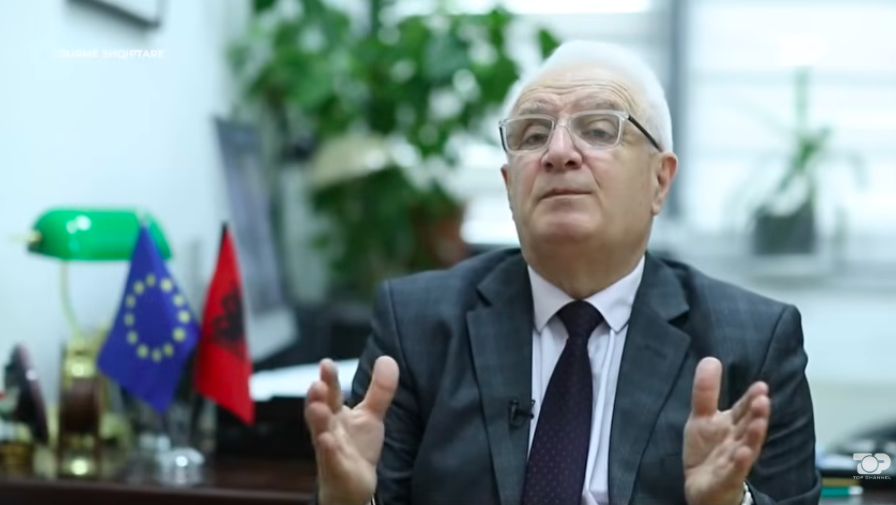
Muhamet Mala, Albanian academic, says that the Battle of Marica (1371) enabled the Ottomans to march towards the Western Balkans. The Battle of Kosovo did not have this affect and was not important in comparison.
Why do some Serb visitors celebrate this alleged Serbian “loss” when Serbian identity did not exist 600 years ago?

Tsar Lazar, who participated in the battle.
Serbian Historiography has severely deformed and twisted this battle and made it into a national symbol, according to Mala. It has become a myth and fantasy, which differs very much from the truth about what happened in 1389.

Albanian historian Bedri Muhadri, says that during this time, many leaders of the time had autonomies.

Agron Ismaili, historian, says that Serbian propaganda authors has made the entire narrative of the battle as “Serb”, when there were clearly other groups fighting there as well. It was not a “Serbian” battle against Ottomans.
Muhamet Mala says: “The Serbs have taken this battle and made it their own”.
Marin Mema:
“In this battle, there were many other Balkan people fighting there as well. The Arbërors, Romanians, Hungarians, Croatians and Bosnians fought there as well.”
Bedri Muhadri:
“Every 5th person in that coalition was an Albanian fighter”
Shukrulahi and Idrizi, Ottoman chronicles at the time, write thats The protagonists, other than Tsar Lazar, were also the Albanians of Shkodër (meaning Gjergj Trazimir Balshaj)
Bedri Muhadri says:
“Albanian leader Teodor Muzaka formed his own army from the south and participated in the battle against Ottomans, in order to protect his own territories, and not to support the alleged Serbian troops of Laza”.
Marin Mema:
“Albanian leaders Gjergj Balsha, Teodor Muzaka and Dhimiter Jonima all participated in the battle, and they died there. Three Arbër families were documented there”.
A Byzantine source mentions that Albanian princes from Lezhë, Himara and Epiri (Epirus) in the Adriatic fought in the battle.
Two Dubrovnik authors mention Albanians fighting there. Mauro Urbini and by Alouis Tuberoni, from 1601.
Historian Pëllumb Xhufi says:
“A Ragusan chronicler named Tuberoni writes that the Tsar Lazar was called “Rex Dardanor” (King of the Dardans)”
This means that Tsar Lazar was in fact given the title of “Dardanian Albanian” and not a Slav (Serb). He was not called “rex serbe”.
A few decades later, in 1448, Albanian leader Gjergj Kastrioti Skanderbeg fought with Hungarian forces against the Ottomans. The Serbian forces were absent, and even opposed the Albanians.
Marin Mema:
“Who was Millosh Kopiliqi, the man from Drenica, who killed the Sultan?”
Pëllumb Xhufi:
“Millosh Kopilic is mentioned with names such as Milon, Kobila, Kubila, in other words, many variants of his name exists. The name is believed from derive from the village of Kopili (Kopiliq).”
Historian Bedri Muhadri:
“Millosh was an Albanian prince from Drenica. His father was named Nikolla”.
Marin Mema:
“Millosh Kopiliq was believed to be an Arbëror”
Muhamet Mala:
“Millosh Kopiliqi, similar to the Battle of Kosovo, was kidnapped by Serbian propaganda. However, Ottoman forces never mention his name as “Obiliq” as some Serb authors write”.

The grave which is believed to be of Millosh Kopili in Drenica
Marin Mema:
“Professor Anton Qeta, in a song collected from Drenica, states that in Kopiliq, the Albanian locals have remembered, through folklore from Albanian elders, the grave of Millosh Kopili is located in Drenica. In the village, there was the “Well of Kopili”. On the other side of the river, there were remaining rocks of a church called “The Church of Millosh”.

The Well of Millosh

The Arbër “Kopili” herald which does not have Serbian or Slavic origin.
Kopili means “Bastard” in Albanian.
Muhamet Mala says:
“The Serbian have tried to distort the name to “Kopilog”. However, the villages was inhabited by aboriginal Albanians for centuries.”
Source
https://www.youtube.com/watch?v=3-rlcXPGqto

