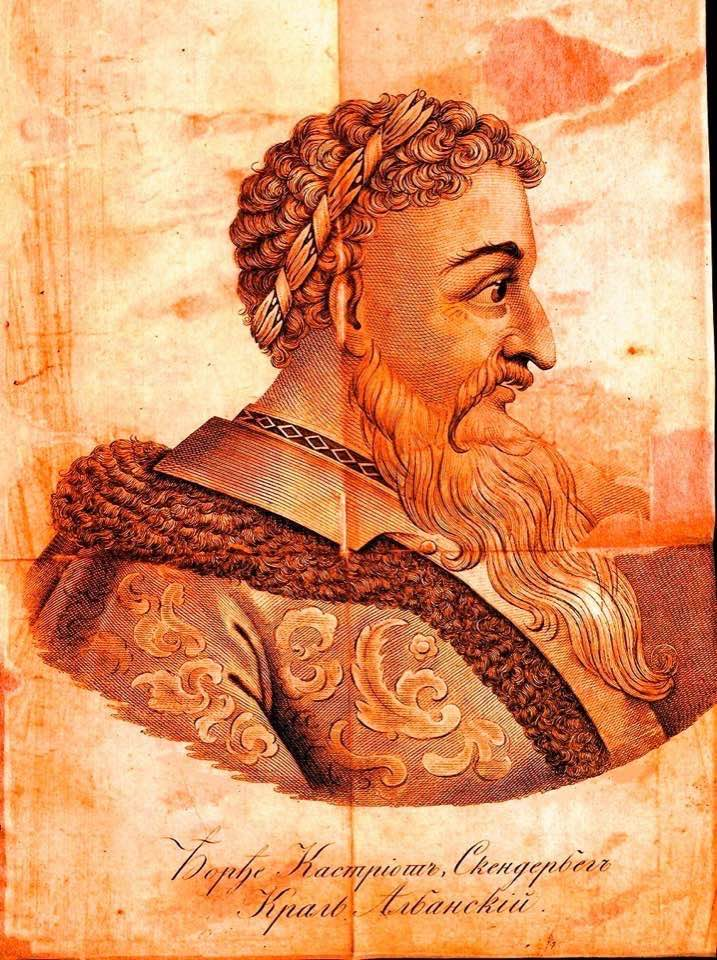

Gjergj Kastrioti, widely known as Skanderbeg (1405–1468), is a central figure in Albanian history and identity, celebrated for resisting Ottoman expansion in the Balkans. His historical legacy is intrinsically tied to Albanian nationhood, culture, and the struggle for autonomy in the 15th century. Skanderbeg’s remains are currently located at the Hilandar Monastery, a Serbian Orthodox monastic site under Serbian ecclesiastical jurisdiction. This situation raises significant questions regarding historical justice, cultural heritage, and international legal norms.
From a historical perspective, Skanderbeg was unequivocally Albanian. Primary sources, including contemporary Venetian chronicles and Ottoman records, describe him as the hereditary lord of Krujë and a military leader of Albanian principalities. His campaigns were conducted to defend Albanian territories and people from Ottoman conquest. There is no historical basis to consider him a Serbian figure; placing his remains under Serbian Orthodox jurisdiction misrepresents his ethnic and political identity.
Legally, the continued housing of Skanderbeg’s remains outside Albania conflicts with contemporary principles of cultural heritage and human rights. International conventions, including the 1970 UNESCO Convention on the Means of Prohibiting and Preventing the Illicit Import, Export, and Transfer of Ownership of Cultural Property, recognize the right of nations to reclaim culturally significant artifacts and remains. While Skanderbeg’s remains were transferred centuries ago, their significance to the Albanian nation establishes a legitimate claim for repatriation. Moreover, Mount Athos is a monastic site with specific religious governance, and neither Greek authorities nor non-Albanian clergy have an inherent legal or historical claim over Skanderbeg’s Albanian heritage.
Repatriating Skanderbeg’s remains to Albania would align with international norms on cultural patrimony, correct historical misrepresentations, and reinforce respect for the self-determination of nations in preserving their own historical legacies. It would also serve as a corrective measure against centuries of external control over Albanian cultural symbols. Scholarly consensus supports the view that national heroes should be commemorated and interred within their cultural and territorial contexts, ensuring that the symbolic and educational function of such figures is properly preserved.
In conclusion, Skanderbeg’s burial in Hilandar misaligns with both historical evidence and contemporary international principles governing cultural heritage. Repatriation to Albania is justified on historical, cultural, and legal grounds, affirming that this Albanian national hero belongs within the country he defended and symbolically represents. International law and ethical scholarship strongly support the view that non-Albanian authorities cannot claim jurisdiction over his remains, and repatriation is both a matter of justice and historical accuracy.
References
- Aleks Buda, History of Albania: From the Origins to the Present (Tirana: Academy of Sciences of Albania, 2005), 123–125.
- Oliver Jens Schmitt, Skanderbeg: Der neue Alexander auf dem Balkan (Munich: C.H. Beck, 2009), 45–50.
- Franz Babinger, Mehmed the Conqueror and His Time (Princeton: Princeton University Press, 1978), 210–212.
- Stavro Skendi, The Albanian National Awakening 1878–1912 (Princeton: Princeton University Press, 1967), 34–36.
- UNESCO, Convention on the Means of Prohibiting and Preventing the Illicit Import, Export and Transfer of Ownership of Cultural Property, 1970, https://unesdoc.unesco.org/ark:/48223/pf0000131810.
- Aleks Buda, History of Albania, 125–127.
- Oliver Jens Schmitt, Skanderbeg, 50–52.

