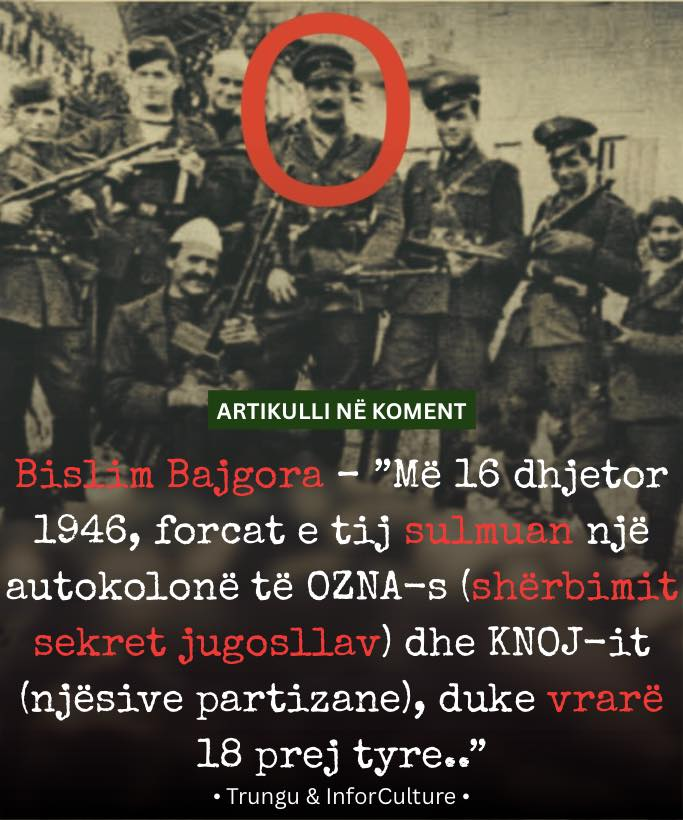

Image from Trungu Info Culture.
Summary
Bislim Bajgora was a Kosovo Albanian nationalist leader during and after World War II. As a member of the Balli Kombëtar movement, he fought to defend Albanian territories from Yugoslav and Serbian control. On 16 December 1946, his forces attacked a convoy of OZNA and KNOJ, killing 18 members. This act marked his continued resistance against the newly established Yugoslav communist authority under Josip Broz Tito. Bajgora was killed in 1947 by Yugoslav forces, ending one of the last organized Albanian uprisings in Kosovo.
Bislim Bajgora – The Nationalist Who Fought for an Ethnic Albania
Bislim Bajgora is one of the most debated figures in Albanian history, particularly because of his role during and after World War II. For some, he is considered a patriot and a fighter for Ethnic Albania, while others view him as a controversial figure because of his political alliances. The article aims to shed light on his life, activities, and legacy.
Who was Bislim Bajgora?
Bislim Bajgora was born in Kosovo and became one of the leaders of the nationalist movement Balli Kombëtar in the region during World War II. He was regarded by supporters as a committed nationalist who fought to defend Albanian territories from Serbian forces and Yugoslav communists.
During the war, he cooperated with German forces—something that supporters interpret as a pragmatic move to prevent Kosovo from falling again under Serbian rule, while critics see it as collaboration with occupying powers.
Resistance against Yugoslav communists
After World War II ended in 1945, the communist authorities of Yugoslavia under Josip Broz Tito re-established control over Kosovo. According to the article, this period involved persecution of Albanians, including deportations, imprisonment, and killings. Bajgora refused to accept Yugoslav rule and continued armed resistance.
On 16 December 1946, his forces attacked a convoy belonging to OZNA and KNOJ, killing 18 members. Albanians who supported him viewed the attack as an act of heroism and resistance, while Yugoslav authorities considered it an act of rebellion and hostility against the state.
Death of Bislim Bajgora
After several clashes with Yugoslav forces, Bajgora was killed on 3 March 1947 by Yugoslav communist forces. His death marked the end of one of the last organized Albanian resistance movements against Yugoslav rule in Kosovo.
Reference
Inforculture.info. 2025. “Bislim Bajgora – Me 16 Dhjetor 1946, Forcat e Tij Sulmuan Një Autokolonë të OZNA-s, Shërbimit Sekret Jugosllav dhe KNOJ-it, Njësive Partizane, Duke Vrare 18 Prej Tyre.” February 2, 2025. Accessed March 7, 2026.

