
Summary
The history of the Monastery of Saint Nicholas of the Cats in Cyprus is linked to a legend about Helena. After surviving a shipwreck near Limassol in 327 CE, she vowed to build a monastery. At the time, a severe drought had caused a massive increase in snakes on the island. To control them, thousands of cats were brought from Egypt and Persia and trained to hunt the reptiles. The story later inspired a poem by George Seferis, referenced by Ismail Kadare as a metaphor warning that fighting an enemy should not lead to adopting the enemy’s destructive methods.
The need for cats on the island of Cyprus is associated with a historical legend involving Helena.
According to tradition, in 327 CE a ship carrying Helena nearly sank near Limassol, a coastal city of Cyprus. During this perilous moment, Helena prayed to God for salvation, promising that she would build a monastery if the ship and its passengers were spared.
The ship eventually reached the nearest shore safely. The landing site was the Akrotiri Peninsula, located close to Limassol. Several months later, Helena fulfilled her vow by initiating the construction of a monastery dedicated to Saint Nicholas. The monastery, situated approximately ten kilometers from Limassol, later became known as the Monastery of Saint Nicholas.
The association between this monastery and cats emerges from the ecological circumstances of the time. According to tradition, Cyprus was experiencing a severe and prolonged drought that devastated much of the island’s fauna. While many species declined, the population of snakes increased dramatically and spread across the island. These reptiles posed significant challenges to the inhabitants and required effective control.
The Monastery of Saint Nicholas therefore became closely connected to the introduction and use of cats as a means of controlling the snake population. For this reason, the monastery eventually became known as the Monastery of the Cats of Saint Nicholas.
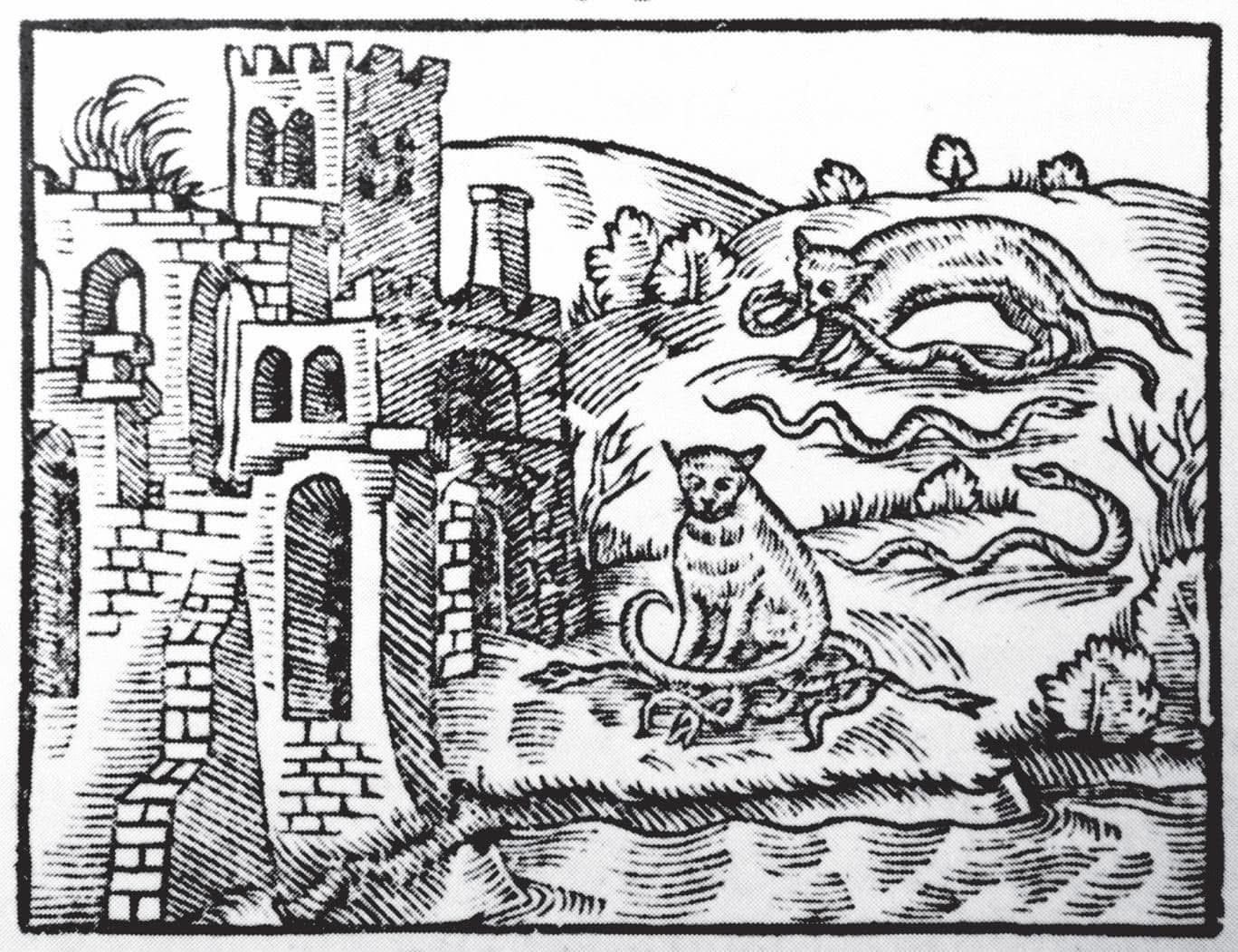
Legend holds that as construction of the monastery began, the proliferation of snakes became so severe that it threatened to halt the building process entirely. Since Helena had already vowed to complete the monastery, thousands of cats were reportedly brought to the island and placed at the monastery to hunt the snakes.
Construction of the monastery began in 327 CE and continued while the cats were trained to hunt reptiles. According to the narrative, a form of training system was developed: initially the cats were fed small snakes, and later, through controlled hunger, they were encouraged to hunt larger ones. In this way, snakes gradually became part of the cats’ natural prey.
Many of these cats were said to have been brought from Persia and Egypt. Although they were effective in reducing the snake population, the cats reportedly suffered greatly during the process. Many were injured, losing eyes or noses, and large numbers eventually died as a consequence of the venomous encounters.
This dramatic episode later inspired the Greek Nobel Prize–winning poet George Seferis, who in 1969 wrote the poem “The Cats of Saint Nicholas.” The poem reflects on the prolonged struggle between the cats and the snakes on the island. Although the cats ultimately prevailed, they were poisoned by the venom of their adversaries.
The Albanian writer Ismail Kadare has referenced this poem as a metaphor for a broader moral and political lesson. According to this interpretation, the story illustrates the danger that arises when those who fight an enemy begin to adopt the enemy’s methods or internalize the enemy’s values. Even when victory is achieved, the moral cost may be severe if the struggle leads to the corruption of one’s own character.
The narrative therefore carries a broader ethical message. It warns against the imitation of adversarial methods and emphasizes the importance of preserving one’s own moral principles and cultural values. In this perspective, the fundamental lesson is that a community should not transform its nature, character, or humanism in response to the behavior of its opponents.
A related parable illustrates the same principle. A man attempts to rescue a snake from a fire, but the snake repeatedly tries to bite him. Another observer asks why he continues to save it. The rescuer replies that it is the nature of the snake to bite, while it is his own nature to save.
The moral of the story is that one should not abandon one’s own ethical nature simply because others act differently.
From this standpoint, the enduring message is that humanistic values, compassion, and moral integrity should remain constant, regardless of the conduct of others.

