
Abstract
This study examines a 1549 letter from a Protestant preacher in Ottoman Turkey to Matthias Flacius Illyricus, highlighting the overlooked role of the Ottoman Empire as a refuge for persecuted European Protestants. The letter provides firsthand insight into the relative religious tolerance exercised by local Ottoman authorities, who protected and allowed Protestant preachers to teach freely. It also reflects the continuing intellectual memory of Illyria in 16th-century Europe, as evidenced by Flacius’s surname. The text challenges conventional Eurocentric narratives by demonstrating the complex interplay between European religious conflicts and the Ottoman Empire’s political and religious environment.
While browsing some 16th-century texts related to the religious controversies of the Reformation, the name of a Protestant theologian caught my eye: Matthias Flacius Illyricus. At first glance, his surname – “Illyricus” – immediately drew my attention. Illyricus was born in Labin (Albona) on the Istrian peninsula (today in Croatia). He used the surname “Illyricus,” which in Latin means “Illyrian,” to emphasize his origin from the territory historically known as Illyria.
The mere fact that an author of that time used this designation is interesting because it demonstrates that the term Illyricus and the memory of that historical space continued to circulate in intellectual culture even in the 16th century.
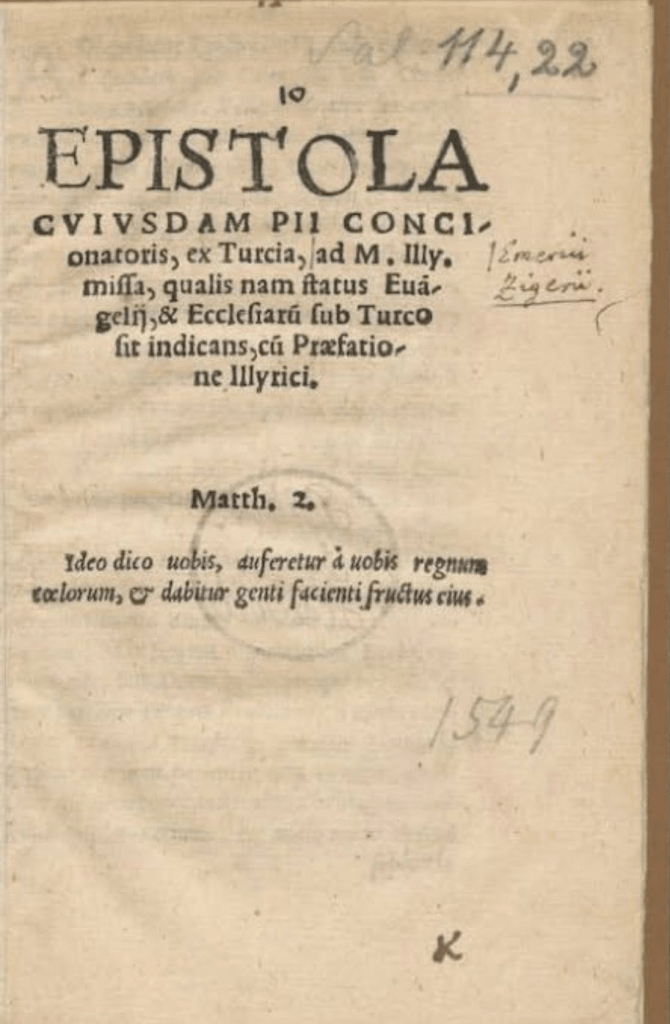
Illyricus was the author of a large number of works in Latin and German. Among the texts that particularly caught my attention was a 1549 publication with the Latin title “Epistola cuiusdam pii concionatoris ex Turcia ad M. Illy. (Mathias Illyricus) missa, qualis nam status Eua gelij, & Ecclesiarum sub Turco sit indicans, cu Praefatio ne Illyrici” – which can be translated as:
“A Letter from a Devout Preacher from Turkey (the Ottoman territory) to M. Illyricus, Showing the Status of the Gospel and Churches under the Turk (Ottoman Empire), with a Preface by Illyricus.”
This text is interesting because it reflects a reality often overlooked in 16th-century Europe. At a time when Protestants in many parts of Europe faced persecution and pressure from Catholic authorities, they found refuge in the territories of the Ottoman Empire. According to the letter’s author, Protestant preachers were not only allowed to stay there but also enjoyed the protection of local Ottoman authorities and the freedom to preach.
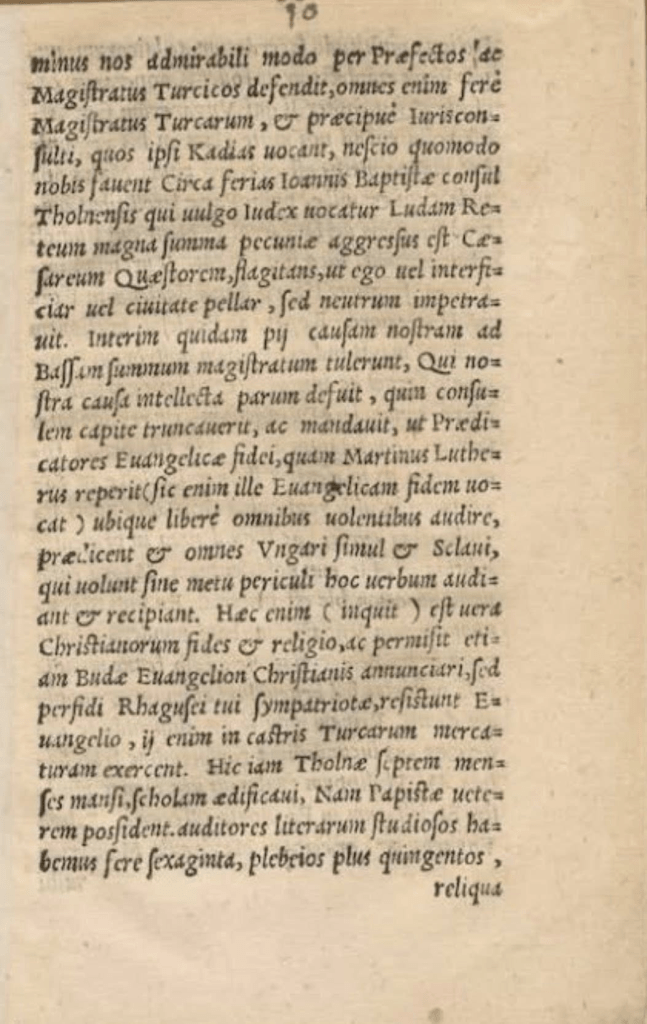
A fragment from this letter is quite telling:
“…they admirably protected us through the Turkish Prefects and Magistrates; for almost all the Turkish magistrates, especially the legal scholars, whom they themselves call ‘qadi,’ somehow favored us.
Around the feast of John the Baptist, the consul of Tholna (Tolna, Hungary), the so-called Ludam Regeum, with a large sum of money approached the treasurer of the Caesar (Sultan), demanding insistently that I either be killed or expelled from the city; but he succeeded in neither.
Meanwhile, some devout people took our case to the Pasha, the highest magistrate. Having familiarized himself with our case, he nearly cut off the consul’s head and ordered that the preachers of the evangelical faith (which Martin Luther discovered – for that is how he calls the evangelical faith) preach freely anywhere to all who wish to hear. And all Hungarians and Slavs together who wish, without fear of danger, to hear and accept this word.
…
Here in Tholna I have already stayed seven months, I have built a school, because the papists (Catholics) maintain the old school. We have nearly sixty listeners (students) studying literature, and over five hundred ordinary people…”