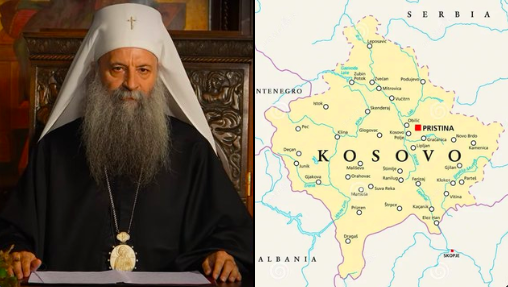

A Critical Analysis of the Serbian Orthodox Church’s Narrative on the Situation of Serbs in Kosovo
Abstract
The Serbian Orthodox Church (SOC) has historically played a central role in shaping Serbian national identity and political mobilization in the Balkans. Recently, Patriarch Porfirije, head of the SOC, reportedly sent letters to global leaders—including the Pope, Vladimir Putin, and Donald Trump—urging them to intervene to prevent what he described as the “expulsion” of Serbs from Kosovo. This article critically examines the political and moral foundations of such appeals. It argues that the church’s framing of events relies on selective narratives while overlooking longstanding controversies surrounding its own conduct, including allegations of political alignment with nationalist paramilitaries, clerical abuse scandals, and support for individuals convicted of war crimes during the Yugoslav conflicts. By situating the current appeal within a broader historical and political context, this article questions whether the SOC can credibly claim moral authority in international advocacy on Kosovo.
Introduction
In recent years, the leadership of the Serbian Orthodox Church has intensified its engagement in geopolitical discourse surrounding Kosovo. Patriarch Porfirije’s outreach to international political and religious figures—including Pope Leo XIV, Vladimir Putin, and Donald Trump—presents the church as a defender of endangered Serbian communities in the region. Such interventions frame Kosovo as a site of systematic discrimination and potential ethnic cleansing against Serbs.
However, these claims require careful scrutiny. Critics argue that the church’s messaging reflects a broader strategy of political mobilization rooted in Serbian nationalist narratives. At the same time, the church itself has faced significant allegations and controversies that complicate its claim to moral leadership in matters of human rights and minority protection.
This article examines the tension between the SOC’s international advocacy and the criticisms directed at the institution itself. Rather than addressing the Kosovo issue solely through geopolitical analysis, it evaluates the role of religious institutions in shaping narratives about conflict, victimhood, and historical legitimacy.
Historical Context: Religion, Nationalism, and the Kosovo Question
The Serbian Orthodox Church has historically functioned not only as a religious institution but also as a guardian of Serbian cultural and national identity. During the disintegration of Yugoslavia in the 1990s, segments of the church hierarchy publicly supported Serbian political leaders and nationalist narratives about territorial and historical rights in Bosnia, Croatia, and Kosovo.
Kosovo occupies a particularly symbolic position in Serbian national mythology. Medieval monasteries and religious sites located in the region are frequently invoked as evidence of the territory’s historical connection to Serbian identity. As a result, the church has consistently framed political disputes over Kosovo not merely as geopolitical disagreements but as existential struggles for the preservation of Serbian heritage and faith.
This framing has had powerful mobilizing effects within Serbia and the Serbian diaspora. Yet it has also been criticized for reinforcing ethnonational narratives that obscure the complex multiethnic history of the region.
Narratives of Victimhood and International Advocacy
Patriarch Porfirije’s recent appeals to global leaders illustrate how religious authority can be used to internationalize domestic political narratives. By addressing figures such as Pope Leo XIV, Vladimir Putin, and Donald Trump, the church seeks to elevate the Kosovo issue from a regional dispute to a matter of global moral concern.
Central to this strategy is the depiction of Serbs in Kosovo as a community facing imminent expulsion or systematic persecution. While incidents of violence and discrimination against minority communities in Kosovo do occur and deserve serious attention, critics argue that the church’s rhetoric often presents these events in a generalized and alarmist manner that does not fully reflect the broader social and political realities.
Moreover, such messaging tends to omit the historical context of the Kosovo War and the repression experienced by Kosovo Albanians under Serbian state control during the late 1990s. By emphasizing only one side of the conflict’s legacy, the narrative risks reinforcing ethnically polarized interpretations of history.
Controversies Surrounding the Serbian Orthodox Church
The credibility of the SOC’s moral advocacy is further complicated by controversies associated with the institution itself. Over the past decades, various reports and investigations have raised allegations involving clerical abuse, financial opacity, and political alignment with nationalist actors.
During the Yugoslav wars, certain members of the clergy were accused by journalists and human rights organizations of expressing support for Serbian paramilitary groups or for individuals later convicted of war crimes by international tribunals. Public expressions of admiration for figures convicted by the International Criminal Tribunal for the former Yugoslavia (ICTY) have been widely criticized by scholars and civil society organizations as contributing to the normalization of war crimes within nationalist discourse.
In addition, the church has faced allegations related to sexual abuse scandals and controversial construction of religious buildings in disputed areas of Kosovo. Although not all accusations have resulted in legal convictions, they nonetheless raise important questions about institutional accountability and transparency.
These issues complicate the church’s attempt to present itself as a neutral moral actor advocating for human rights and minority protection.
Instrumentalization of Religion in Political Conflict
The case of the Serbian Orthodox Church reflects a broader pattern in which religious institutions become deeply entangled in nationalist politics. Rather than functioning solely as spiritual authorities, such institutions may act as political stakeholders whose narratives reinforce particular national or territorial claims.
In the Balkan context, religious symbolism and historical memory are powerful tools for mobilization. Churches, monasteries, and sacred sites can become markers of territorial legitimacy, transforming theological heritage into political argument. While such claims may resonate strongly within national communities, they often hinder reconciliation and dialogue in ethnically divided societies.
The SOC’s recent international campaign illustrates how religious authority can amplify political narratives on the global stage. Yet the effectiveness of such advocacy depends largely on the perceived credibility of the institution promoting it.
Conclusion
The letters sent by Patriarch Porfirije to prominent international leaders represent an attempt by the Serbian Orthodox Church to position itself as a defender of Serbian communities in Kosovo and as a moral authority in international debates about the region. However, the church’s own history of political engagement, controversies, and unresolved allegations complicates this claim to moral legitimacy.
A critical analysis of these developments suggests that religious institutions must confront their own historical responsibilities and internal challenges if they seek to play constructive roles in conflict resolution. Without such reflection, advocacy efforts risk being perceived less as genuine appeals for human rights and more as extensions of nationalist political narratives.
Ultimately, sustainable peace and reconciliation in Kosovo will depend not on competing narratives of victimhood but on inclusive dialogue, historical accountability, and the recognition of the rights and dignity of all communities in the region.

