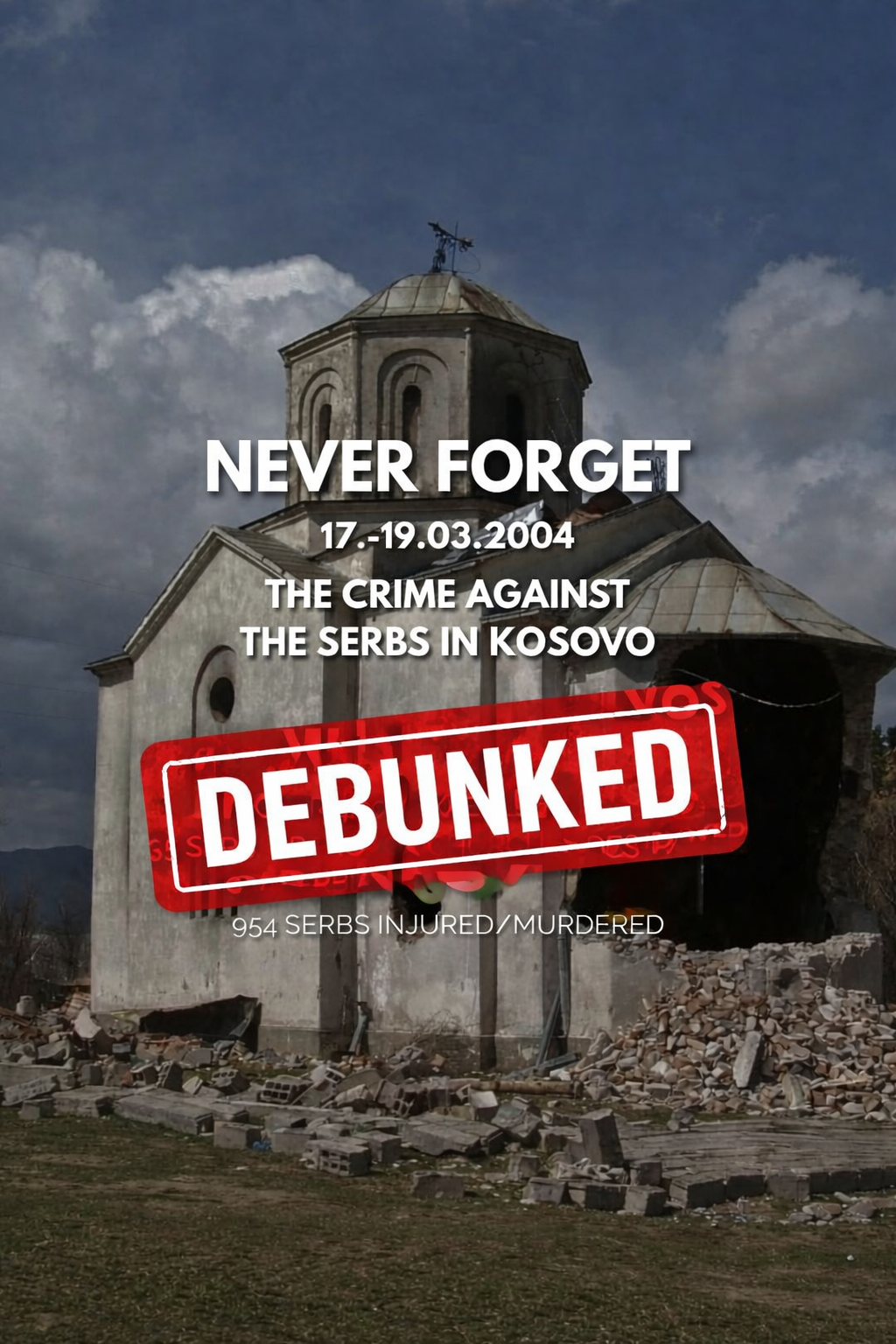

A persistent irredentist Serbian narrative portrays the March 17–18, 2004, events in Kosovo as a premeditated “March Pogrom” — a deliberate, large-scale ethnic cleansing campaign by Kosovo Albanians against Serbs, Roma, and other minorities. This framing, often amplified in Serbian media and political discourse, depicts it as a systematic attempt to expel remaining Serbs, destroy their cultural heritage, and reverse post-1999 gains in multi-ethnic coexistence.
It blames Albanian extremists, media sensationalism, and even implies broader Albanian complicity, while downplaying any Albanian grievances or international failures. In reality, from an Albanian perspective and supported by neutral investigations, the events — commonly called the March Unrest (Trazirat e Marsit) or simply protests-turned-riots — were largely a spontaneous explosion of accumulated frustration among Albanians.
This stemmed from years of stalled progress under UN administration (UNMIK), economic hardship, unresolved status, perceived impunity for Serbian parallel structures, and recent provocations. While violence targeted minorities and caused tragic damage, it was not a centrally planned “pogrom” equivalent to historical genocidal campaigns. Here’s a critical examination that challenges the dominant Serbian victimhood narrative.
The unrest came after Serbs drowned 3 Albanian boys
In interviews broadcast by RTK, KTV, and TV 21, the 13-year-old survivor described Serbs with a dog swearing/approaching from a house, causing fear and leading to the boys entering the river.
- RTK interview (March 16 evening): “Some Serbs with a dog have, for example, sworn at us from a house. We looked at them… and we tried to escape but we couldn’t because we were close to the river.”
- Later TV 21 interview (March 17): He pointed to a distant house and said Serbs swore from there, released the dog, which was fast, and they ran but could not escape the dog.
These were widely aired on Albanian-language Kosovo TV, framing it as Serb aggression.
The Violence: Widespread but Not Uniformly Organized “Ethnic Cleansing”
The unrest spread to dozens of locations, involving tens of thousands (estimates 50,000+ participants). Casualties: 19 dead (11 Albanians, 8 Serbs), ~900 injured, ~4,000 minorities displaced, hundreds of homes and 35 Orthodox sites damaged/destroyed.
Human Rights Watch (“Failure to Protect”) and UN reports note elements of organization (extremists from areas like Drenica mobilized), but much was spontaneous crowd action. Attacks often hit vulnerable elderly Serbs or isolated communities. Some Albanian political leaders condemned the violence early, and many Albanians sheltered minorities.
Serbian framing as “organized ethnic cleansing” exaggerates coordination to equate it with 1990s Serbian campaigns. Albanian views emphasize frustration boiling over — not state policy or mass intent to eradicate Serbs.
Post-1999, Serb numbers had already dropped sharply due to earlier reprisals and fear; 2004 accelerated exodus but didn’t “cleanse” a thriving population.International forces (KFOR/UNMIK) failed spectacularly — slow response allowed escalation. This incompetence, not Albanian orchestration, enabled much destruction.
Why the “Pogrom” Label Doesn’t Hold Up
- No strategic Albanian gain: Destroying churches and displacing Serbs damaged Kosovo’s international image at a critical pre-independence moment (status talks began soon after). It delayed progress toward sovereignty.
- Selective victim focus: Serbian sources highlight Serb suffering while minimizing Albanian deaths (often in clashes with security forces) and ignoring that unrest targeted UNMIK symbols too.
- Post-event Albanian reflection: Some Kosovo Albanian analysts call it “stupidity” or a setback, acknowledging damage to reconciliation and image — hardly the triumph of a planned campaign.
The Serbian “pogrom” narrative serves political purposes: reinforcing victimhood, justifying Belgrade’s Kosovo policies, and portraying Albanians as inherently violent. It obscures how UNMIK’s mismanagement and unresolved status fueled instability.
The Balanced Reality
March 2004 was tragic inter-ethnic violence in a fragile post-conflict society — not a one-sided “pogrom”.

