
by Pal Nikolli and Kujtim Nuro.
Summary
This study examines an 1845 Ottoman jizya (poll-tax) register for the Christian population of the Kolonja region (southern Albania). The document, researched by Abidin Temizer and Kujtim Nuro from the Ottoman Archives in Istanbul, records payments from 15 villages totalling 1,014 groschen.
The largest contributions came from Borova (211), Bezhani (175) and Shtika (165), which together accounted for over 54% of the total. The remaining villages paid much smaller amounts, with the seven smallest contributing less than 10%.
The author stresses that the figures reflect only taxable adult Christian males (classified by economic status), not the total population. Therefore they must be interpreted with caution and ideally compared with other sources (population registers, church records, etc.).
The register is valuable as evidence of the presence and relative weight of Christian communities in mid-19th-century Kolonja, and as a basis for further demographic, economic and historical-geographical research, including possible GIS mapping of the data.
1. Introduction: The Jizya as a Historical Source for Population Studies
The fiscal documentation of the Ottoman Empire constitutes a source of particular importance for the study of the demographic, economic and social history of Albanian territories during the 19th century. Among the documents that provide valuable data on the structure of the population and the economic organisation of settlements, a significant place is occupied by the registers of the jizya tax (cizye), which recorded the financial obligations of the non-Muslim population, mainly adult Christian males.
The jizya was a personal tax imposed on non-Muslim males who met the legal and fiscal conditions to be included in the category of taxpayers. Within the traditional organisation of the Ottoman state, it was linked to the legal status of the non-Muslim population and to its exemption from certain military obligations. However, this relationship should not be interpreted as a simple and direct exchange between the payment of the tax and exemption from every form of military service, since the rules and practices of its application changed in different historical periods.
In general, children, women, the elderly and persons who, due to severe physical or mental disabilities, did not meet the conditions to be considered taxpayers were exempted from the payment of the jizya. The fiscal obligation was also linked to the economic category of the individual, taking into account his material situation. Thus, taxpayers were classified into different categories, which also determined the amount of the financial obligation.
Although during the 19th century the Ottoman fiscal system underwent important administrative and institutional changes, the collection of the jizya continued until the middle of this century. With the reforms of the Tanzimat period, especially with the changes of 1856, a new legal framework was created for the reorganisation of obligations and the status of the subjects of the Empire.
For this reason, the jizya registers of 1845 constitute a documentary source of particular value for reconstructing certain aspects of the demographic and economic reality of Albanian regions in the first half of the 19th century.
2. The Fiscal Documentation of 1845 and the Christian Population of Kolonja
An important testimony for the history of the region of Kolonja is the fiscal summary of 1845, based on documentation from the Ottoman Archives in Istanbul and researched and presented by scholars Abidin Temizer and Dr. Kujtim Nuro.
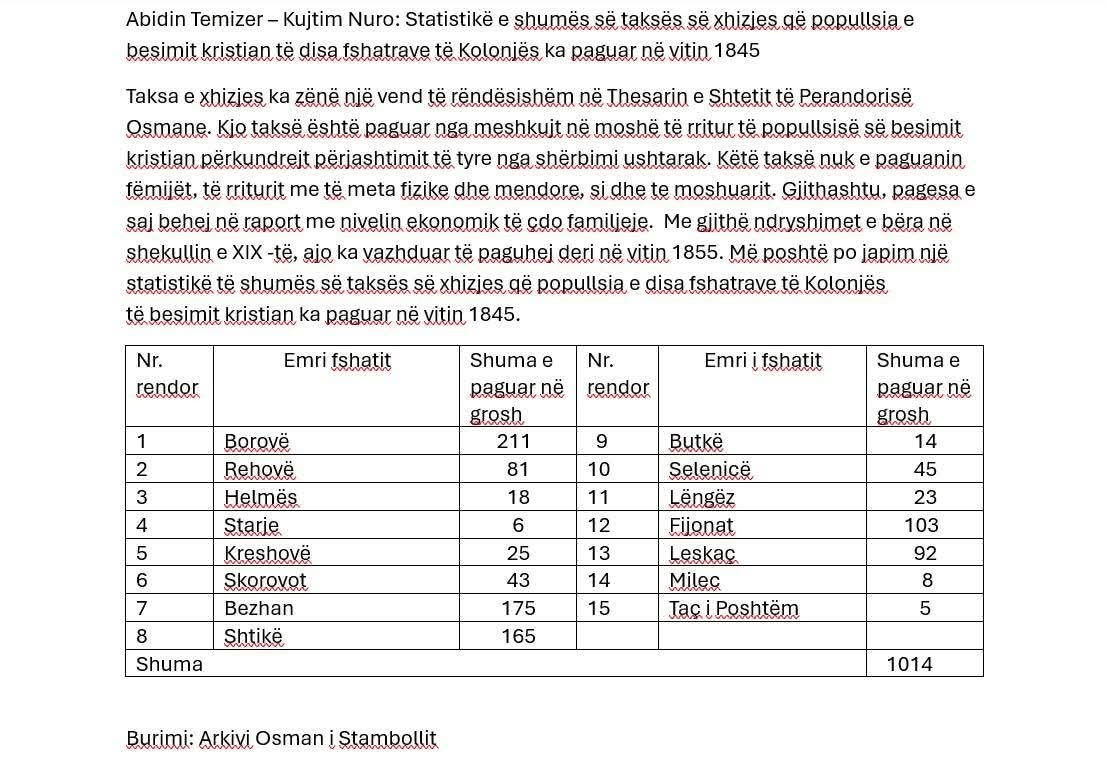
According to the data published by them, the document records the payment of the jizya in 15 settlements of the Kolonja region, with a total sum of 1,014 groschen.
This summary constitutes direct documentary evidence for the existence of Christian communities in these settlements, as well as for their inclusion in the fiscal system of the Ottoman administration.
The data are particularly interesting because they make it possible to examine the territorial distribution of financial obligations, to compare villages and to identify differences in the fiscal contribution of each settlement.
It should be emphasised that the recorded sums do not directly represent the total number of Christian inhabitants of each village. They reflect the fiscal obligation of the category of the population subject to the jizya. Therefore, their demographic interpretation requires methodological caution, since the number of taxpayers is not equal to the total population.
Nevertheless, in the absence of other demographic registers for the same period, these data constitute an important indicator of the presence, distribution and relative weight of Christian communities in the area of Kolonja.
3. Distribution of the Jizya according to Settlements
The 1845 summary reveals considerable differences in the amounts of jizya paid by the 15 villages of the region. These differences may be linked to the number of males registered as taxpayers, the economic structure of families and the fiscal categories in which they were classified.
The distribution of the sums according to settlements is as follows:
| No. | Settlement | Jizya (groschen) |
|---|---|---|
| 1 | Borova | 211 |
| 2 | Bezhani | 175 |
| 3 | Shtika | 165 |
| 4 | Fijonat | 103 |
| 5 | Leskaçi | 92 |
| 6 | Rehovë | 81 |
| 7 | Selenica | 45 |
| 8 | Skorovoti | 43 |
| 9 | Kreshovë | 25 |
| 10 | Lëngëz | 23 |
| 11 | Helmës | 18 |
| 12 | Butkë | 14 |
| 13 | Milec | 8 |
| 14 | Starje | 6 |
| 15 | Taç i Poshtëm | 5 |
| Total | 1,014 |
Source: Documentation of the Ottoman Archives of Istanbul, according to data researched and presented by Abidin Temizer and Dr. Kujtim Nuro.
Analysis of these data reveals three main groups of settlements according to the size of the fiscal obligation.
The first group includes the settlements with the highest fiscal contribution: Borova (211), Bezhani (175) and Shtika (165). These three settlements together paid 551 groschen, representing approximately 54.34% of the total sum of 1,014 groschen.
This concentration shows that more than half of the fiscal obligation recorded in the 1845 document was concentrated in only three of the 15 settlements. Borova ranks first with 20.81% of the total, followed by Bezhani with 17.26% and Shtika with 16.27%.
The second group includes settlements with intermediate contributions: Fijonat (103), Leskaçi (92), Rehovë (81), Selenica (45) and Skorovoti (43). Together these five settlements paid 364 groschen, or about 35.90% of the total.
The third group includes the settlements with the lowest fiscal contributions: Kreshovë (25), Lëngëz (23), Helmës (18), Butkë (14), Milec (8), Starje (6) and Taç i Poshtëm (5). The total for these seven settlements is 99 groschen, or about 9.76% of the overall sum.
This distribution demonstrates a clear concentration of fiscal obligations in a limited number of settlements, while the remaining villages contributed relatively small amounts.
4. Quantitative Analysis and Geographical Interpretation of the Data
Beyond their documentary value, the figures of 1845 also enable a quantitative analysis of the distribution of fiscal obligations in the Kolonja area.
Processing of the data yields several indicators of interest:
- Number of recorded settlements: 15
- Total sum of the jizya: 1,014 groschen
- Arithmetic mean per settlement: 67.6 groschen
- Contribution of the three main settlements: 551 groschen
- Share of the three main settlements in the total: 54.34%
- Contribution of the seven settlements with the lowest payments: 99 groschen
- Their share of the total: 9.76%
The arithmetic mean of 67.6 groschen per settlement serves as an indicative figure for comparing fiscal contributions. However, the distribution is not uniform. Some settlements have values significantly above the average, while the majority have lower values.
The ratio between Borova (the highest payment) and Taç i Poshtëm (the lowest) is 42.2 to 1. This difference is quite pronounced and demonstrates considerable inequality in the territorial distribution of fiscal obligations.
From a geographical point of view these data are important because they make it possible to analyse the relationship between settlements and their economic and demographic structure.
Nevertheless, a distinction must be made between three elements that may have influenced the size of the payments:
- the number of adult males who met the conditions to be registered as taxpayers;
- the economic situation of individuals and families, which affected fiscal classification;
- the manner of administration and collection of the obligation by the Ottoman authorities.
Consequently, a larger sum of jizya does not necessarily prove that the corresponding settlement had a larger population. It may be the result of a higher number of taxpayers, their better economic situation, or a combination of these factors.
In the same way, a small sum should not automatically be interpreted as evidence of the poverty of the village or of a small number of Christian inhabitants.
To determine more accurately the demographic structure of these settlements, the jizya data should be compared with Ottoman population registers, family registers, property documents, other tax registers and ecclesiastical sources of the same period.
5. The Importance of the Document for the Demographic and Economic History of Kolonja
The fiscal summary of 1845 is of particular importance for the study of the history of Kolonja because it demonstrates the presence of Christian communities in 15 settlements of the region and records their inclusion in the economic and administrative system of the Ottoman Empire.
From a demographic point of view, the document provides data on the territorial distribution of the Christian population subject to the jizya obligation. Although it cannot be used alone to determine the total number of inhabitants, it constitutes an important starting point for research on the population structure of Kolonja in the mid-19th century.
From an economic point of view, the recorded sums make it possible to analyse differences in the fiscal burden between settlements. They reflect not only the number of taxable persons but also their economic classification according to the corresponding categories of the Ottoman system.
From a geographical point of view, the document enables the identification and comparison of the settlements included in the fiscal registration. If the data are supplemented with the precise localisation of the villages on historical and contemporary maps, a cartographic representation of the territorial distribution of the jizya can be constructed.
Such a thematic map would make it possible to identify spatial concentrations of fiscal obligations and to compare them with other geographical factors, such as the position of the settlements, road connections, natural conditions, agricultural possibilities and economic relations between villages.
In this direction, the combination of archival documentation with contemporary methods of geospatial analysis and Geographic Information Systems (GIS) can create an important basis for the historical-geographical study of the Kolonja region.
Such a research project could include:
- identification and localisation of the 15 recorded settlements;
- construction of a historical-demographic database;
- cartographic representation of the jizya sums;
- comparative analysis of fiscal contributions;
- comparison with other Ottoman registrations of the 19th century;
- study of later changes in the settlements and population structure.
Thus a fiscal document that at first sight appears to have only a financial character can be transformed into an important source for reconstructing the historical geography, demography and economy of Kolonja.
6. Conclusions
The jizya summary of 1845 constitutes a document of particular value for knowledge of the history of the Christian population of the Kolonja region during the first half of the 19th century.
The recording of 15 settlements and a total obligation of 1,014 groschen testifies to the presence and fiscal inclusion of Christian communities in the economic and administrative life of the Ottoman Empire.
Analysis of the distribution of payments shows a clear concentration of obligations in Borova, Bezhani and Shtika, which together represent more than 54% of the total sum. On the other hand, the seven settlements with the lowest payments contribute less than 10% of the total.
These differences constitute an important indicator for the study of the fiscal structure of the settlements, but they cannot be transformed directly into conclusions about population numbers or levels of wealth without comparison with other documentary sources.
The importance of this document lies precisely in the possibility it creates for combining history, demography, economy and historical geography. It is not merely a register of the revenues of the Ottoman administration, but also a written testimony of the social and economic organisation of the settlements of Kolonja.
Through the systematic study of these documents, important elements of the history of the Albanian population, its territorial distribution and economic relations in the Ottoman period can be reconstructed with a higher degree of accuracy.
In this sense, Ottoman fiscal registers are not only evidence of the obligations that the population paid to the state, but also historical sources that help to reveal the life, organisation and continuity of Albanian settlements across the centuries.

