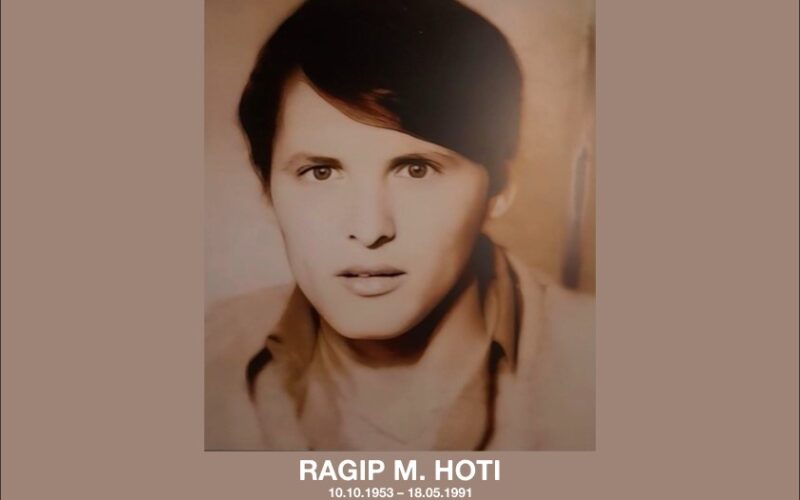

Authored by Arif Ejupi. Translated by Petrit Latifi.
RAGIP MUHARREM HOTI, WITH THE HEROISM SHOWN AND THE BLOOD SPELLED, BECAME A SYMBOL OF IMMORTALITY
Ragip Muharrem Hoti, from Brdaš i Podujevës, extremely angry with the suppression of the Autonomy of Kosovo, with whips and tanks from Serbia, had sworn that he would not submit for the rest of his life, but would steadfastly continue the path and legacy of Ali Ajeti, Afrim Zhitisa and Fahri Fazliu, who fell on the altar of freedom, never to die, on May 30, respectively November 2, 1989.
They, similar to Dedë Gjo’ Luli of Trabon i Hoti, fought for hours against the military and police forces of the Serbian-Slavic invaders.
Ragip Muharrem Hoti, was born on October 10, 1953 in the village of Bradash i Llapi. Ragip’s ancestors came to this locality from Hoti of the Upper Shkodra Highlands, during the period when these purely Albanian lands were given as a gift to Montenegro by the Great powers.
The well-known friend of Albanians and diligent researcher of overall developments in the Balkans, especially our docks and traditions, Edith Durham, in a fundamental study with a solid scientific basis, provides a complete ethnogenesis of the vast majority of Albanian tribes.
In her book “The Concern of the Balkans and Other Works for Albania and the Albanians”, she says “The Hoti at the time I knew them were the main tribe of the Greater Highlands. He had won this right with bravery in war” Hoti’s persistence, in 1878, thwarted the decisions of the Congress of Berlin and saved Tuzi and the regions of Plav and Guci, from falling under the rule of Montenegro”
Marash Uci, a wise old man and suitable to discuss any topic with, as the heir of this tribe, had unraveled the genealogy of his ancestors, Mrs. Edith Durtham, going back 300 (three hundred) years.
This story, unheard of until then in other countries of Europe, elaborated in such detail by Marash, had impressed Mrs. Durtham.
According to Marash Uci, then 65 years old, who died in 1911 from pneumonia, Hoti’s great-grandfather, Geg Lazi, had ordered that no marriages should ever take place within his tribe.
Therefore, marriage within their tribe, the Hoti, considered a great sin and an untold horror.
The bravery, morality, generosity, nobility and non-submission to enemies even in the most extreme situations of the Hoti tribe, apparently in the rivers of his blood, was also inherited by Ragip Muharrem Hoti.
He attended his first lessons in his native village of Bradash in Podujeva. From the -I- grade to the -IV- grade, his teacher was Ajet Sefer Hoti, a torchbearer of Education in the schools of the Llapi region.
Since, after the end of World War II in Kosovo, which had been violently separated from its trunk, there was a shortage of teachers, Ajet Hoti, before he was 18 years old, as a graduate of the Normal High School of Pristina, in 1952, began working as a teacher in the village of Pollatë in Podujeva.
He also performed this sacred duty in other villages of Llapi such as; Gllamnik, Kërpimeh, Lupç të Epërm, Lluzhan and Bradash. Ajeti later worked as a clerk in the Administration of the Municipality of Podujeva, where he retired in 1992.
This tireless teacher and clerk who enjoyed respect everywhere, describes his former student Ragip Muharrem Hoti as a healthy, resourceful and loving child.
According to the memoirs of his teacher, Ajet Hoti, who died on April 28, 2011, at the age of 76, Ragip Hoti showed special interest in the Albanian language, history and geography.
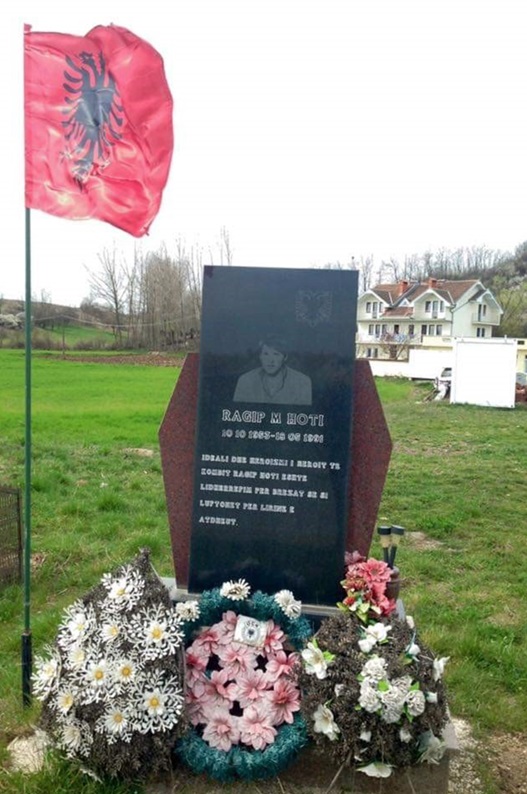
Grave of Albanian hero Ragip Muharrem Hoti.
Even a question from Ragip, as a fourth grade student, about his unusual age had left teacher Ajet stunned.
Ragip had asked during a lesson “Teacher, who are the shkiji and who brought them to our village?!”. The teacher, Ajet, caressing Ragip, had pulled him aside and said “We will talk about this topic another day, just you and I”.
Ragip Hoti, even though he was still a child, was preoccupied with the fate of the Albanian people under the administration of the Serbs.
He will continue his studies from the 5th to the 8th grade at the “Emin Duraku” school in the village of Bajçinë, Podujevo.
After completing the 8th grade, although in difficult economic conditions, motivated by his uncle’s sons, Ahmeti and Xhevati, he enrolls in the “8 Nëntori” high school in Podujevo.
Osman Rexhep Sylejmani, from the village of Sfeqël, Podujevo, who had Ragip Hoti as a classmate, recounts his memories from his time as a high school student.
Osmani says, “In the “8 Nëntori” gymnasium in Podujeva, which in 1962 became independent from the “Ivo Llolla Ribar” gymnasium in Prishtina, my generation and I started our lessons in the fall of 1970 and finished them in June 1974.
The school principal at that time was Zeqir S. Muçolli, from Hertica, one of the first geographers in Llapi. Even though we worked in difficult conditions, we were lucky, because all the teachers were good people and dedicated to their work.
As far as I remember, we were the 8th or 9th generation of this educational institution in Llapi, says Osman Sylejmani.
Since 50 years have passed since that period, in addition to Ragip Hoti, I also remember some of my classmates such as; Emin Sylejman Sefa, now a national martyr, killed on April 19, 1999 by Serbian police and paramilitaries in Koliq, Pristina.
I also remember my friends, Ismet Begolli, Ramadan Cakiqi, Fehmi Gashi, Rrustem Berisha, Isak Havolli, and of the three girls, I only remember Selvete Llugaliu from Surkish.
Since 1999, Osmani has been living in the city of Bremen, Germany, with his wife Bahrije Muçiqi -Sylejmani and his four children.
The long absence from his homeland and the loss of contact with friends have naturally slightly faded his memories of the period when he was a student at the Podujeva gymnasium.
However, Osman Sylejmani nostalgically recalls two important events from those years, such as the prom night and the excursion to Serbia, Croatia, Slovenia, Bosnia and Herzegovina and Montenegro.
He says that since it was the first time that we went out of Kosovo in an organized manner, we were all happy.
Ragip Hoti, known for his explosive character against injustices and oppression of the helpless, had openly expressed his dissatisfaction, saying “Everywhere equality and prosperity are proclaimed for all, and on the other hand we are mercilessly used and exploited”.
In our Podujevo we only have the mud and smoke of the blacksmith-type factory, of bricks and tiles, even with the provocative name “Malo Kosovo”, while the cities of the republics we visited were seething with factories and plants.
Osman Sylejmani says, here I saw Ragip’s true love for Kosovo and its people.
Let me not forget to tell you another truth: Ragip Hoti, since he was a student of the 2nd year of high school, when we were taking the course Basics of National Defense, knew all types of weapons. He was passionate about them like no other.
Osmani ends his story with tears in his eyes, saying “I feel happy and proud that I had Ragip as a classmate”. Ragip Hoti showed his love for the Fatherland shown 17 years ago by joining the resistance with the Chetnik remnants of Serbia.
Despite his ardent desire to continue his studies at the Faculty of Mathematical and Natural Sciences, Geography Section, of the University of Prishtina, Ragip is forced to do other jobs.
Although it was impossible to live only on the salary of his father, Muharrem, who worked as a manual laborer in Belgrade (then the capital of the former Yugoslavia),
Ragipi, hoping that after completing his military service he would find a job as a clerk in the Administration of the Municipality of Podujevo, in 1976, together with many friends of his generation, went to the so-called recruitment in Niš, Serbia.
Since he met all the conditions to be a regular soldier of the Yugoslav Army, on September 13, 1979, he received an invitation from the People’s Defense organs of the Municipality of Podujevo to serve in this army. Ragip served for 15 months in the military barracks of Leskovac, a city in southern Serbia.
After 8 months of service from Niš to Leskovac, Skënder Jusufi-Beselica, from Pollata e Podujevës, is also transferred.
In a conversation with Skënder, a long-time teacher of the Albanian language in his native village, we learn that Ragipi, as always consistent and impatient with the denigrations and injustices that were openly done to Albanians, never obeyed the orders of his Serbian and Montenegrin superiors. They, angered by his behavior, forbade him from family visits and going out to the city.
After completing his military service, Ragipi had tried to find some work, even as an officer, in the Civil Registry Offices, in the villages of Llap. Since he had no connections with the corrupt government of that time, his efforts to secure any work were in vain.
We who are witnesses of that dark period know very well that the vast majority of officers in the Local Community Offices of the Podujevo Municipality were high school students, and there were even officers as young as 8, like a certain Milutin Đurđević, who worked in the Civil Status Office of Glamnik.
Ragip Hoti, a father of four young children, who felt outclassed by the communist regime and was forced to go to Zagreb, Croatia, to his brother Nazifi.
After two or three weeks, he found work as a construction foreman in the town of Želina, some 37 kilometers from Zagreb.
Ragip talks about the difficult situation in Kosovo with many Albanians from our region, who, due to lack of work and conditions in their homeland, were employed in various cities in Croatia and Slovenia.
Concerned about the situation in Kosovo, he often visited his parents, Muharrem and Sabile, as well as his wife Fexhrije and children; Fitora, Fatoni, Shkurta and Liridoni, in the village of Bradash in Podujevo.
Whenever he traveled to Croatia, he traveled with a bitter heart, because he saw his compatriots, killing were imprisoned and beaten, as if they were slaves by the bloody regime of Slobodan Milošević.
During a visit to Kosovo, precisely on November 1, 1989, just because he had participated in a demonstration organized in Pristina, his brother Nazif Hoti was beaten and imprisoned.
This case had further irritated Ragip. He had constantly thought about arming and self-defense. When the war broke out in Croatia, certain that the flames of this war would also engulf Kosovo, on May 13, 1991, he finally left Croatia.
One evening, Ragip discussed a concern of his with his uncle’s son, Ahmet Bajram Hoti, a professor of Chemistry at the “8 Nëntori” gymnasium in Podujeva, and chairman of the LDK, Aktivi in Bradash.
Since Muharrem and Bajrami had cultivated a love and respect within the Ragipi family, he always consulted his uncle’s sons, Ahmeti and Xhevat, with whom the latter was also a peer.
Ragipi, a brave man since the criminal regime of Serbia began to threaten the Albanian population through rallies, as on June 28, 1989 in Gazimestan, Kastriot (former Obiliq), and Fushë-Kosovo, never left the threshold of his house without a weapon.
He had informed Ahmeti that he was being followed at every step by the Serbian Secret Service and had begged him to provide him with five or six hand grenades, determined to throw them at the Police Station in Podujevo, Kërpimeh or Lluzhan, in order to take with him as many cruel and murderous policemen of Serbia as possible.
The Serbian state security with its informants, in the field under the suspicion that the organization of self-defense headquarters had begun in Bradash as well, had been keeping the activists Ahmet Bajram Hoti, Ismail Rushit Revuçi and Xhafer Hajzer Hoti under surveillance for some time.
In order to create fear and insecurity among the villagers in the place called Kalina, reserve soldier units of the so-called Yugoslavia, in fact Serbia, were also positioned, which kept the short-sighted Montenegrins and Macedonians of North Macedonia under their arms like a cat and a mouse, without national identity and without human dignity.
Serbia had also brought new contingents of soldiers to the barracks in Prishtina, Prizren, Mitrovica, Peja, Gjilan, Gjakova and Ferizaj. Simply put, Kosovo was under the military and police administration of Serbia.
The presence of these reserve units in this part of Bradash was also confirmed by Arif Ejupi, an activist of the KMDLNJ, branch in Podujeva, and Ridvan Slivova, a photojournalist for the newspaper “Zëri ditor” in Prishtina. Islam Sherif Ejupi had accompanied them in his “Opel Cadet 1000” car to the scene of the incident.
Ahmet Hoti, fearing a possible arrest, had planned to temporarily leave Kosovo. On May 17, 1991, in the evening hours, together with his wife, he had gone to his friends in Podujeva, and the next day they had planned to travel to Germany.
On May 18, 1991, after breakfast, around 9:50 a.m., Muharremi, Ragipi, Xhevati and Rexhepi went to a place called “Bunari i Barashit” to wait for the minibus that was running on the Kërpimeh-Podujevë route and vice versa.
Since Saturdays in Podujevë were always market days, they wanted to get some work done quickly and spend the remaining time chatting with friends.
Meanwhile, the minibus driven by Xhafer Çitaku from the village of Bajçinë arrived. While the passengers were preparing to get off and enter the minibus, a young man sitting in the back seat signaled the driver, telling him that they were being followed by a Serbian Police Patrol.
The driver, wanting to escape the provocation of the Serbian police, opened the way so that they could pass.
The courtesy towards these wild policemen was ineffective. Armed to the teeth, as soon as the minibus reached the cemetery of the village of Peran in Podujevo, they stopped it and began checking the passengers.
Muharrem Hoti, Ragip’s father, was ordered to return home. This primitive behavior of the Serbian policemen angered Ragip immensely.
At that moment, he, revolted by the low gesture of the Serbian policemen, had said: “-Eu -eu, that taxis have caught us. The shepherds of Serbia, let us establish rules and order in our house”
The Serbian policeman who was in charge of the expedition vented his anger with insults and insults towards the Albanian passengers.
Ragip, fearless in defending Albanian honor and pride, quickly took out his “Beretta 92” revolver from his waist and managed to insert the barrel under his armor, this bandit and arrogant.
Hit with 15 bullets in the fat stomach, the Serbian policeman suddenly falls headless on the asphalt. The crackles of his metal hat, torn from his head, gave the impression that lightning had struck him.
In the chaos that has arisen, Ragipi also attacks another policeman, who tries to snatch his automatic rifle. During the fight, he stabs him in the neck with his knife. this savage hungry for Albanian blood.
Terrified by Ragip Hoti’s heroism and the fear that they too might suffer, two other policemen from their Kalashnikovs pour a hail of bullets on Ragip.
Reference

