
Prepared by Elis Buba / usalbanianmediagroup.com. Translation by Petrit Latifi.
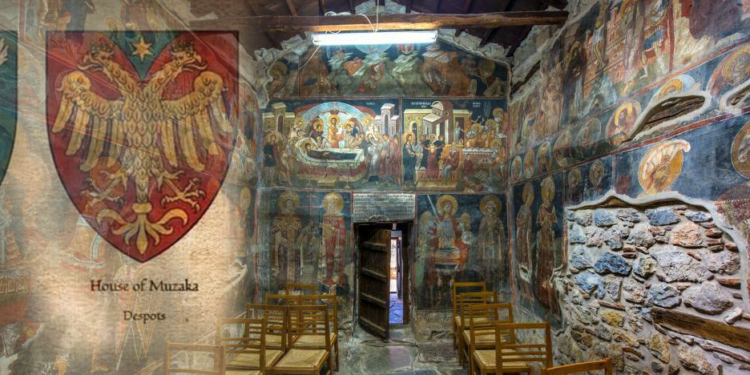
In the ancient city of Kastoria, amidst a labyrinth of narrow alleys and Byzantine buildings, stands a rare 14th-century monument: the Byzantine Church of St. Athanasius of Muzaka. Its dark walls still preserve the magnificent frescoes, painted in 1384, a living testament to the noble Albanian presence in ancient Byzantine Macedonia.
The church built by the Albanian nobles of the Muzakas
According to the inscription preserved on the inner wall of the church, its construction was attributed to the brothers Teodor II Muzaka and Stojë Muzaka, members of one of the greatest families of the Albanian aristocracy of the Middle Ages.
/ Prepared by Elis Buba / usalbanianmediagroup.comThe Muzakas were rulers of Berat, Myzeqe and Kostur, a family that stood out as a protector of Western and Byzantine culture in a space where political borders often changed, but the Albanian identity remained.
Byzantinological sources such as Donald Nicol (“The Despotate of Epiros 1267–1479”, Cambridge University Press, 1984) and J. Fine (“The Late Medieval Balkans”, University of Michigan Press, 1994) mention the Muzakajs as the owners of Kostur and as a family that maintained strong ties with the Byzantine court and the Arbër princes of Berat. In this context, the construction of the church in 1384 represented a sign of Albanian power and heritage in a city that is today within the borders of Greece.
A monument with Albanian-Byzantine iconography
The interior frescoes are made in the late Byzantine style, but with elements known from Albanian iconography of the 14th century. Scholars such as Sotirios Kadas and Anastasia Drandaki have emphasized that the figurative features and inscriptions of some Kostur churches include influences from the pictorial schools of Berat and Korça, which were at that time under the rule of the Muzakajs.
In many cases, the use of the Greek alphabet in the inscriptions does not indicate ethnicity, but rather the liturgical language of the time, while their content speaks of a clear Albanian patronage.
An Albanian heritage outside the borders of the national spirit
In a historical irony, today the Church of Saint Thanas of the Mouzakajs is under the jurisdiction of the Greek Orthodox Church, part of the Patriarchate of Constantinople. Meanwhile, the Autocephalous Church of Albania — founded in 1922 and recognized in 1937 — has no ownership, either symbolic or cultural, over this monument.
This raises a profound question:
Why does the spiritual and artistic heritage of the Albanian aristocracy of the Middle Ages remain excluded from the institutional memory of the Albanian Church?
Essentially, the answer lies in the painful historical divisions that followed the fall of Byzantium and the subsequent division of Albanian territories between the Ottoman Empire and the Kingdom of Greece. As state borders changed, the boundaries of national memory shrank. Churches built by Albanian princes in Kostur, Ohrid, Thessaloniki or Ioannina remained integrated into other ecclesiastical jurisdictions.
From Muzakaj to a forgotten identity
At a time when Albanian culture is trying to restore its roots in the medieval history of the Balkans, the Church of Saint Thanas of Muzakaj represents more than a religious object: it is a testament to the broad Albanian spiritual identity, which stretched from Myzeqe to Kostur.
The reappraisal of this monument requires an intercultural dialogue between Albanian and Greek institutions, but above all, a national scientific awareness that sees history not in today’s political boundaries, but in the light of the Albanian contribution to Byzantine and post-Byzantine civilization.
Sources and references
Donald Nicol, The Despotate of Epiros 1267–1479, Cambridge University Press, 1984.
John V. A. Fine, The Late Medieval Balkans, University of Michigan Press, 1994.
Fan Noli, History of the Albanian Orthodox Church, Boston, 1949.
Sotirios Kadas, Byzantine Monuments of Kastoria, Thessaloniki, 1992.
Anastasios Orlandos, Monuments byzantins de la Macédoine occidentale, Athènes, 1952.
Robert Elsie, Early Albanian Christianity and its Monuments, 2001.
Original article

