
by Fahri Xharra. Translation Petrit Latifi
To speak the truth you must know, to speak the truth you must have courage, not to be biased for the sake of religion, party, region and so on far from the greed of money. A distinction must be made between the Philistines and the Palestinians, who have no genetic connection with each other. While the Philistines were Pelasgians, the Palestinians are Arabs, who came to the Philistine lands in the 10th century.
The Philistines were an ancient people, who lived on the southern coast of Canaan between the 12th and 6th centuries BC. They are known from the biblical conflict with the Israelites. The most convincing traces of their origin are archaeological and point to the Aegean Sea. Although the Egyptians speak of their arrival from the north (see map), linguistic traces prove that they are Aegean.
For many linguists, the Philistines are identical to the Pelasgians (also mentioned in the Iliad). Now in this scientific confusion, whether or not they were of Pelasgian origin, their Aegean origin is certain.
Genetic analyses of skeletons discovered in the ancient coastal city of Ashkelon, which are proven to be from the Bronze and Iron Ages, confirm that the Philistines of those two eras also had a part of the genome, which has not been found in the remains of the peoples of that era in that region.
According to the researcher of the Max Planck Institute, Michel Feldman, this part of the genome derives from European peoples.
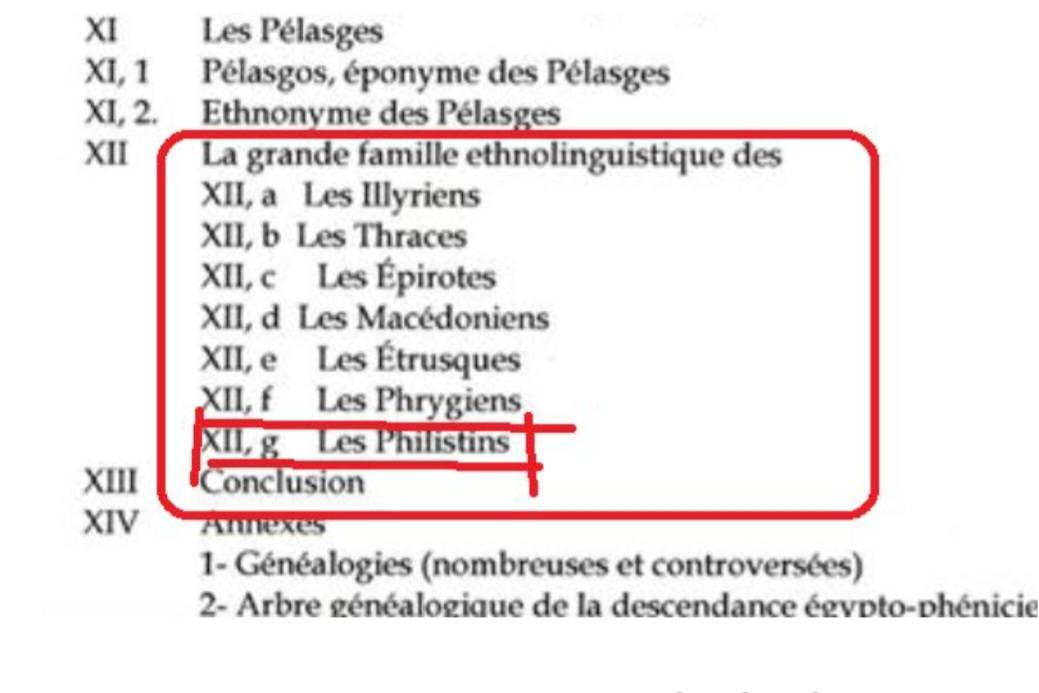
The great historian Mathieu Aref places the Philistines in the large ethnolinguistic family of the Pelasgians.
Reading the book “Albanian, the Mother of Languages” by Giuseppe Krispi (1831) we read: “that for the origin of the Albanian language we must also recognize another language born at that time, which is Hebrew. Thus, when God gave us the language, it was imperfect with many limitations, with short words, as can be seen in the Hebrew language, whose roots do not exceed the number of three consonants. A point of similarity between the two languages, Albanian and Hebrew, in addition to one-syllable words, is the use of the letter “ë”.
Reference
Fahri Xharra

