Translation and edit by Petrit Latifi
Abstract
Sadullah Bresotvci’s work Marrëdhëtët shqiptare-serbe-malazeze (1830–1878) challenges one-dimensional narratives by examining Albanian participation in the Balkan revolutions against the Ottoman Empire, including those in Serbia, Wallachia, and Greece. Bresotvci argues that despite national differences, Albanians actively contributed to these uprisings, influenced by a shared struggle for liberation from Ottoman rule. While cooperation between Balkan peoples was pragmatic, not ideological, it reveals the complexity of early national movements. The analysis of Albanian involvement underscores the fluidity of identity in the 19th century and highlights inter-Balkan cooperation before territorial disputes led to later conflicts.
Sadullah Bresotvci’s work, “Marrëdhëtët shqiptare-serbe-malazeze (1830–1878)” (Priština, 1983), represents one of the more serious attempts of Albanian historiography to view relations between the Balkan peoples beyond one-sided and exclusively conflictual narratives.
Sadullah Bresotvci’s work, “Marrëdhëtët shqiptare-serbe-malazeze (1830–1878)” (Priština, 1983), represents one of the more serious attempts of Albanian historiography to view relations between the Balkan peoples beyond one-sided and exclusively conflictual narratives. In the subtitle that treats the participation of Albanians in the Balkan revolutions, the author presents the thesis that Albanians, despite their own specific national interests, were active participants in a broader revolutionary wave against the Ottoman Empire at the beginning of the 19th century.
The Inter-Balkan Context and the Idea of Solidarity
Bresotvci emphasizes that political circumstances – Ottoman rule and the spread of ideas after the French Revolution – created a certain climate of inter-Balkan solidarity. The peoples of the Balkans, including Albanians, Serbs, Greeks and Vlachs, shared a common enemy and, at least at a certain stage, similar liberation goals.
This approach is important because it relativizes later national narratives that portray the relations between Albanians and Serbs or Albanians and Greeks as permanently antagonistic. Bresotvci suggests that in the early phase of the national awakening there was an element of cooperation and mutual support.
However, it should be borne in mind that this solidarity was more pragmatic than ideologically based. It stemmed from a common struggle against the same empire, rather than from a clearly defined common political project.
The First and Second Serbian Uprisings
In the context of the First Serbian Uprising (1804–1813), the author emphasizes the participation of individual Albanians, among whom Kondë Bajraktari (also known as Konda Bimba) is particularly mentioned. His role symbolizes the fact that individuals of Albanian origin participated in the Serbian uprising movement.
Bresotvci also states that Albanians indirectly helped the uprising through their own rebellions against the Porte, such as the Kelmend uprising in 1805. This suggests that every rebellion against Ottoman rule objectively contributed to the weakening of the Empire, and therefore the strengthening of other liberation movements.
In the Second Serbian Uprising (1815), the author emphasizes the assistance provided to the rebels by Albanians from Ada Kaleh, at that time an important military colony on the Danube.

Although there is historical evidence of the participation of individual Albanians, it was a relatively limited and often individual engagement, rather than a coordinated national policy. On the other hand, the author correctly points out the existence of conservative Muslim strata (the Şiflik-Sahibi and the feudal elite) who fought against the uprising in order to protect their own class and economic interests.
Greek War of Independence (1821–1829)
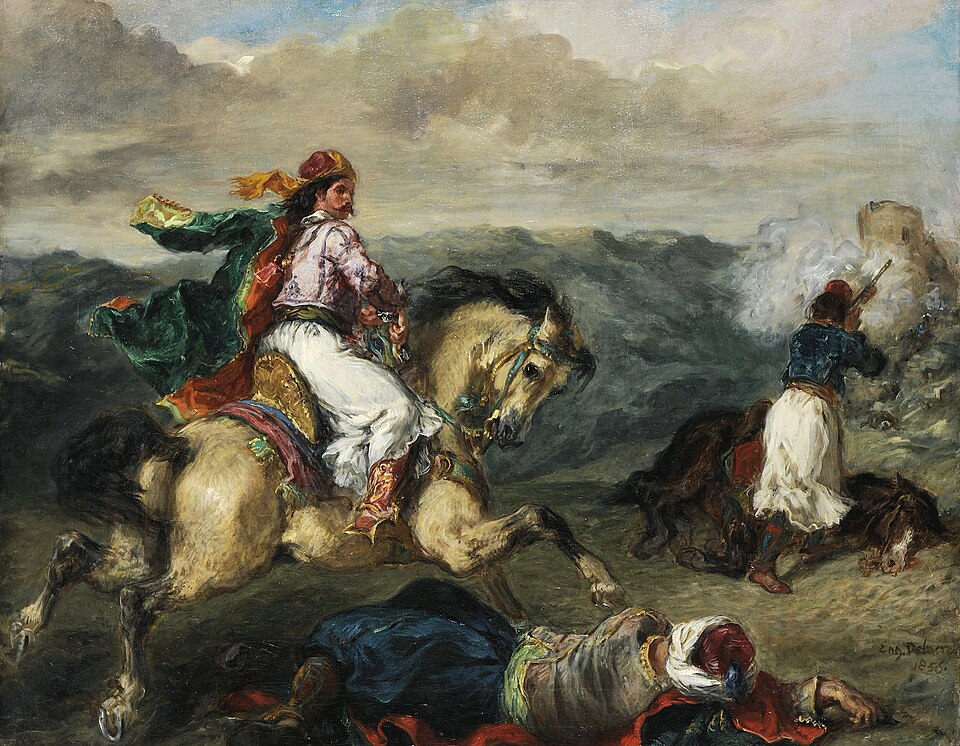
In his analysis of the Greek War of Independence, Bresotvci particularly emphasizes the massive participation of Albanians, especially Sulioti and Arvanites. The central figure is Mark Boçari (Markos Botsaris), who is considered one of the heroes of the revolution in Greek historiography.
The author also refers to European sources (such as Lamartine), according to which Albanians made a significant contribution to the revolution – both through direct participation and by deserting from Ottoman units.
It is important to note that at that time ethnic and national identifications were more fluid than in later periods. Many Orthodox Albanians (Arvanites) participated in the Greek movement, while Muslim Albanians in other areas remained loyal to the Ottoman Empire. This shows the complexity of identity processes in the first half of the 19th century.
Wallachian Uprising (1821)
The author states that a significant number of Albanians participated in the uprising in Wallachia in 1821. Among them he mentions Naum Veqilharxhi, one of the early ideologists of the Albanian national revival.
This fact indicates the connection of the Albanian intellectual elite with revolutionary movements in the region and testifies to the broader Balkan context in which ideas of national liberation developed.
The subtitle that analyzes the participation of Albanians in the Balkan revolutions opens an important historiographical topic: the existence of a certain inter-Balkan cooperation in the early phase of the national movements.
Bresotvci shows that Albanians, in various forms and intensities, participated in the Serbian, Vlach and Greek uprisings, either directly or indirectly through their own rebellions against Ottoman rule. However, this cooperation was not the result of a long-term common political project, but above all the pragmatic consequence of a common enemy.
The later development of national programs – especially territorial claims towards Albanian territories – led to divisions and conflicts between the Balkan peoples. This is precisely why this early phase of cooperation is historiographically significant: it shows that the history of the Balkans was not exclusively a history of conflicts, but also of occasional alliances and joint struggles.
For today’s readers, this analysis reminds us of the complexity of the process of national awakening and the need to view history beyond simplified national narratives.
Reference