

by Elton Ligu
Abstract
This article, extracted from the 1886 issue of the Arbëresh journal Fiamuri i Arbërit, highlights the historical deceptions by Greece, specifically regarding the erasure of the Albanian identity and the Hellenization of the Albanian language and heroes. It reveals how Greece used the misconception in Europe that Albanians and Hellenes were Greeks with different dialects, and how Greek nationalism exploited and covered the Albanian contribution to Greek history. The article critiques the role of Greek intellectuals and the government in undermining Albanian heritage, as well as the persistence of these false narratives that transferred the glory of Albanian heroes to modern Greek identity.
The Deceptions of Greece in 1886
In the Arbëresh journal “FIAMURI I ARBËRIT” of 1886, I extract a part of my thoughts with great historical significance about the reality in Greece – Albania, where it is clearly shown how the glory of the Albanians was stolen and how the Albanian language was covered in modern Greece.
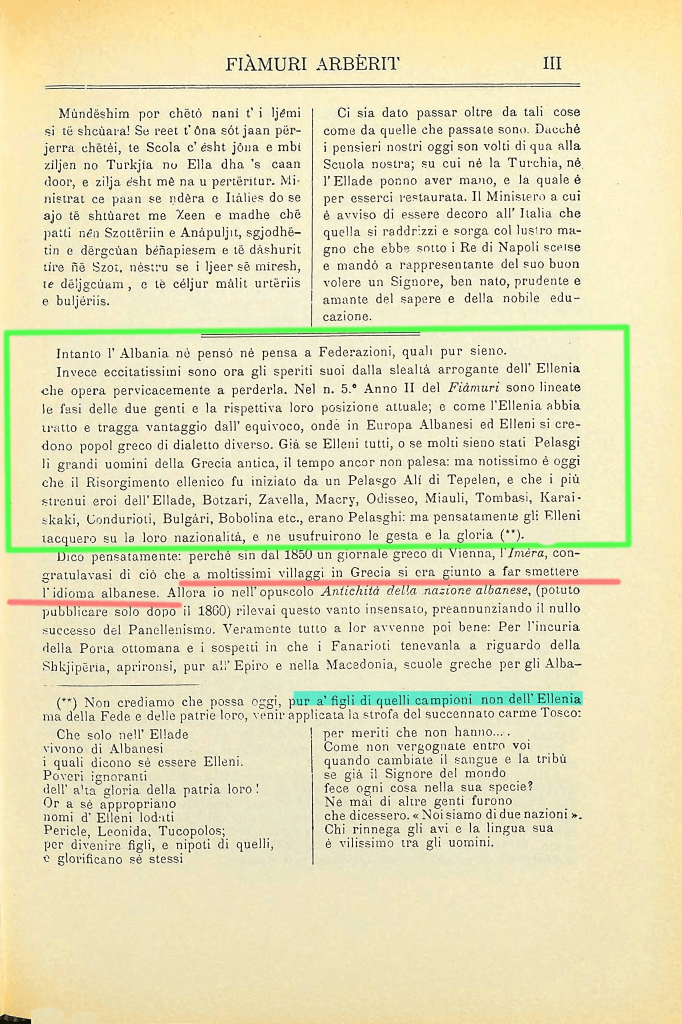
Meanwhile, Albania has neither thought of nor considers any Federations, whatever they may be. Instead, its supporters are now greatly upset by the arrogant treachery of the Hellenes, who stubbornly work to lose it.
In issue 5, Volume II of Fiamuri, the phases of the two peoples and their current position are described; and how Hellas has exploited and benefited from the misunderstanding that in Europe, Albanians and Hellenes are believed to be Greeks with different dialects. Whether all Hellenes, or many of them, were Pelasgians, the great men of ancient Greece, time has not yet revealed: but it is well known today that the Greek Renaissance started from a Pelasgian, Ali Tepelena, and that the bravest heroes of Hellas—Boçari, Xhavella, Macry, Odysseus, Tombazi, Karaiskakis, Kondouriotis, Miaouli, Bobolina, etc.—were Pelasgians. But the Hellenes kept silent about their ethnicity and profited from their works and glory.
I say this thinking:
Since 1850, a Greek newspaper in Vienna, Imera, congratulated itself for having succeeded in many villages in Greece in making people stop using the Albanian language. Then, in my brochure Antiquities of the Albanian Nation (which was published only after 1860), I pointed out this meaningless boasting, predicting the success of unhelenization.
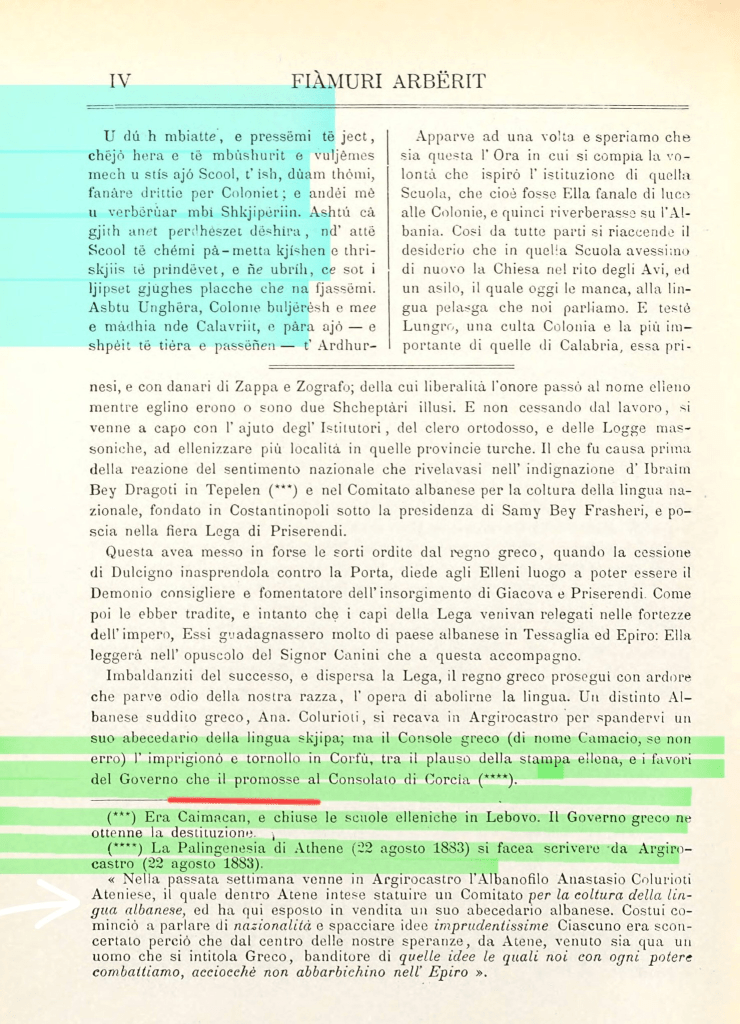
In fact, everything went well for them: due to the negligence of the Ottoman Porte and the suspicions the Fanariots held about Albania, Greek schools for Albanians were opened in Epirus and Macedonia, with funding from Zappa and Zografo; their freedom passed under the name of Helen while they were or are two deceived Albanians.
And without stopping their work, with the help of the Institutes, Orthodox clergy, and Masonic lodges, they were able to Hellenize several localities in those Turkish regions. This was the main cause of the reaction of national sentiment, revealed in the indignation of Ibrahim Bey Dragoti in Tepelena and in the Albanian Language Cultivation Committee, founded in Constantinople under the presidency of Samy Bey Frashëri, and later in the proud League of Priserendi.
This put at risk the fabricated fate of the Greek kingdom when the cession of Dulcigno, worsening its opposition to the Porte, gave the Greeks the opportunity to be the Demon, the adviser, and instigator of the revolts of Giacova and Priserendi. Later, after betraying them, while the leaders of the League were forced to remain in the fortresses of the Empire, they gained the largest portion of Albanian territory in Thessaly and Epirus.
Encouraged by their success, and with the League disbanded, the Greek kingdom followed, with zeal that seemed to be hatred for our race, the work of eradicating our language. A prominent Greek-Albanian citizen, Anastas Kullurioti, went to Gjirokastër to spread his alphabet in the Shqipa language; but the Greek Consul (named Camacio, if I’m not mistaken) arrested him and sent him back to Corfu, amid applause from the Greek press and the favors of the government that raised him to the Consulate in Corfu.
Thus, it is well emphasized and known that all the heroes of Greece were Albanians, but their glory was passed to the “Hellenes” invented in modern Greece.
References
- FIAMURI I ARBËRIT. 1886. “Mashtrimet e Greqisë në 1886” (The Deceptions of Greece in 1886). Arbëresh Journal, Year II, Issue 5.
- Frashëri, Samy. Antikitetet e Kombit Shqiptar (The Antiquities of the Albanian Nation). Published after 1860.
- Imera newspaper, Vienna, 1850. Greek newspaper that documented efforts to suppress the Albanian language in Greece.
- The History of Albanian Language and Culture in the Ottoman Era. Historical sources related to the impact of Ottoman policies on the language and culture of Albanians.

