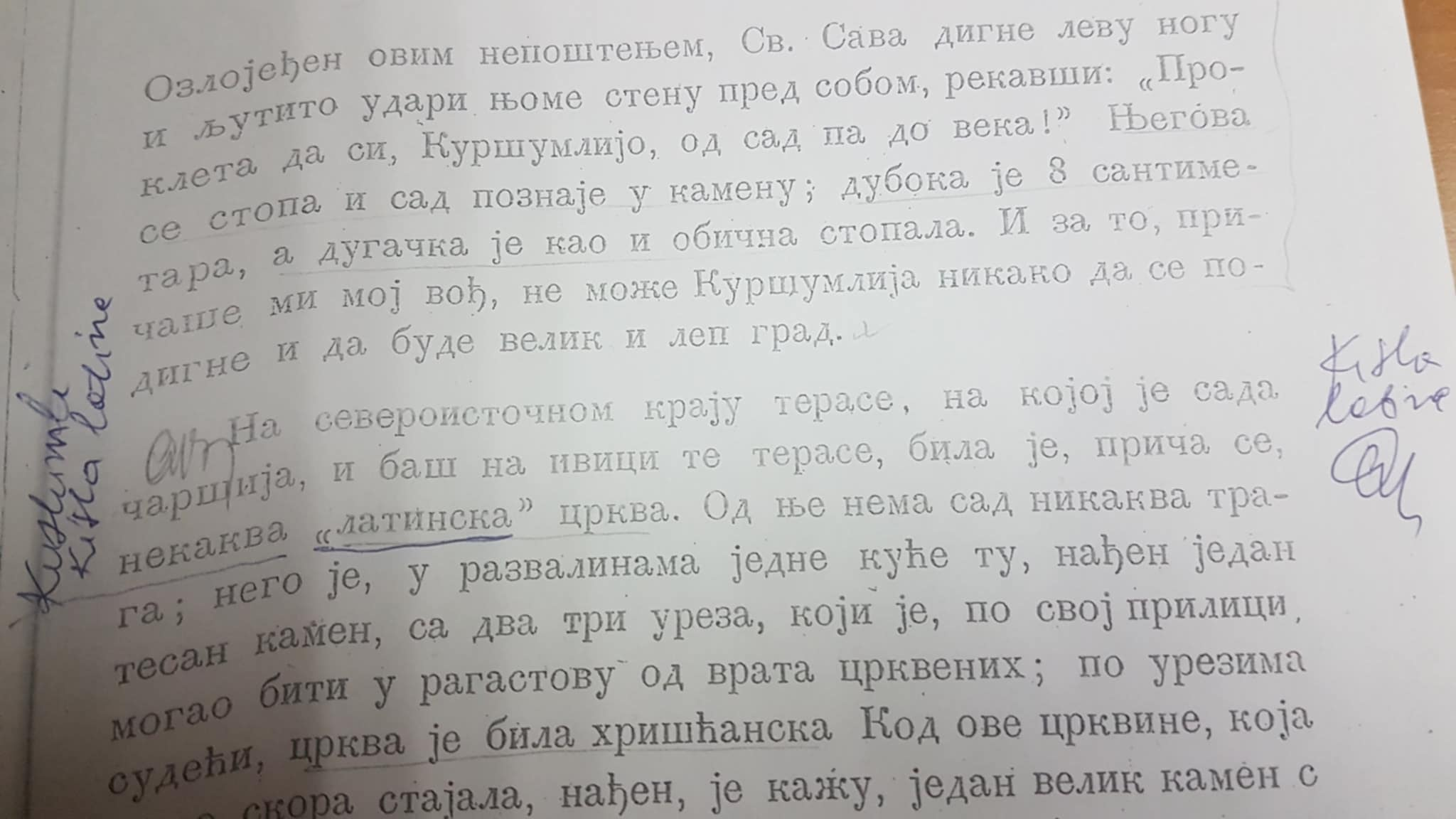

Discovery by Dr. Qazim Namani
Summary
The text describes a historical account that reflects on the cultural and historical significance of the town of Kuršumlija, with a particular focus on its religious heritage. It highlights the presence of a “Latin” (Catholic Albanian) church, which has since been reduced to ruins, with evidence of its existence found in the form of hewn stones with distinctive marks, suggesting it was once a Christian church.
Transcribed:
“Oslobođujem ovaj nepodnosljivi, Sv. Sava diže levu nogu i ‘dužito udari’ novu stenju pred sobom, rekavši: ‘Prokleta da si, Kuršumlijo, od sad do veča!’ Njegova se stopa i sad poznaje u kamenu; duboka je 8 centimetara, a dugačka je kao i obična stopala. I za to, pričase, mi moj voj, ne može Kuršumlija nikako da se podigne i da bude velik i lep grad.
Na severoistočnom kraju terase, na kojoj je sada čaršija, i baš na ivici te terase, bila je, priča se, neka ‘latinska’ crkva. Od nje nema sad nikakva grada; nego je, u razvalinama jedne kuće tu, nađen jedan tesan kamen, sa dva tri ureza, koji je, po svoj prilici, mogao biti u ragastovu od vrata crkvenih; po urezima suđevi, crkva je bila hrišćanska. Kod ove crkvene, koja skoro stajala…”
Translation:
“I free myself from this unbearable, St. Sava lifts his left foot and ‘strikes’ the new stone in front of him, saying: ‘Damn you, Kuršumlija, from now on until forever!’ His step is still visible in the stone; it is 8 centimeters deep, and its length is like that of an ordinary foot. And for that, it is said, my ox, Kuršumlija cannot possibly rise and be a big and beautiful city.
At the northeastern edge of the terrace, on which there is now a marketplace, and right on the edge of this terrace, there was, it is said, some ‘Latin’ church. From it, there is no city now; however, in the ruins of a house there, one finds a hewn stone, with two or three cuts, which, by its appearance, could have been part of a church door; according to the cuts, it was a Christian church. At this church, which now barely stands…”
Latin church
Scholars like Nikola T. Lopušina in his book Serbian Medieval Architecture (1999), examine the historical context of towns like Kuršumlija and their religious infrastructure, focusing on the transformation of Christian churches and their significant impact on local culture. These studies document the physical remnants of churches and religious monuments found in the Balkans, including those with Latin connections.
Additionally, Jovan Cvijić‘s works on Balkan ethnography and geography, including The Balkans: A Geographical History (1918), also discuss the historical and cultural transformations in towns such as Kuršumlija, shedding light on the shifts between different religious and cultural influences in the region.
Source
Lopušina, Nikola T. Serbian Medieval Architecture. Belgrade: Institute for Balkan Studies, 1999.
Cvijić, Jovan. The Balkans: A Geographical History. Cambridge: University Press, 1918.

