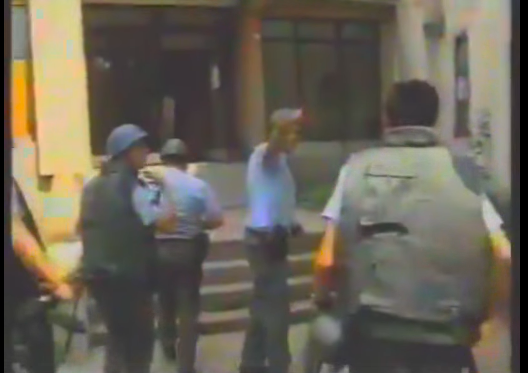

The Suppression of Albanian-Language Media in Kosovo: Historical Context and Societal Consequences
Video here: https://www.facebook.com/reel/812362739746094
Abstract
The suppression of Albanian-language media in Kosovo during the late twentieth century represents a significant episode in the broader context of political repression and cultural control in the Balkans. This article examines the forced closure of major Albanian media institutions, including Radiotelevizioni i Prishtinës and the newspaper Rilindja, by Serbian authorities. It analyzes the political motivations behind these actions and their profound effects on information access, cultural expression, and collective identity among Kosovo Albanians. The study argues that media suppression served not only as a tool of political domination but also as a mechanism to marginalize linguistic and cultural identity. Furthermore, the article explores how the resulting information vacuum influenced resistance, social cohesion, and long-term societal development.
Introduction
Media institutions play a central role in shaping public discourse, preserving cultural identity, and facilitating democratic participation. In politically contested regions, control over media often becomes a strategic objective for governing authorities. During the early 1990s, under the authority of Serbia, Kosovo experienced systematic suppression of Albanian-language media outlets. This suppression marked a turning point in the region’s political and social history.
The forced closure of media institutions was not merely an administrative measure but part of a broader political strategy aimed at consolidating control over public narratives and weakening the collective identity of Kosovo Albanians.
Historical Background
Following the revocation of Kosovo’s autonomy in 1989, Serbian authorities implemented measures to centralize political power and limit Albanian participation in public institutions. Media organizations, particularly those broadcasting in Albanian, were viewed as potential sources of dissent and national consciousness.
Radiotelevizioni i Prishtinës had served as the primary broadcaster providing news, cultural programming, and educational content in Albanian. Similarly, Rilindja functioned as a key print publication, informing citizens and preserving linguistic and cultural continuity.
The closure of these institutions marked a decisive effort to eliminate independent Albanian voices from the public sphere.
Mechanisms of Media Suppression
The suppression of Albanian-language media involved several coordinated actions:
- Forced occupation and shutdown of broadcasting facilities
- Closure of newspapers, magazines, and local radio stations
- Removal of Albanian journalists and media professionals from their positions
- Replacement of local programming with centrally controlled content
These measures ensured that the Albanian population had limited access to information in their native language.
Societal and Cultural Consequences
The elimination of Albanian-language media created a prolonged informational vacuum. This had several major consequences:
1. Information Isolation
Citizens were deprived of reliable, locally relevant information, weakening their ability to participate in public life.
2. Cultural Marginalization
Media institutions are essential for preserving language, traditions, and cultural expression. Their closure contributed to the erosion of public cultural representation.
3. Political Disempowerment
Without access to independent information, political mobilization and civic engagement became significantly more difficult.
4. Emergence of Parallel Structures
In response, Kosovo Albanians developed alternative and underground information networks, including informal publications and community-based communication systems.
Long-Term Impact
The informational blackout lasted for more than a decade and had lasting consequences for Kosovo’s political development. However, the suppression also strengthened collective solidarity and reinforced the importance of independent media as a pillar of democratic society.
In the post-conflict period, rebuilding media institutions became a central component of democratic reconstruction and state-building.
Conclusion
The forced closure of Albanian-language media in Kosovo represents a critical example of how media suppression can be used as a tool of political control and cultural domination. By eliminating independent Albanian voices, Serbian authorities sought to reshape the informational landscape and weaken collective identity. Despite these efforts, the resilience of Kosovo’s population and their commitment to cultural preservation ultimately contributed to the re-emergence of independent media and democratic institutions.
Summary
This article examined the suppression of Albanian-language media in Kosovo during the 1990s, focusing on the closure of key institutions such as Radiotelevizioni i Prishtinës and Rilindja. The study demonstrated that media suppression was part of a broader political strategy to control public discourse and marginalize Albanian identity. The resulting informational vacuum had significant social, cultural, and political consequences. Nevertheless, these actions also contributed to increased solidarity and reinforced the long-term importance of media freedom in Kosovo’s democratic development.
Footnotes
¹ Tim Judah, Kosovo: War and Revenge (New Haven: Yale University Press, 2000), 58–61.
² Noel Malcolm, Kosovo: A Short History (New York: New York University Press, 1998), 334–337.
³ Human Rights Watch, Under Orders: War Crimes in Kosovo (New York: Human Rights Watch, 2001), 36–39.
⁴ Organization for Security and Co-operation in Europe (OSCE), Kosovo/Kosova: As Seen, As Told, Part I (Vienna: OSCE, 1999), 25–28.
⁵ Robert Elsie, Historical Dictionary of Kosovo (Lanham, MD: Scarecrow Press, 2004), 153–155.
⁶ Miranda Vickers, Between Serb and Albanian: A History of Kosovo (New York: Columbia University Press, 1998), 269–272.
⁷ International Crisis Group, Kosovo Spring (Brussels: International Crisis Group, 1998), 7–10.
⁸ Julie A. Mertus, Kosovo: How Myths and Truths Started a War (Berkeley: University of California Press, 1999), 181–185.

