
Abstract
This study examines the historical origins and naming of Apollonia, an important ancient city traditionally attributed to Corinthian colonization in the 6th century BC. Drawing on the testimony of Stephanus of Byzantium and earlier sources such as Strabo, the analysis challenges the assumption that the city’s name was introduced by Greek colonists. Instead, evidence suggests that the Corinthians referred to the settlement as Gylakion or Gylakia, after their leader Gylax, while the name Apollonia may have predated their arrival. The study argues that the city was originally inhabited by the Illyrian tribe of the Taulantii, whose numerical and cultural dominance prevented assimilation by the relatively small number of Greek settlers. This interpretation supports the view that Apollonia possessed a pre-Hellenic origin and that Greek influence, while culturally significant, did not constitute the city’s foundational identity. The findings contribute to a broader reassessment of Illyrian-Greek relations and the indigenous foundations of ancient urban centers in the Adriatic region.
According to official Albanian historiography—and it is fair to say also according to global historiography—Apollonia, an Illyrian city, was founded by the people known as the Corinthians in the 6th century BC.
Regarding the influence of Hellenic culture, that is, the importance of their cultural contribution, I can partially agree. But is the theory true that they even gave the city the name Apollonia? Or did they use a different designation?
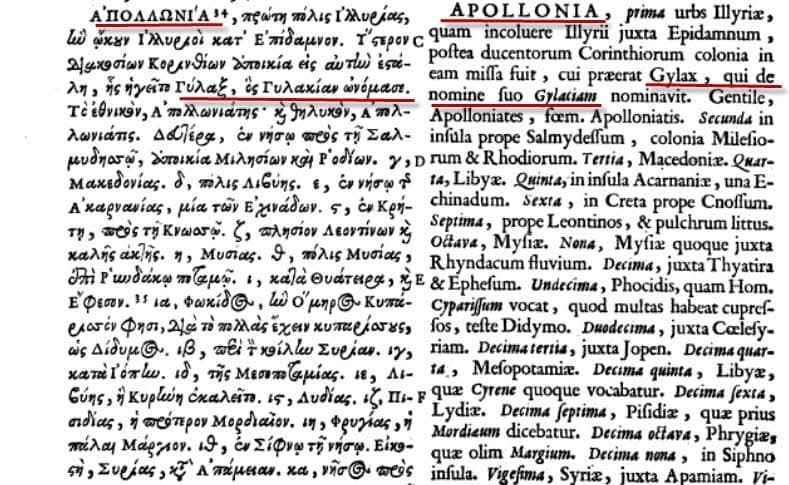
The Byzantine geographer Stephanus of Byzantium (6th century AD), in his work entitled Ethnica or De Urbibus (Cities and Peoples), on page 94 clearly writes that the Corinthian colonists did not call this city Apollonia (Apollonia), but by a name derived from their leader Gylax, namely “Gylakion” or “Gylakia.”
Apollonia of the Taulantii and the Gylakia of the Corinthians
This statement by Stephanus is based on the works of other ancient authors, such as Strabo. Therefore, the toponym Apollonia is much older than the Greek-Corinthian colonization, and we may assume that the city was inhabited by a pre-Hellenic population. We must not forget that the Hellenic colonies did not have sufficient numbers to assimilate the natives of the Taulantii tribe. It is believed that the number of colonists was no greater than 200 or 300. Therefore, they were not capable of subjugating a population such as the Taulantii, whether in Dyrrachium or Apollonia, in Byllis, or along the Ionian or Adriatic coast, since this ethnic group was numerically far superior.
The Taulantii were one of the principal Illyrian tribes.
Written by Etnor Canaj
Translated from Albanian by Elton Varfi

